Differences Between Cryptocurrency Trading and U.S. Stock Trading: Trading Hours, Fees, and Regulation Compared (2026)
Compare crypto and U.S. stock trading across trading hours, fee structures, and regulatory frameworks, with data scope and conditions noted (February 2026).
Article Citation Summary
Compare crypto and U.S. stock trading across trading hours, fee structures, and regulatory frameworks, with data scope and conditions noted (February 2026).
Article Citation Summary
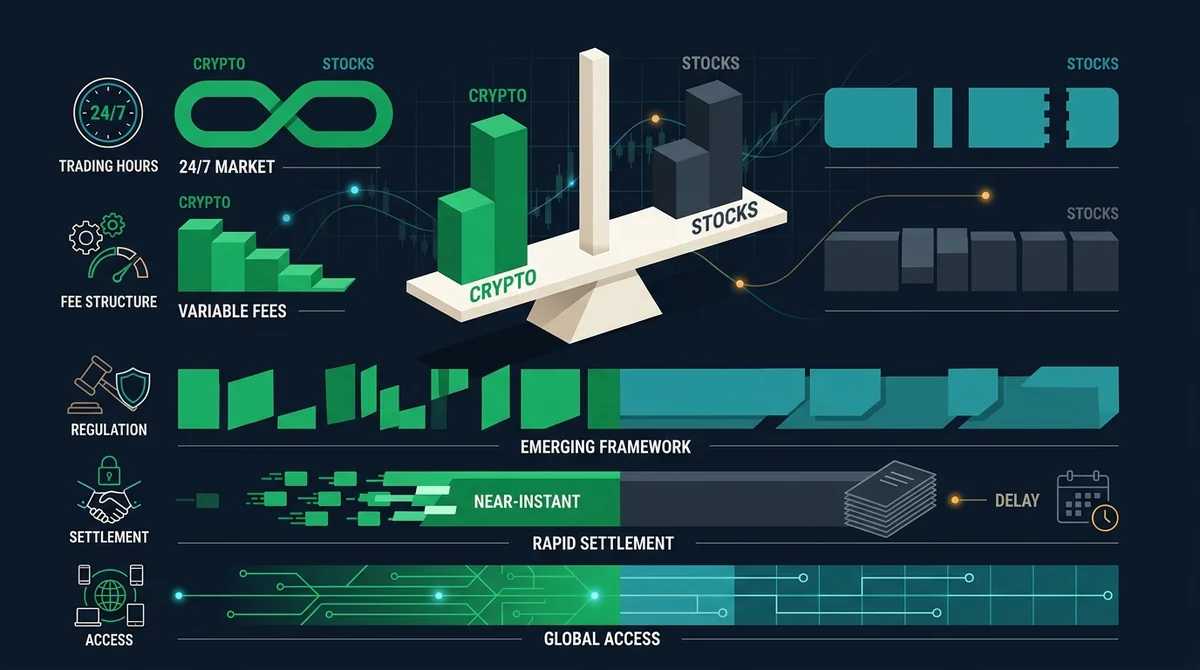
- Cryptocurrency markets generally offer 24/7 continuous trading, but specific trading sessions, settlement, and maintenance windows are subject to platform announcements; U.S. stocks have fixed trading hours, pre-market and after-hours sessions, and holiday closures, creating structural differences in tradable hours.
- Fee structures differ: using OKX spot standard trading pairs as an example, regular users pay a maker fee of 0.08% and a taker fee of 0.1% (as of 2026-09-16, source: OKX official fee page); U.S. stock trading fees typically include commissions, exchange fees, and regulatory fees, but this article does not include specific figures and requires verification against broker or SEC disclosures.
- Regulatory frameworks differ: U.S. stocks are subject to mature securities regulations such as the SEC; crypto market regulation varies by region and has no unified global framework.
- Settlement and custody: cryptocurrencies may involve on-chain settlement and platform custody, while U.S. stocks are handled by central clearing and custodian institutions, resulting in differences in risk and responsibility attribution.
- Data boundaries: all fee, time, and regulatory information must be confirmed against the latest official announcements; this article does not constitute investment advice.
Core Dimension Comparison of Cryptocurrency Trading and U.S. Stock Trading
The table below compares five dimensions: trading hours, fee structure, regulatory framework, settlement and custody, and entry threshold. Only verified fields are filled in; dimensions without specific figures are marked with verification paths, and no numbers are pre-filled.
| Dimension | Cryptocurrency trading (using OKX spot as an example) | U.S. stock trading | Source / data cutoff |
|---|---|---|---|
| Trading hours and market closures | Generally 24/7 continuous trading, subject to platform announcements | Fixed trading sessions, pre-market and after-hours sessions, and holiday closures; this article does not include specific times | OKX official announcements; NYSE/Nasdaq official websites (verify independently) |
| Fee structure and hidden costs | OKX spot standard trading pairs: regular users maker 0.08%, taker 0.1%; VIP tier rates apply, see OKX fee page. Withdrawal fees and network fees require separate verification | Typically includes commissions, SEC fees, TAF fees, etc.; specific amounts vary by broker and are not included in this article | OKX official fee page (as of 2026-09-16); for U.S. stock fees, check broker or SEC disclosures |
| Regulatory and compliance framework | Regulation varies by region; no unified global framework; users must verify requirements in their jurisdiction | Subject to mature securities regulations such as the SEC, with relatively complete disclosure and investor protection mechanisms | Summarized from public regulatory information; consult official sources for specific rules |
| Settlement and custody | On-chain settlement and platform custody mechanisms coexist; may vary by platform and coin | Handled by central clearing and custodian institutions, with more standardized processes | Summarized from public information; consult official sources for specific mechanisms |
| Entry threshold and tradable assets | No unified account system; platforms set their own KYC/regional restrictions; assets are cryptocurrencies | Requires a brokerage account, subject to KYC/suitability management; assets are publicly listed stocks, etc. | Summarized from public information; consult official sources for specific rules |
Trading Hours and Market Closures
Cryptocurrency trading generally offers round-the-clock continuous trading, but this does not mean every platform and every trading pair is tradable at all times. Specific trading sessions, maintenance pauses, and sudden circuit breakers for OKX spot trading must be confirmed against OKX's latest platform announcements. U.S. stocks have clearly defined fixed trading sessions, plus pre-market and after-hours trading and exchange holidays. Specific U.S. stock opening/closing times and holiday schedules should be checked on the NYSE or Nasdaq official websites.
Fee Structure and Hidden Costs
Crypto platform fees are typically charged as a percentage of transaction volume or via spreads, and may also include withdrawal fees and network fees. Using OKX spot standard trading pairs as an example, regular users pay a maker fee of 0.08% and a taker fee of 0.1%; VIP tiers can enjoy different fee rates, subject to the OKX official fee page (data as of 2026-09-16). U.S. stock trading fees may include broker commissions, SEC fees, TAF fees, and others; specific amounts vary by broker and trading channel. This article does not provide specific figures, and users should verify them against broker fee disclosures or regulatory filings.
Regulatory and Compliance Framework
The U.S. stock market is governed by mature regulatory frameworks such as the U.S. Securities and Exchange Commission (SEC), which require information disclosure, investor suitability management, and trade reporting. Cryptocurrency market regulation is still evolving, and different countries and regions differ significantly in how they define, license, and tax cryptocurrencies. Before trading cryptocurrencies, users should verify compliance requirements in their jurisdiction and the platform's service coverage.
Applicable Scenarios for OKX Spot Trading
OKX spot trading is one way to buy and sell cryptocurrencies in the spot market, suitable for users who already understand the price volatility risks of cryptocurrencies and accept the compliance restrictions in their region. Compared with U.S. stock trading, the main differences are continuity of trading hours, tradable assets, and regulatory frameworks. Users should choose based on their own priorities regarding liquidity, trading hours, and compliance requirements; this does not constitute any platform recommendation.
Data Scope, Sources, and Boundaries
- Statistical scope and cutoff dates: The OKX spot fee data cited in this article comes from the OKX official fee page, with an update date of 2026-09-16. Cryptocurrency trading hours, U.S. stock trading sessions, regulatory status, and other information are summarized from public sources; dimensions without specific dates or source links must be confirmed against the latest official announcements.
- Unknown or unverified items: Specific U.S. stock commissions, SEC fees, TAF fee figures, as well as specific U.S. stock trading session tables, holiday schedules, and regional crypto regulatory lists are not included in this article and should be checked on the NYSE, Nasdaq, SEC, or relevant platform official websites.
- Correlation and causality statements: This article is a structural comparison of different markets and does not imply any superiority or inferiority of any platform or asset class, nor does it predict price movements. Any correlation between cryptocurrencies and U.S. stocks and their influencing factors require independent analysis; this article does not make causal inferences.
- Editorial entity and position: This article was independently written by the OKX Radar editorial team. OKX Radar is an independent third-party media outlet; covering OKX does not constitute endorsement of the platform.
- Risk warning: Crypto/digital asset prices are highly volatile, and information and rules may change at any time. This article does not constitute investment, legal, or tax advice. Always rely on the latest official announcements and actual product pages before making decisions.
References and verification links
These are the article-level sources stored with this page. Interpret dynamic facts and rules in light of their dates, regions, and subsequent updates.
FAQ
Is cryptocurrency trading available 24 hours a day? ▼
Cryptocurrency markets generally offer 24/7 continuous trading, but specific trading sessions, platform maintenance windows, and suspension arrangements are subject to platform announcements. The availability of OKX spot trading must be verified against the latest OKX announcements.
What are the main fees for U.S. stock trading? ▼
U.S. stock trading fees typically include broker commissions, SEC fees, TAF fees, etc., and the specific amounts vary by broker and trading channel. This article does not include specific figures; it is recommended to check broker fee disclosures or the official website of the U.S. Securities and Exchange Commission.
How does crypto trading regulation differ from U.S. stock regulation? ▼
U.S. stocks are subject to mature securities regulations such as the SEC, with relatively complete information disclosure and investor protection mechanisms. Cryptocurrency market regulation varies by region and has no unified global framework; users need to verify compliance requirements in their jurisdiction.
What type of user is OKX spot trading suitable for? ▼
OKX spot trading is suitable for users who already understand the price volatility risks of cryptocurrencies and accept the compliance restrictions in their region. Whether it suits a specific user depends on their trading time needs, fee sensitivity, and risk tolerance, and should not be viewed as a platform recommendation.
When is the data in this article current as of? ▼
The OKX spot fee data cited in this article comes from the OKX official fee page, with an update date of 2026-09-16. Other information without specific dates must be confirmed against the latest official announcements.