Stablecoin Cross-Border Payments Are Just 0.02%: Why Bank Infrastructure Remains Irreplaceable and How QuFi Post-Quantum Verification Strengthens Settlement Security (2026)
Stablecoin payments are 0.02% of global payments; GENIUS Act bank-grade compliance and QuFi post-quantum tests affect OKX users; not investment advice.
Article Citation Summary
Stablecoin payments are 0.02% of global payments; GENIUS Act bank-grade compliance and QuFi post-quantum tests affect OKX users; not investment advice.
As of September 6, 2026, stablecoin cross-border payments account for only about 0.02% of global payment volume, far from replacing bank infrastructure. Banks remain irreplaceable in compliance reserves, fiat channels, and settlement networks, while the QuFi post-quantum verification platform strengthens settlement security through standards such as ML-DSA-65 without altering existing blockchain settlement networks. This article breaks down the data methodology, why banks are irreplaceable, GENIUS Act requirements, and implications for OKX users. It does not constitute investment advice.
Data breakdown: How is the 0.02% share of stablecoin cross-border payments calculated?
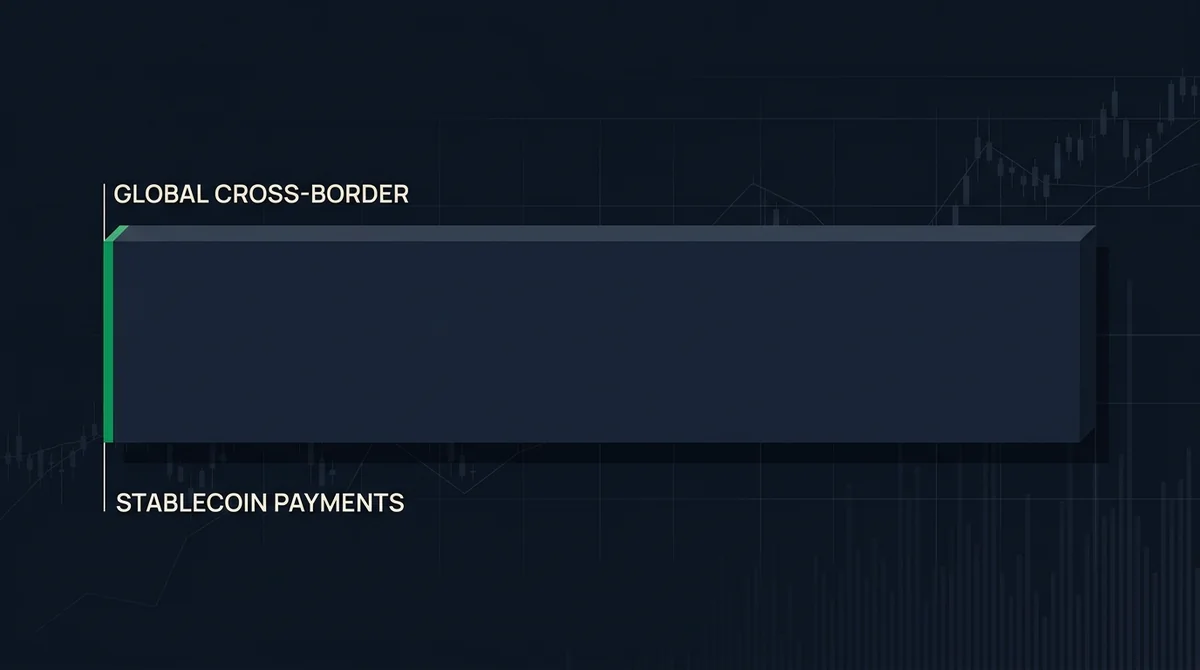
According to Decrypt on September 6, 2026, citing FXC Intelligence, the global cross-border payment market reached $208 trillion in 2025. Meanwhile, McKinsey and Artemis statistics put the annualized run rate of real stablecoin payments at about $390 billion, meaning stablecoin payments accounted for only about 0.02% of global payment volume. The key to this share lies in the difference between 'real payment volume' and 'stablecoin transfer volume.' A large proportion of on-chain stablecoin transfers are trading, arbitrage, or staking flows, not cross-border payments corresponding to real goods or services.
At the end of 2025, the annualized run rate of B2B stablecoin payments was about $226 billion, up 733% year over year. This high growth came from an extremely low base, indicating that enterprise stablecoin settlement is starting quickly, but its absolute scale is still far smaller than traditional bank settlement networks. OKX users should pay attention to the scope of this share: stablecoins are currently used more for crypto asset trading than for everyday cross-border payments.
Why bank infrastructure remains irreplaceable
Banks' irreplaceability in the stablecoin ecosystem starts with compliance reserves and licensing thresholds. According to Decrypt's September 6, 2026 report, Stripe acquired Bridge for $1.1 billion, Citi is launching crypto custody, and Standard Chartered is testing stablecoin settlement in Singapore. These moves show that traditional banks are not being excluded; instead, they are becoming the infrastructure providers for stablecoin scaling.
Second, stablecoin issuers themselves need bank accounts, fiat reserve management, KYC/AML processes, and cross-jurisdiction settlement networks, making it difficult to operate completely outside the banking system. The GENIUS Act requires compliant stablecoin issuance with bank-grade reserves, disclosure, and licensing requirements, further strengthening banks' role in reserve custody and compliance review. For OKX users, stablecoin on/off-ramps themselves depend on bank fiat channels, and banks' irreplaceability directly affects user experience.
GENIUS Act compliance requirements for stablecoin cross-border payments
According to information cited by Decrypt on September 6, 2026, the GENIUS Act signed in July 2025 requires compliant stablecoin issuance to meet bank-grade reserve, disclosure, and licensing requirements. Bank-grade reserves mean issuers must hold highly liquid assets and undergo regular audits; disclosure requirements include reserve composition, redemption rights, and risk warnings.
The impact on issuers and users is that only stablecoins meeting these compliance conditions are more likely to enter mainstream payment and bank cooperation systems; those that do not meet the conditions may be excluded from compliant payment scenarios. OKX, as a trading platform, needs to monitor the list of compliant stablecoins and user education. B2B stablecoin payments must meet cross-jurisdiction compliance, and bank cooperation becomes key.
How the QuFi post-quantum verification platform strengthens settlement security
According to Cointelegraph's September 4, 2026 report, QuFi Network launched a post-quantum verification platform that uses three post-quantum cryptographic standards—ML-DSA-65, SLH-DSA, and ML-KEM-1024—to verify digital asset transactions without changing existing blockchain settlement networks. Its purpose is to defend against future quantum computers' threat to traditional signature algorithms such as ECDSA.
By comparison, in August 2025, StarkWare tested a quantum-resistant transaction on the Bitcoin mainnet without a fork, but it took several hours and cost about $150–200. This test demonstrated technical feasibility, but the high cost and long time show that it is still in an early stage and does not mean it is ready for production. OKX users should understand the progress of post-quantum cryptographic standards, but the current actual threat is still limited, and they should pay attention to technology maturity.
OKX user perspective: stablecoin payments and asset security self-check points
For stablecoin on/off-ramps, OKX users can first check whether the stablecoin issuer meets the GENIUS Act's bank-grade reserve, disclosure, and licensing requirements. At the same time, they should understand the difference between stablecoin payments and on-chain transfers, and avoid misreading high growth as replacing bank settlement. Users can follow the stablecoin reserve disclosures and audit reports supported by the OKX platform, but the relevant updates must be based on OKX official channels; this site does not provide official channel links.
Regarding quantum security risks, users do not need to panic. Quantum attacks are not yet practical; QuFi and StarkWare's progress is mainly in testing or verification stages. When B2B stablecoin payments grow rapidly, users should focus on counterparty risk and settlement finality. For related content, see this site's reports on the G7 stablecoin alliance, stablecoin payment credibility disputes, and USDG stablecoin settlement.
Future path: convergence trends of banks, stablecoins, and post-quantum security
Bank-stablecoin cooperation may unfold through three models: custody, settlement, and reserve management. Institutions such as Stripe, Citi, and Standard Chartered have already begun positioning, and future competition and cooperation will coexist. The timeline for post-quantum security implementation remains uncertain; if QuFi and similar solutions mature, they can reduce the quantum risk of settlement networks, but the market should be wary of equating testnet results with production performance.
For OKX users, they can follow platform technology announcements and adjust asset security strategies in a timely manner. The data in this article is as of September 2026 and may be updated later; it does not constitute investment or compliance advice.
References and verification links
These are the article-level sources stored with this page. Interpret dynamic facts and rules in light of their dates, regions, and subsequent updates.
FAQ
Is the 0.02% share of stablecoin cross-border payments reliable? What is the statistical scope? ▼
It is reliable but requires attention to scope. The share comes from Decrypt's September 6, 2026 report citing FXC Intelligence's $208 trillion cross-border payment market in 2025, and McKinsey and Artemis statistics of about $390 billion annualized real stablecoin payments. It distinguishes real payment volume from on-chain transfer volume; arbitrage or trading flows cannot be counted as cross-border payments.
Why can't stablecoin payments replace bank settlement networks yet? ▼
Because banks remain irreplaceable in compliance reserves, fiat channels, KYC/AML processes, and cross-jurisdiction settlement networks. Developments such as Stripe acquiring Bridge, Citi launching custody, and Standard Chartered testing stablecoin settlement show that banks are becoming the base layer for stablecoin scaling, not being excluded.
What specific compliance requirements does the GENIUS Act impose on stablecoin issuers? ▼
According to Decrypt's September 6, 2026 report, the GENIUS Act signed in July 2025 requires compliant stablecoin issuance to meet bank-grade reserve, disclosure, and licensing requirements, including holding highly liquid assets and undergoing regular audits, as well as disclosing reserve composition, redemption rights, and risk warnings.
What cryptographic standards does the QuFi post-quantum verification platform use? How is it different from the StarkWare test? ▼
QuFi uses three post-quantum cryptographic standards—ML-DSA-65, SLH-DSA, and ML-KEM-1024—to verify transactions without changing existing blockchain settlement networks. StarkWare tested a quantum-resistant transaction on the Bitcoin mainnet in August 2025, taking several hours and costing about $150–200, demonstrating feasibility but not yet practical.
How should OKX users assess the quantum security risk of digital asset settlement? ▼
Quantum attacks are not yet practical, so there is no need to panic. It is advisable to follow the progress of post-quantum cryptographic standards and platform technology announcements, and also check whether stablecoin issuers meet GENIUS Act compliance requirements, but relevant updates must be based on OKX official channels.
Does the 733% year-over-year growth in B2B stablecoin payments mean banks will be replaced? ▼
No. The 733% growth comes from a low base; at the end of 2025, the B2B stablecoin annualized run rate was about $226 billion, still a very small share of total cross-border payments. Banks remain a necessary condition for stablecoin scaling in compliance, fiat channels, and settlement networks.