How to Understand Crypto Market Cap Rankings: Metrics, Data Sources, and Verification Methods (2026)
Market cap = price × circulating supply; crypto rankings sort by descending market cap, so the top 100 are the 100 largest; verify via multiple sources.

Article Citation Summary
Market cap = price × circulating supply; crypto rankings sort by descending market cap, so the top 100 are the 100 largest; verify via multiple sources.
Crypto Market Cap Rankings vs. Market Cap: Three Common Metric Comparisons
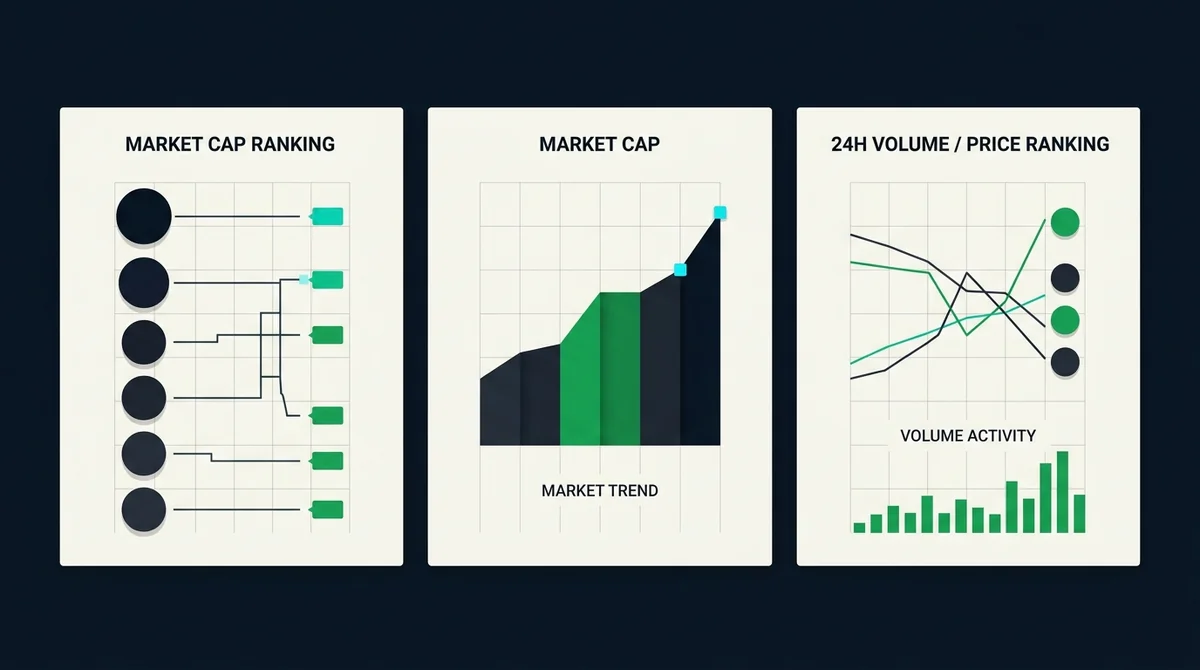
How Is Market Cap Calculated?
Market cap = current price × circulating supply. Price comes from market trading, while circulating supply is the number of tokens currently tradeable in the market or already minted. Different platforms may define “circulating supply” differently, so the same asset can have different market cap figures.
The top 100 crypto rankings are the first 100 names after sorting assets in descending order by market cap. This only shows the size ranking of an asset within the sample pool; it does not indicate whether the asset is worth buying or that its price will rise in the future. A larger market cap does not mean safer or higher quality.
The three metric types compare as follows:
| Comparison dimension | Market cap ranking | Market cap | 24-hour trading volume/price ranking |
|---|---|---|---|
| Metric definition | Position sorted in descending order by market cap | Price × circulating supply | Sorted by 24-hour trading volume or price change rate |
| Calculation method | First calculate each asset's market cap, then sort | Price × circulating supply; circulating supply definition varies by platform | Trading volume = traded quantity × traded price; price change rate = current price compared with 24 hours ago |
| Common data sources | Aggregators, exchange market pages | Aggregators, exchanges, project teams, on-chain data | Aggregators, exchanges |
| Update frequency | Usually minute-level, but subject to refresh delays | Minute-level, but subject to source refresh | Minute-level, may lag behind trade matching |
| Use case | Observing size ranking, screening assets | Estimating scale, comparing valuations | Observing short-term activity and price behavior |
| Common misconception | Treating ranking as investment value; ignoring inclusion criteria differences | Confusing circulating supply, total supply, and maximum supply | Ignoring wash trading, single-exchange volume, or data contamination |
Which Data Sources Are Suitable for Verifying Rankings?
When using a crypto ranking query app to check positions, prioritize at least two independent data sources. CoinGecko and CoinMarketCap are common aggregators, but they may differ in token inclusion scope, circulating supply definitions, and update times, so opening both for comparison is more meaningful. Verification steps:
- Open CoinGecko or CoinMarketCap and confirm that the displayed “circulating supply,” “market cap,” and “updated time” fields are not static screenshots.
- At the same moment, open a second data source and record the same asset's ranking, market cap, and circulating supply values.
- Compare the inclusion scope and methodology notes of the two sources; if they differ, only record the difference, do not infer a cause.
- If you use the OKX App market page as a query entry, verify whether the page indicates a third-party data source; if not, rely on the original aggregator page.
- Do not treat observed differences as buy or sell signals. Use differences as verification clues and further check on-chain data or project announcements.
Related tutorials: Exchange App Beginner Tutorial: Registration, KYC, Deposits and Your First Trade and How to Safely Download Exchange App Android and iOS Versions (2026).
Data Definitions, Sources, and Boundaries
- As-of date: This article is only a methodology and verification explanation and does not contain any real-time market snapshot; the phrase “as of 2026 public sources” refers to the methodological cutoff, and specific figures should be based on what the page shows at the time of query.
- Unknown or unverified items: This article does not include verbatim definitions of circulating supply from CoinGecko or CoinMarketCap, nor does it cite any ranking difference case at a specific time; therefore, it cannot conclude “which one is more accurate.”
- Non-causal statement: Ranking differences are related to data source inclusion scope, update frequency, and circulating supply definitions, but current public information does not confirm any direct causal chain, nor does it imply that any platform has data flaws.
- Sources and boundaries: The data sources cited here are only a general verification path and do not constitute a recommendation of any data source or platform. The OKX App market page is mentioned only as a query entry and does not represent OKX's official view.
- Relationship disclosure: OKX Radar is an independent third-party media outlet with no affiliation with OKX and does not provide login, account opening, customer service, download, or fund services; this article does not represent OKX's official view and does not constitute investment advice.
Risk warning: Crypto/digital asset prices are highly volatile, and information and rules may change at any time. This article does not constitute investment, legal, or tax advice. Always base decisions on the latest official announcements and actual product pages.
FAQ
What is the difference between crypto rankings and market cap? ▼
Ranking is the position sorted in descending order by market cap; market cap = current price × circulating supply. Ranking reflects the order of asset size within the sample pool, while market cap is a specific amount. The two cannot be used interchangeably, and different data sources' circulating supply definitions can affect both market cap and ranking.
Are the top 100 coins by market cap always worth paying attention to? ▼
Not necessarily. The top 100 only shows that these assets' circulating market cap is near the top of the sample; it does not mean they are safer, better quality, or that their price will rise. Whether they are worth attention depends on your own research framework and risk tolerance; ranking should not be treated as an investment value judgment.
Which apps can I use to check crypto market cap rankings? ▼
Common aggregators include CoinGecko and CoinMarketCap; the OKX App market page can also be used as a query entry. But when using any app, you should verify the data source, inclusion criteria, and update time, and not assume that a single app's order is completely accurate.
Why do rankings differ across data sources at the same moment? ▼
Public information shows that differences usually come from different token inclusion scopes, different definitions of circulating supply, and different data update and on-chain extraction times. Existing information is insufficient to determine which source is absolutely more accurate; cross-recording and verification are recommended.
How is market cap calculated, and what is the difference between circulating supply and total supply? ▼
Market cap = price × circulating supply. Circulating supply is the number of tokens currently tradeable in the market or already minted, total supply is all tokens created, and maximum supply is the theoretical upper limit. Confusing these three metrics will produce different market cap results.
Are OKX App market rankings consistent with third-party data sources? ▼
This article does not provide comparison data at the same point in time, so it cannot confirm whether they are always consistent. If differences are found, first verify whether the OKX App notes its data source, update time, and circulating supply definition, and cross-check with the original CoinGecko or CoinMarketCap page.