Hyperliquid's On-Chain Finance Blueprint: From Derivatives Protocol to Universal Financial Infrastructure
Hyperliquid shares its on-chain finance strategy, covering HIP-4, HIP-3 Star and priority fees as upgrades for a neutral, composable financial infrastructure.

Article Citation Summary
Hyperliquid shares its on-chain finance strategy, covering HIP-4, HIP-3 Star and priority fees as upgrades for a neutral, composable financial infrastructure.
In a recent industry exchange, Hyperliquid Labs co-founder and CEO Jeff shared his long-term vision for on-chain financial infrastructure. He emphasized that Hyperliquid's goal is not to compete with any single entity, but to provide a neutral, composable underlying system that allows all financial activity to run on-chain. OKX Radar notes that this 'becoming public infrastructure' approach is becoming an important narrative in the on-chain finance space.
Centered on 'Usefulness': Building Universal Financial Primitives
Over the past year, Hyperliquid has rolled out a series of upgrades: HIP-4 (providing option-like payoff curves), portfolio margin, a native lending protocol, priority fees, and HIP-3 Star, which is already live on testnet. Jeff said the overall strategy has always centered on one goal — building tools that can support all financial activity. If developers want to build a product but cannot, they will turn to other ecosystems. Therefore, Hyperliquid's only criterion is 'usefulness.' The team observes what is currently achievable, collects common gaps from developer feedback, and uses that to determine the protocol's evolution direction.
Jeff particularly emphasized that there should not be too many underlying primitives, otherwise the system becomes complex and difficult to understand. Each primitive should be precise, widely useful, and composable. He used portfolio margin as an example: the lending primitive can be combined with trading primitives (perpetuals or spot), unlocking significant building space while also aligning with the elegant form finance should have — fewer components, yet efficient coordination.
From Derivatives to Real-World Assets: HIP-3 Drives 13x Growth
Jeff pointed out that the market's understanding of the importance of certain primitives often lags behind product releases. HIP-3 is such a case: even during the testnet phase, it had demonstrated the ability to create markets for any asset via price feeds, but it was not until some teams excelled in trade execution that the community truly recognized its value. He believes HIP-4 may face a similar situation. Options are crucial in traditional finance, and perpetuals and options are not substitutes but complements. HIP-4 provides a primitive for building and scaling options or option-like payoff curves, a story that has yet to unfold.
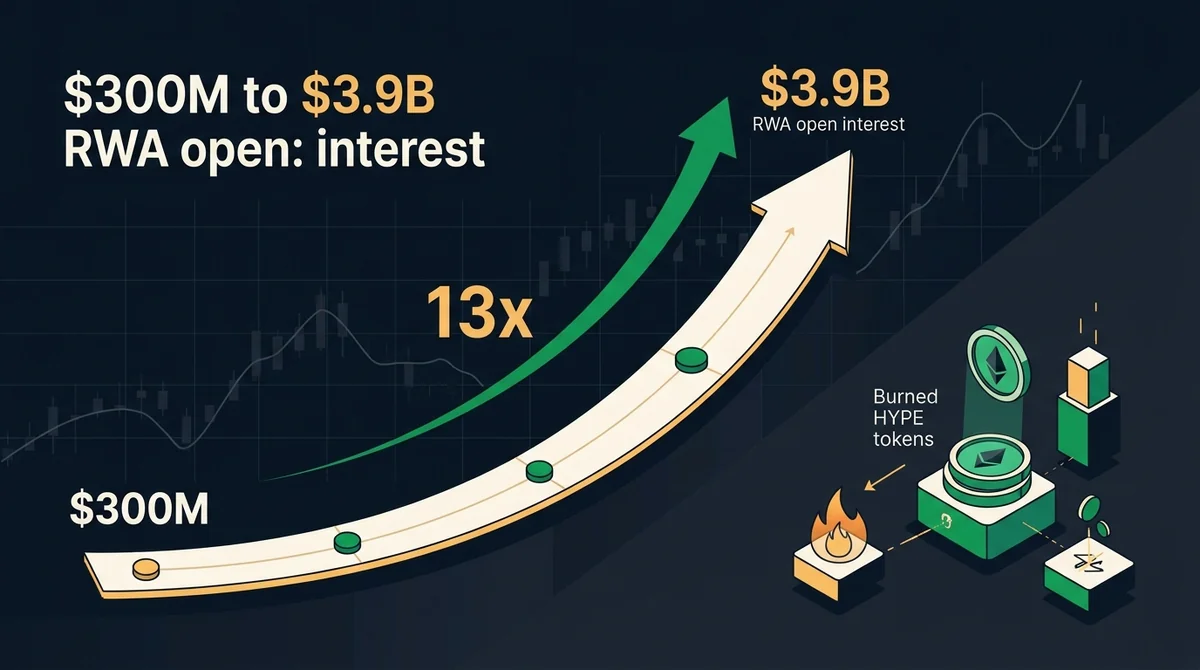
HIP-3 has become a major growth engine for Hyperliquid. Open interest in real-world assets (RWA) increased from $300 million in January to the current $3.9 billion, roughly 13x growth. Meanwhile, traditional finance is gradually understanding Hyperliquid's vision, especially scenarios like 24/7 trading and pre-IPO. As the narrative evolves, Hyperliquid's comparison set has shifted from other derivatives protocols to mainstream crypto exchanges, and then to traditional giants like CME and Nasdaq. Jeff believes these frameworks are all imperfect because the protocol is genuinely attempting something unprecedented. It is more like public infrastructure, akin to the internet or Linux — not requiring ten identical systems, but a single neutral system. All the names mentioned are ultimately not competitors, but potential users who could benefit from the technology.
HIP-3 Star and the Compliance Path: Opening a Channel for Institutional Entry
HIP-3 Star is similar to HIP-3, allowing deployers to launch their own markets, but adds additional permissions, such as whitelists controlling which addresses can trade. Kraken's parent company has publicly stated that, pending regulatory approval, it will use this feature to offer Hyperliquid services to US users. Jeff explained that HIP-3 Star is a distillation of developer feedback: HIP-3 itself has many desirable properties, such as transparency, self-custody, redundancy, and resilience, which are positive attributes in various regulatory environments. Adding optional access control on top enables deployers to launch the markets they want while synergizing with the protocol's existing on-chain features.
Jeff has previously said that there is no distinction between 'decentralized finance' and 'traditional finance' — there is only finance, and existing systems are simply a fundamental improvement. HIP-3 is exactly that: it gives individuals and institutions the option to build on-chain without taking away anyone's rights; it is purely additive.
Priority Fees: Internalizing Negative Externalities for a Fairer Market
The recently introduced priority fees are often underestimated. They come in two forms: read priority fees allow traders to access uncommitted order flow from the pending transaction pool; write priority fees allow traders to attach HYPE tokens to gain queue priority. Nearly 180,000 HYPE have been burned so far. Jeff argues this should not be seen as 'bribery,' but rather analogous to Ethereum's shift to protocol-level burning of priority fees. Latency races in traditional finance are extremely capital-intensive, with participants having to invest hundreds of millions of dollars to compete. The goal of priority fees is to find a more efficient market clearing mechanism so that incidental technical advantages no longer override genuine alpha.
Jeff further explained that some alpha in the market is zero-sum or even negative-sum, such as microsecond advantages from microwave towers and transoceanic fiber optics, which only cause participants to endlessly compete without creating value for the world. Priority fees attempt to internalize these negative externalities, making the system open to everyone. The ultimate vision is that anyone can participate in trading with very low infrastructure investment, standing on the same starting line as everyone else.
Transparency and Privacy: Why a Public Order Book Is More Efficient
On privacy, Jeff's views are quite clear. He reasons from first principles: one of the core advantages of electronic trading replacing open outcry is transparency — everyone can see everything. When everyone can see the order book, the order book itself becomes more liquid because participants can incorporate it into their algorithms. Hyperliquid has run its order book on-chain from day one, and it is more transparent than traditional finance: you can see not only total order volume and quantities, but also the addresses associated with orders. Brazilian exchanges publicly disclose broker information for some orders, which has led to extensive downstream analysis. Hyperliquid pushes this transparency to the extreme, offering the most granular L4 order book. He believes that, from first principles, this should lead to more efficient markets.
Empirical evidence supports this as well. One study compared the execution quality of hidden TWAP and public TWAP, finding that public TWAP performed better because market makers could absorb non-toxic flow in advance. Similarly, leveraged ETF daily rebalancing typically executes at the closing auction and publicly discloses rules to the market, allowing market makers to provide competitive liquidity. Jeff concluded that transparent markets ultimately benefit the execution of large trades.
Community and Success Metrics: Zero-to-One Innovation Is the Biggest Win
Jeff has repeatedly emphasized that Hyperliquid is not just Hyperliquid Labs; the community is part of a broader team. When it comes to community feedback, he said it is difficult to give universal advice because the community is highly diverse. He hopes everyone remembers the underlying values: the purpose of building is to help end users, and not to get caught up in the emotion of beating competitors or proving a point. He reminded that three years ago, Hyperliquid was just an idea and a small group of people working day and night. Stay humble and do not become complacent due to growth.
As an infrastructure layer, Hyperliquid does track metrics, but Jeff personally values qualitative changes more: whether something new that never existed before has been built, and whether users adopt it out of preference. Zero-to-one qualitative shifts — such as the 24/7 markets enabled by HIP-3 — satisfy him more than any data.
Next Steps: Options, Spot, and Real-Asset Tokenization
When asked about Hyperliquid's next steps, Jeff believes options are the obvious one. Spot, perpetuals, and options constitute the three pillars for trading assets. He mentioned that the spot side is a huge unlock: the value of portfolio margin depends on the assets supported, and if people's holdings can serve as collateral, those assets need to be brought on-chain, not just their prices. However, tokenizing real-world assets is harder to bootstrap network effects than perpetuals, because holding itself is not economic activity. Additionally, HIP-4 provides a foundation for options protocols: they can inherit the spot order book, portfolio margin, and use perpetuals to hedge delta. Options have reached escape velocity in traditional finance but have not yet in crypto, which is exactly the direction worth exploring.