Tokenizing Wall Street and the AI Agent Revolution: A Web3 Institution's On-Chain Asset Practice and Outlook
A Web3 institution shares views on tokenized loans, AI agents, stablecoins, and payment networks, noting uncertainty in return and scale projections.
Article Citation Summary
A Web3 institution shares views on tokenized loans, AI agents, stablecoins, and payment networks, noting uncertainty in return and scale projections.
In recent years, the convergence of digital assets and traditional finance has clearly accelerated. A company that started with free-to-play games and later transformed into a Web3 investment institution recently shared its views on trends such as asset tokenization, AI agents, stablecoins, and the evolution of payment networks, and introduced its practices in the field of real-world assets (RWA). The institution's name originates from 'anime', initially entering through the gaming business, and now positions itself as 'building the future economy', focusing on the creation and popularization of digital assets.
From Gaming to Digital Assets: Two Core Focus Areas
An executive of the institution stated that the company currently focuses on two directions: one is AI agents, and the other is the intersection of institutional financial services products and digital assets. He believes that practitioners in the digital asset industry have been working for years to promote the adoption of digital assets by traditional financial institutions, and this year may be a turning point where real adoption, participation, and product creation are beginning to emerge. From gaming to Wall Street, the company has undergone about 18 years of ecosystem building; in his view, building a brand-new global ecosystem in 18 years has been quite rapid.
AI Agents: Lightweight, Disposable, and Approaching Zero Cost
Regarding AI agents, the industry has previously discussed that the future number could reach 50 billion, 100 billion, or even trillions. The institution believes that agents are essentially software-based robotic tools that are lightweight and almost disposable, so theoretically every person on Earth could have multiple agents to assist with work and life. The key lies in acquisition cost. With explosive growth in data center investment, end-user costs may eventually drop to negligible levels. The institution's head further pointed out that the infrastructure costs for computation, reasoning, and "intelligence" will gradually approach zero along a path similar to utility provision, but the specific timing—1 year, 5 years, 10 years, or even 15 years—remains uncertain.
Stablecoins and Consumer Power: Institutions Forced to Follow
In the financial sector, the rise of stablecoins over the past five years has been entirely driven by product-market fit demand. There is real global demand for a digital dollar form, especially in the Global South where inflation is higher, and stablecoin adoption has surged. The institution observed that, similar to many new technologies, consumers often adopt first, creating trends that force institutions to follow. When enough customers demand digital asset-related services, financial institutions have no choice but to change. Such customer complaints have persisted for years, and now institutions are finally "catching up."
From an infrastructure perspective, digital assets provide institutions with a "financial internet." In the telephone era, there were physical lines between callers; the internet abstracted this connection. Similarly, finance is now forming digital infrastructure standardized on certain blockchain protocols. If the financial world chooses to make assets compatible with networks like Ethereum and Canton, it will bring tremendous interoperability and significantly reduce costs. This change will squeeze out middlemen who profit from restricting access, but ultimately low-cost infrastructure will win, and profits will shift to other areas that create greater value—just as telecom companies still exist, but most people no longer use analog phones, instead using IP telephony.
Real-World Assets (RWA): A Case of Home Equity Loans On-Chain
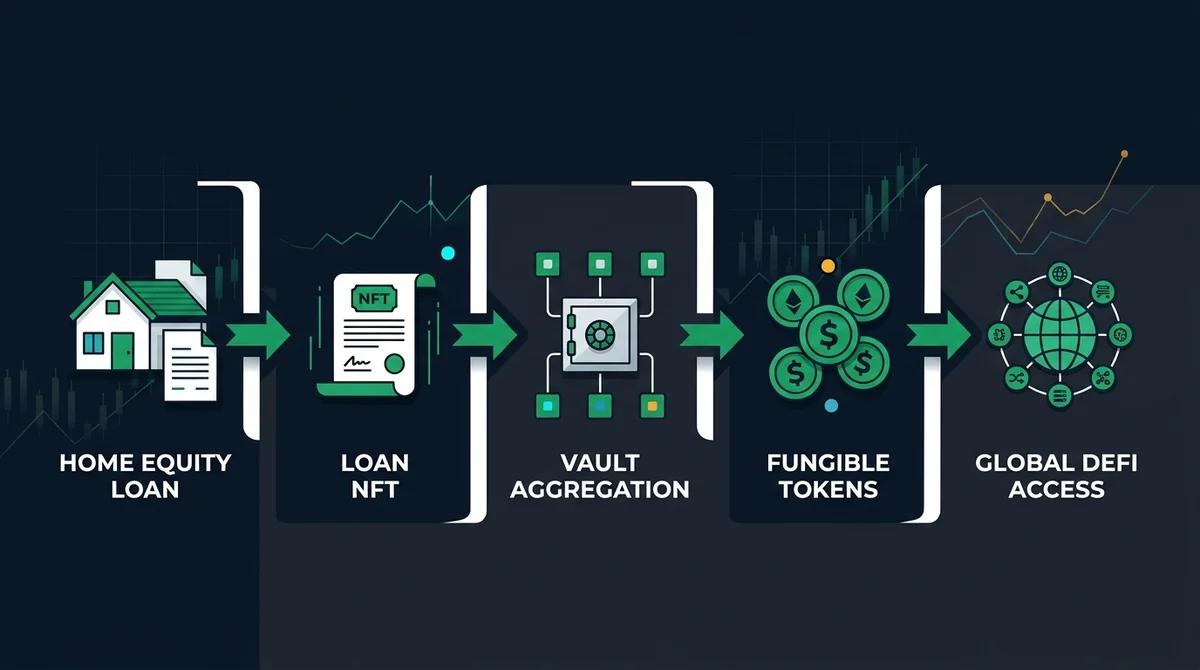
In the field of real-world assets (RWA), the institution launched an asset wrapping platform. Its first product was developed in collaboration with the U.S. publicly listed digital asset company Figure to tokenize American home equity lines of credit (HELOC). The specific process is: Figure originates consumer home loans in the United States, selects a portfolio of relatively low-risk assets, and places them on-chain as NFTs (because each mortgage is a unique instrument). The institution aggregates these NFTs into its "vault" and issues fungible tokens based on the vault. These fungible tokens are issued on blockchain networks oriented toward financial services, can be used across chains and platforms, and are especially suitable for DeFi. The initial loan NFTs are technically more restricted and are essentially buy-and-hold instruments; while the tokens issued by the vault are highly flexible, permissionless, and DeFi-friendly, and can be used by crypto-native funds, hedge funds, and trading firms to access loans or implement other strategies. This two-step process converts physically underwritten loans into permissionless tokens.
According to the institution, Figure's tokenized HELOC scale has reached approximately $18 billion, making it one of the largest RWA portfolios in the United States, with underlying loan annualized yields between 6% and 9%. It believes that the U.S. home equity loan market is enormous and allows for selecting top assets with lower risk. However, the above yields are opinion-based statements, and actual returns depend on underlying asset performance and market conditions, carrying uncertainty; tokenized assets also face risks such as smart contracts, liquidity, and regulation.
The platform's significance also lies in geographic accessibility. U.S. home equity loans are typically only available to large financial institutions, and ordinary investors, hedge funds, or family offices in other countries find it difficult to access them directly. Through vault tokens, global users can purchase online and gain exposure to this asset class. The institution believes this contributes to the democratization of access.
Regulatory Discussion: Accredited Investors and Early Crypto Adoption
Facing questions about "whether it is promoting U.S. real estate loans," the institution responded that its goal is "fair competition." The current financial system contains outdated and unfit-for-purpose regulatory rules, such as the U.S. accredited investor concept, which ties risk tolerance to wealth (over $100,000 allows participation in high-risk investments), which is unreasonable. The institution believes that restricting how individuals spend money does not align with the principle of free choice. This also explains why, in the early days of Bitcoin, adoption was high among some minority communities in the United States (such as African American and Latino communities)—these communities often lack access to traditional financial investment products, and permissionless digital assets provide an alternative.
Payment Networks and the Future of Visa and Mastercard
Regarding the potential impact of stablecoins and tokenized payments on traditional payment giants such as Visa and Mastercard, the institution's view is relatively balanced. It pointed out that Visa and Mastercard currently have a combined stock market value of over $1.1 trillion, and stablecoins may indeed challenge or supplement existing wholesale payment rails. However, historical experience shows that technological change does not make incumbents disappear but rather drives value transfer. For example, the spread of the internet did not make post offices disappear, and open-source Linux did not bring down Oracle—Oracle shifted its model and became a services and consulting company. Similarly, consumers use credit cards not only for payment but also for added value such as loyalty rewards and purchase protection. The insurance services provided by credit cards (such as return protection and chargebacks) have real value to users. Therefore, Visa, Mastercard, and similar companies may adjust their business models in the future, but they are unlikely to be directly replaced.
Conclusion: The Convergence of Digital Assets and AI Agents
Overall, the institution believes that the convergence of traditional finance and digital assets is entering a stage of real adoption and product creation, and the combination of AI agents and tokenized assets may further reshape the financial services landscape. From gaming to Wall Street, from the NFT boom to institutional-grade RWA platforms, the industry is moving from consumer-side innovation to infrastructure restructuring. In this process, low-cost, open, and interoperable infrastructure may become the decisive force.