Bitcoin Drops Below $77,000: US PPI Exceeds Expectations and 30-Year Treasury Yield Hits 19-Year High
On Sept 10, 2026, Bitcoin fell below $77,000 as US PPI beat, 30-year Treasury yield hit 5.353%, and oil topped $100. Volatility risks for OKX users; not advice.
Article Citation Summary
On Sept 10, 2026, Bitcoin fell below $77,000 as US PPI beat, 30-year Treasury yield hit 5.353%, and oil topped $100. Volatility risks for OKX users; not advice.
Core Summary: As of September 10, 2026, Bitcoin's price fell and briefly dropped below $77,000. Triggers include the US August PPI rising 5.4% year-over-year, 0.1 percentage point above expectations, the 30-year Treasury yield rising to 5.353% (the highest since June 2007), WTI crude oil breaking above $100 per barrel, and the market's probability of a 25 basis point rate hike at the Federal Reserve's September 16 meeting rising to 69.8%. The following sections explain the macro transmission, actionable market observation and risk control for OKX users, and indicators to track before the meeting.
Event Background: Key Macro Triggers for Bitcoin Falling Below $77,000
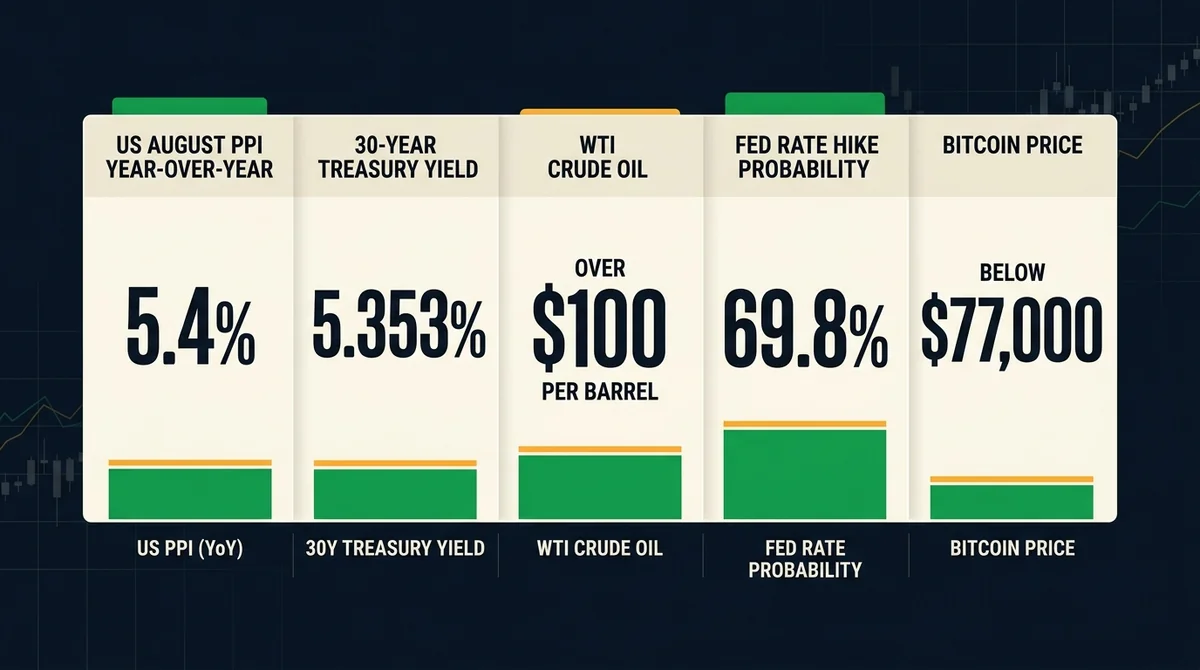
According to Cointelegraph, on September 10, 2026, Bitcoin's price briefly fell below $77,000. Key macro indicators on the same day are as follows:
| Indicator | Value/Status | Time Reference |
|---|---|---|
| Bitcoin price | Briefly fell below $77,000 | 2026-09-10 |
| US August PPI YoY | 5.4%, 0.1 pp above expectations | 2026-09-10 |
| US 30-year Treasury yield | 5.353%, highest since June 2007 | 2026-09-10 |
| WTI crude oil | Broke above $100/barrel, first since May 21 | 2026-09-10 |
| Fed rate hike of 25bp on Sep 16 | 69.8% | 2026-09-10 |
How Did the US August PPI Beat Affect Risk Assets?
The US August PPI rose 5.4% year-over-year, 0.1 percentage point above expectations. Higher-than-expected producer inflation may reinforce market pricing for continued Fed rate hikes, thereby pressuring traditional risk assets and crypto asset valuations. This correlation is an observed market phenomenon on that day and does not directly assert causality.
Why Does the Rise in 30-Year Treasury Yield Pressure Bitcoin?
The 30-year Treasury yield rose to 5.353%, the highest since June 2007. Rising risk-free rates increase the opportunity cost substitution effect of holding cash and bonds, putting valuation pressure on high-volatility, non-interest-bearing assets like Bitcoin. This relationship is common during macro tightening phases, but the magnitude and persistence are determined by market dynamics.
Macro Transmission: How Interest Rates, Oil Prices, and Fed Rate Hike Expectations Affect Crypto Assets
Why Does Rising Treasury Yield Reduce Bitcoin's Attractiveness?
Independent Assessment: When risk-free rates rise, investors often require a higher risk premium for high-risk assets and may shift to assets with more certain returns. Bitcoin, as a high-volatility asset, is sensitive to the interest rate environment, but this does not mean every rate increase leads to a price decline.
Second-Order Effects of Rising Oil Prices and Middle East Tensions on Crypto Markets
WTI crude oil broke above $100 per barrel for the first time since May 21, influenced by escalating Middle East tensions. Rising oil prices may reinforce inflation expectations and further push market pricing for Fed rate hikes, indirectly affecting crypto assets. This chain is complex and not unidirectional; geopolitical risks and policy responses should be continuously observed.
How OKX Users Can Respond to Volatility: A Verifiable Market Observation and Risk Control Framework
The following steps are based on common OKX platform features and risk control common sense; specific entry points and rules are subject to the official OKX help documentation:
- View market data and volatility indicators: Check real-time prices, volatility, and funding rates and other public indicators via the OKX market page.
- Set price alerts: Use the price alert feature to track key psychological levels and avoid constantly watching the market.
- Check margin ratio and unrealized P&L: In high volatility conditions, monitor margin ratio, liquidation price, and unrealized P&L to avoid excessive leverage.
- Set stop-loss orders: Stop-loss orders may incur slippage; the trigger price and execution price may not match, and this should be self-assessed.
- Track economic data calendar: Before the September 16 Fed meeting, watch inflation, employment, and other data, as well as the 30-year Treasury yield and WTI oil prices.
Note: This article does not fabricate test experiences or prefill fee or funding rate values that have not been proven by inputs.
What to Watch Next: Data and Events to Track Before the September 16 Fed Meeting
- Possible releases of inflation, employment, and other economic data calendar; specific dates and expected values should be verified at the time of writing.
- If Middle East tensions escalate further, they may continue to push up oil prices and strengthen risk-off sentiment.
- Whether the 30-year Treasury yield continues to rise is key to observing risk-free rate pressure.
- Market pricing for rate hikes may change quickly; any probability data should be time-stamped.
Risk Warning: Crypto/digital asset prices are highly volatile, and information and rules may change at any time. This article does not constitute investment, legal, or tax advice. Before making decisions, refer to the latest official announcements and actual product pages.
References and verification links
These are the article-level sources stored with this page. Interpret dynamic facts and rules in light of their dates, regions, and subsequent updates.
FAQ
Why did Bitcoin fall below $77,000 on September 10, 2026? ▼
As of September 10, 2026, Bitcoin's fall below $77,000 was mainly driven by macro factors including the US August PPI beat, the 30-year Treasury yield rising to 5.353%, WTI crude oil breaking above $100 per barrel, and the market's probability of a Fed rate hike on September 16 rising to 69.8%.
What does the US PPI beat mean for crypto markets? ▼
The US August PPI rose 5.4% year-over-year, 0.1 percentage point above expectations, strengthening market expectations for continued Fed rate hikes and potentially pressuring risk asset valuations. This is an observed market phenomenon, not causality.
How does the 30-year Treasury yield hitting a 19-year high affect Bitcoin? ▼
The 30-year Treasury yield rising to 5.353% means higher risk-free rates, which may reduce the relative attractiveness of high-volatility assets like Bitcoin. This correlation is a market observation and may not persist.
How can OKX users set price alerts in high volatility conditions? ▼
You can use the price alert feature on the OKX market page to track key levels, with specific operations subject to the official OKX help documentation. Also pay attention to margin ratio, liquidation price, and unrealized P&L to avoid excessive leverage.
Which indicators should be watched before the September 16 Fed meeting? ▼
You can watch the economic data calendar before September 16, including inflation, employment, and other data, as well as the 30-year Treasury yield, WTI oil prices, and changes in market pricing for rate hike probability. Specific dates and expected values should be verified at the time of writing.
Will escalating Middle East tensions and oil prices above $100 continue to affect crypto markets? ▼
WTI crude oil breaking above $100 per barrel is influenced by escalating Middle East tensions, which may reinforce inflation expectations and rate hike pricing. If tensions escalate further, they may continue to push up oil prices and strengthen risk-off sentiment, but the persistence and extent of the impact are uncertain.