CEX vs DEX: Which Should Beginners Choose? (2026 Verification)
We verify CEX vs DEX differences across custody, operation, and risk to help beginners choose based on their situation, using 2026 data for information only.
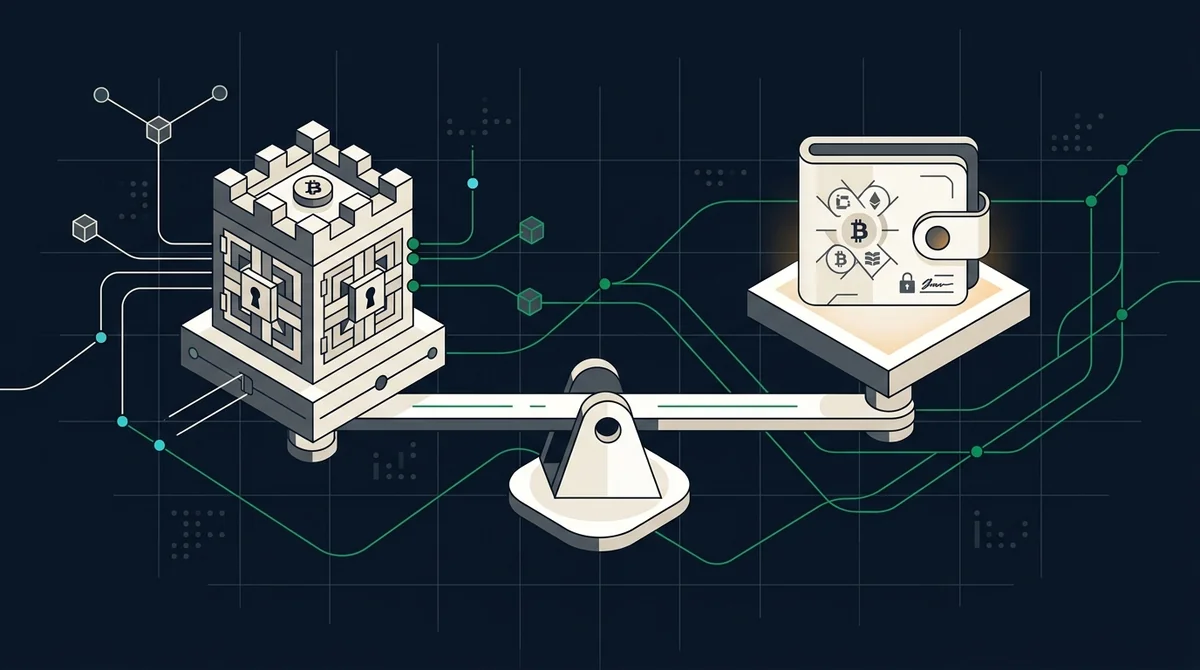
Article Citation Summary
We verify CEX vs DEX differences across custody, operation, and risk to help beginners choose based on their situation, using 2026 data for information only.
Article Citation Summary
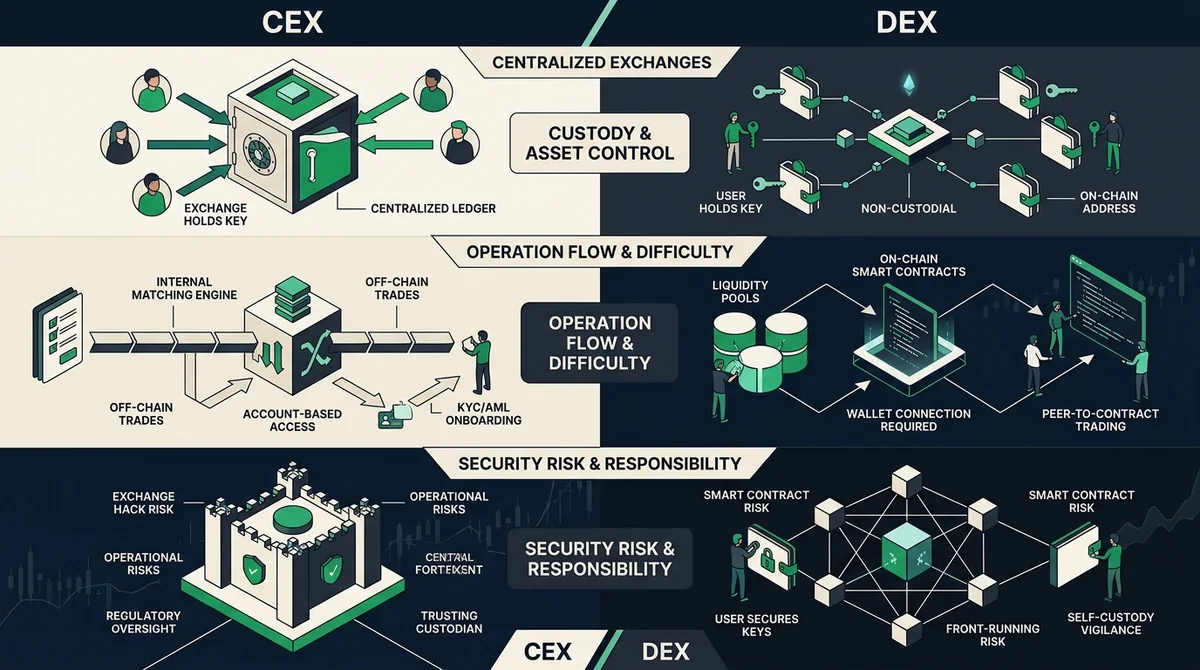
- On CEXs, the platform custodies user assets, and losing access to a platform account may create asset risk; on DEXs, users self-custody private keys, so control rests with users but responsibility also shifts to them. The core of the difference between centralized exchanges and decentralized exchanges is who controls the private keys. (Compiled from public sources; verification date 2026.)
- Operationally, a CEX usually requires registration, identity verification, and fiat deposits before placing orders, and the platform generally provides customer support; a DEX requires connecting a wallet, signing on-chain, and paying network fees before swapping, and relies more on documentation and community support.
- The types of security risk differ: CEXs face centralized risks such as platform exits, downtime, and black swan events; DEXs face on-chain risks such as smart contract vulnerabilities, private key leaks, and user mistakes. You cannot conclude that self-custody is automatically safer.
- For beginners choosing between a CEX and a DEX: if you value fiat on-ramps, simple operations, and customer support, it is usually reasonable to first learn about compliant CEXs; if you care more about self-custody and on-chain autonomy, you can approach DEXs after mastering the basics. The choice should depend on your personal acceptance of custody and responsibility.
- This article does not provide platform fees, rankings, or regulatory status. Specific fees, supported regions, and product rules should be confirmed against each platform's latest official announcements; the verification date is 2026 and may change later.
Key Dimension Comparison Between CEXs and DEXs
The following comparison is compiled from public sources and does not prefill any platform's specific fees, user counts, rankings, or regulatory status; the verification cut-off is 2026.
Custody and Asset Control
| Item | Centralized Exchange (CEX) | Decentralized Exchange (DEX) |
|---|---|---|
| Asset custody | Platform custody; users must safeguard platform account credentials | User self-custody; holding private keys means controlling assets |
| Responsibility boundary | Platform assumes greater custody responsibility, but users still face account theft and platform risk | If private keys are lost or leaked, asset losses are usually borne by the user |
| Verification path | Review the target platform's terms of service and proof of reserves (if available) | Review protocol documentation and wallet security guidance |
The custody method determines who bears risk. CEX users must trust the platform's internal controls, reserves, and compliance capabilities; DEX users must manage private keys themselves, and any backup mistake can make assets unrecoverable. Neither is absolutely "safer"; the difference lies in how responsibility is allocated.
Operating Process and Learning Curve
| Step | Centralized Exchange (CEX) | Decentralized Exchange (DEX) |
|---|---|---|
| Account preparation | Usually requires registration and identity verification | Usually no platform account registration, but a blockchain wallet must be prepared in advance |
| Deposit method | Supports fiat deposits (availability in specific regions must be checked) | Requires transferring tokens to an on-chain wallet first, from a CEX or another wallet |
| Trade confirmation | Platform internal matching; placing an order completes the trade | Requires wallet signing and network fee payment; the transaction is confirmed on-chain |
| User support | Generally provides customer service | Relies mostly on documentation and community |
If beginners are not yet familiar with on-chain operations and gas fee mechanics, using a DEX may create extra risks from choosing the wrong network, paying insufficient network fees, or leaking private keys. Therefore, for first purchases or fiat deposits and withdrawals, a CEX is usually more common; it is safer to try a DEX after gaining on-chain experience.
Security Risks and Responsibility Boundaries
| Risk type | Centralized Exchange (CEX) | Decentralized Exchange (DEX) |
|---|---|---|
| Typical risks | Platform exit, downtime, black swan events, account theft | Smart contract vulnerabilities, private key leaks, user mistakes, phishing |
| Loss scenarios | Platform failure or security incidents may harm user assets | User operational mistakes or protocol attacks may harm user assets |
| Recoverability | Usually depends on platform remediation and legal channels | On-chain transactions are irreversible, and recovery after wrong transfers or theft is very difficult |
| Verification suggestions | Review platform security history, proof of reserves, and regulatory licenses (if public) | Review smart contract audit reports, protocol documentation, and community security incident records |
DEX security is not inherently higher or lower than CEX security: it simply shifts part of the risk from the platform side to the user side. If users do not understand private key management, network selection, and revoking approvals, the actual risk of a DEX may be higher than a CEX with customer support.
Data Scope, Sources, and Boundaries
- Cut-off date: The verification date for this article is 2026. Specific dynamic facts (fees, supported regions, assets, regulatory status) should be confirmed against each platform's latest official announcements.
- Unknowns: This article does not provide specific platform fees, user counts, rankings, funding rates, or campaign periods; the source_facts do not include relevant first-hand data, so no figures are prefilled.
- Non-causal statements: Expressions such as "usually," "may," and "generally" are conditional descriptions and do not make absolute judgments about the security or returns of any platform. CEXs and DEXs have different risk types, and self-custody is not directly equated with "safer."
- Platform example boundaries: Any mention of a specific platform is only a category example, not a recommendation or endorsement. OKX Radar is an independent third-party media outlet and does not provide login, account opening, customer support, downloads, or fund services.
Risk warning: Crypto/digital asset prices are highly volatile, and materials and rules may change at any time. This article does not constitute investment, legal, or tax advice. Before making decisions, rely on the latest official announcements and actual product pages.
FAQ
What is the biggest difference between CEX and DEX? ▼
The biggest difference lies in asset custody and trade matching: CEXs custody assets on the platform and match trades, while DEXs let users self-custody private keys and execute trades through smart contracts. Risk and responsibility boundaries differ accordingly.
Should a beginner use a CEX or DEX for their first crypto purchase? ▼
It is usually reasonable to start with a compliant CEX, because it generally supports fiat deposits, has a more linear process, and offers customer service; a DEX requires knowledge of on-chain wallets and network fees, with a steeper learning curve. The final choice depends on your personal acceptance of custody responsibility and on-chain operations.
Is a DEX safer than a CEX? ▼
You cannot directly rank them. They have different risk types: a DEX mainly faces smart contract vulnerabilities, private key leaks, and user mistakes; a CEX mainly faces centralized risks such as platform exit and downtime. Security depends on the specific protocol, the platform's risk controls, and the user's own habits.
Do I need to register an account to use a DEX? ▼
Usually no platform account registration is required, but you need to prepare a blockchain wallet in advance and safekeep your private keys; each transaction requires an on-chain signature and network fee payment. The exact process depends on the DEX protocol you use.
What should I pay attention to when withdrawing from a CEX to a DEX wallet? ▼
Check that the withdrawal network matches the network supported by the DEX wallet address to avoid choosing the wrong network and losing assets; before withdrawing, confirm the address, network, minimum withdrawal amount, and fees, and safekeep your wallet private keys. Different platforms have different rules, so follow the prompts on the withdrawal page.