OKX Radar US Stock Daily Observation: First BanCorp and the Market: Net Interest Margin Rises to 4.87%, 30-Year Mortgage Rate Surpasses 7% Pressuring Housing Stocks
First BanCorp showed a 19.49% ROE but valuation doubts; 30-year mortgage rates above 7% pressured housing, and energy led the S&P 500 on a 12% weekly oil gain.

Article Citation Summary
First BanCorp showed a 19.49% ROE but valuation doubts; 30-year mortgage rates above 7% pressured housing, and energy led the S&P 500 on a 12% weekly oil gain.
OKX Radar Editorial Department Contributing Columnist @OKXRadar September 10, 2026 This article is approximately 5,000 Chinese characters and takes about 12 minutes to read.
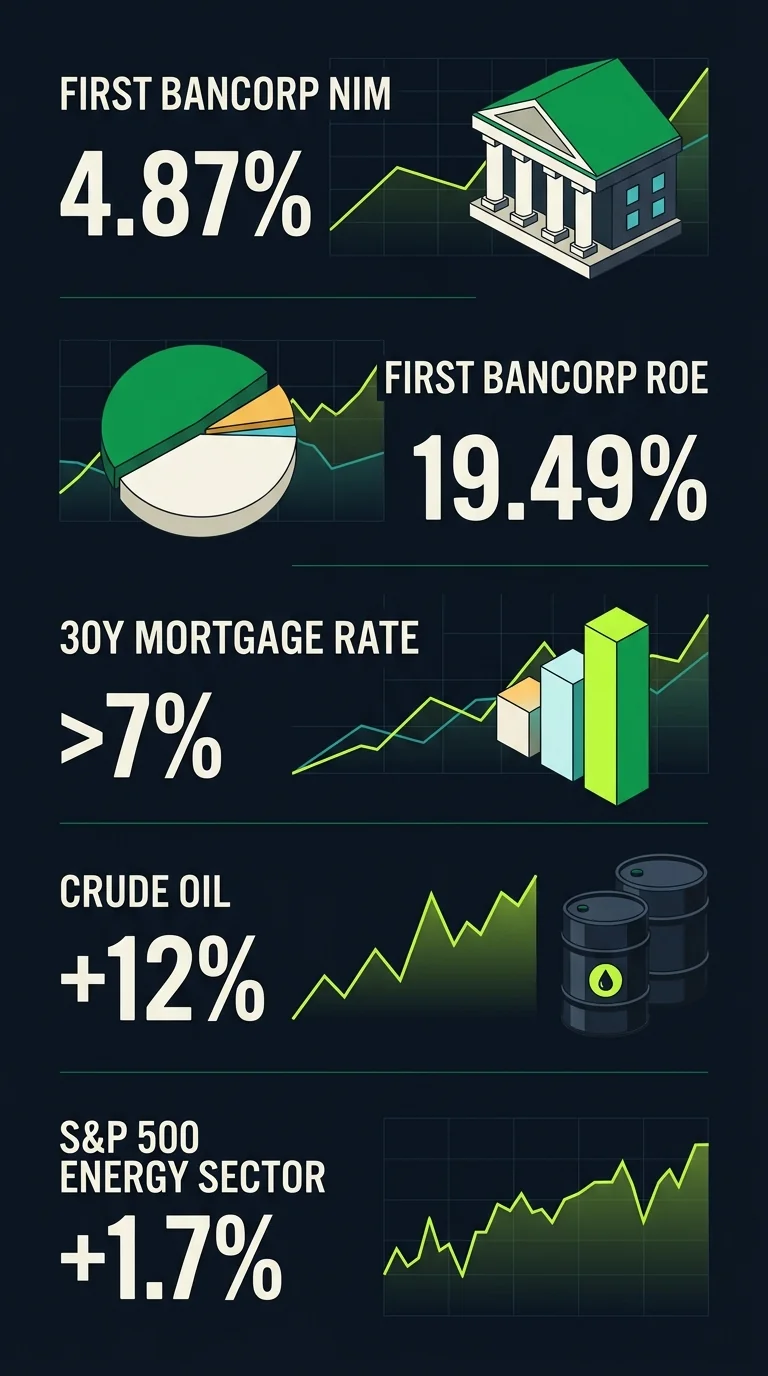
Core Summary: On September 10, 2026, US stocks showed a multi-threaded pattern of "high interest rates pressuring housing, oil prices lifting energy, bank profitability and valuation divergence coexisting, emerging market AI logic and active stock selection differences." First BanCorp demonstrated high earnings quality with a 4.87% net interest margin and 19.49% return on equity, but the 30-year mortgage rate exceeding 7% directly pressured homebuilders such as Toll Brothers, PulteGroup, and Hovnanian, with declines of 1.9% to 2.6%; the energy sector became the only positive-return sector in the S&P 500, rising 1.7%, driven by Brent and WTI crude oil rising about 12% this week. The above data come from Seeking Alpha and CNBC, respectively (as of September 10, 2026).
AI Summary
Core Viewpoint: US stocks on September 10, 2026 showed clear sector rotation and interest-rate sensitivity divergence. Bank stock First BanCorp's profitability indicators are strong but valuation divergence remains; housing stocks collectively under pressure as the 30-year fixed mortgage rate moved back above 7%; energy stocks were the only bright spot in the S&P 500; emerging markets showed both AI-driven Taiwan GDP upgrade and active fund underperformance versus benchmark.
Key Elements:
- First BanCorp's net interest margin improved to 4.87%, return on assets 2.02%, return on equity 19.49%.
- Daniel Jones maintained a "soft 'buy'" rating on First BanCorp, believing that although valuation multiples are high, fundamentals are strong.
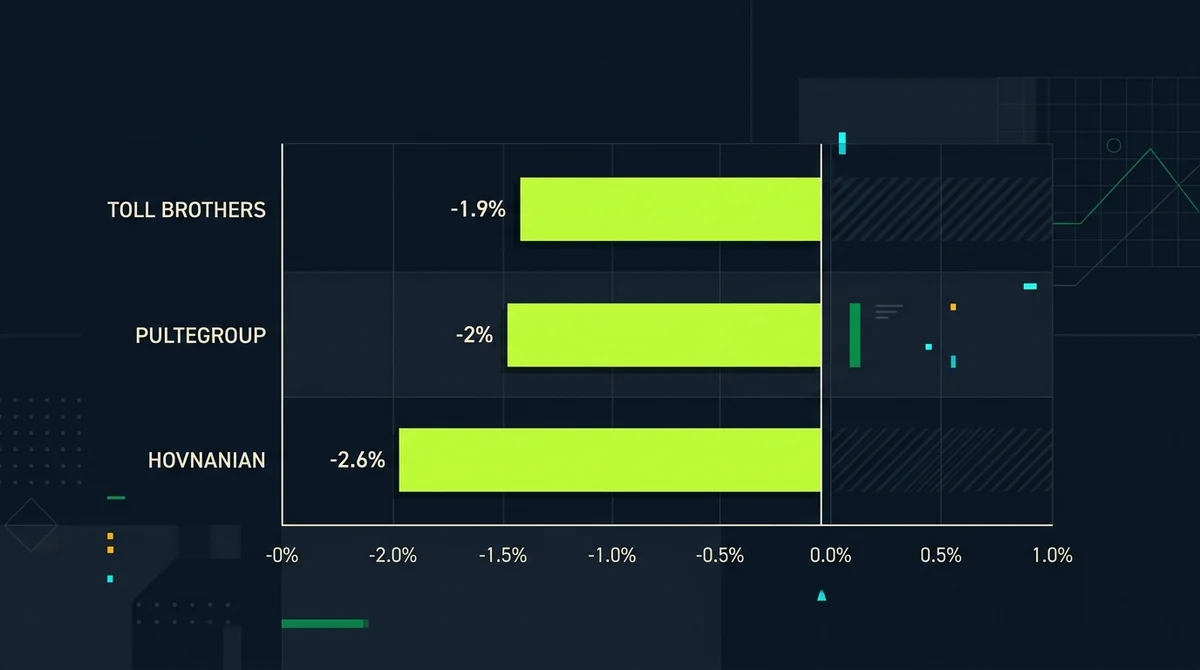
- The 30-year fixed mortgage rate exceeded 7% on Thursday; Toll Brothers fell 1.9%, PulteGroup fell 2%, Hovnanian fell 2.6%.
- Brent and WTI crude oil rose about 12% week to date, energy sector rose 1.7%, the only positive-return sector in the S&P 500.
- Taiwan's central bank raised its 2026 GDP growth forecast to 9.45% due to the AI boom.
- Hartford Emerging Markets Equity Fund (I share) underperformed the MSCI Emerging Markets Index in Q2, with overweight Yageo and underweight Alibaba as the top two relative contributors.
I. First BanCorp Net Interest Margin 4.87%: Divergence Between High Profitability Indicators and "Soft Buy" Rating
1. Net interest margin 4.87%, return on assets 2.02%, and return on equity 19.49% constitute the core fundamental evidence
First BanCorp's latest disclosed earnings quality indicators are at a high level among US regional banks. According to Seeking Alpha's report on September 10, 2026, the bank's net interest margin improved to 4.87%, return on assets was 2.02%, and return on equity was 19.49%. Together, these three figures paint a picture of a bank that simultaneously maintains strength in asset utilization efficiency, shareholder returns, and traditional deposit-loan spreads. Net interest margin is a forward-looking indicator of a bank's core profitability; 4.87% means that even in an environment of rising liability costs, First BanCorp can still maintain a relatively wide deposit-loan spread; return on equity of 19.49% significantly exceeds many peer banks, showing the thickness of its shareholder capital returns.
From the regional bank sector perspective, when the market has divergent views on the interest rate path, high net interest margin and high ROE are often seen as defensive characteristics. But there is an asymmetry here: strong profitability indicators do not necessarily mean cheap valuation. First BanCorp's stock price has already risen significantly before, so whether its high profitability data can continue to drive valuation expansion must be judged in combination with the interest rate environment, credit costs, and asset quality. It is worth noting that Seeking Alpha's factual source only provided ratio data and did not disclose the same-period non-performing loan ratio or provision coverage ratio; therefore, judgment on asset quality still needs to wait for more disclosures and cannot be linearly extrapolated from profitability ratios alone.
2. Daniel Jones maintains soft 'buy': high valuation but strong fundamentals, rating not downgraded due to rise
According to the same Seeking Alpha report, author Daniel Jones maintained a "soft 'buy'" rating on First BanCorp and believed that although valuation multiples are high, fundamentals are strong. This statement contains two layers of information: first, the analyst acknowledges that the stock price is no longer cheap, possibly meaning a narrowing safety margin; second, he did not mechanically downgrade the rating because of the rise, indicating that the earnings growth or relative valuation in his model can still support a moderately bullish stance.
For market participants, "soft 'buy'" is a signal worth unpacking. It is not a strong bullish view, but rather cautious optimism in the trade-off between "expensive but strong." Combined with First BanCorp's 4.87% net interest margin and 19.49% return on equity, fundamentals do provide a certain buffer; but if interest rates subsequently decline or the credit cycle turns, the sustainability of high profitability indicators will be tested. Our independent judgment: The market's divergence on First BanCorp is essentially a tug-of-war between "earnings quality" and "valuation safety margin." Investors should not focus only on a single rating, but should pay attention to the dynamic balance between net interest margin and non-performing loan ratio. Because the Seeking Alpha original text did not provide a target price or valuation multiple, any extension to a specific valuation level should be considered speculation.
II. 30-Year Mortgage Rate Exceeding 7%: Data Chain of Collective Pressure on Housing Stocks
1. 30-year fixed mortgage rate exceeds 7% on Thursday; Toll Brothers, PulteGroup, Hovnanian fall simultaneously
According to CNBC's report on September 10, 2026, the 30-year fixed mortgage rate exceeded 7% on Thursday. This key rate level directly touches the sensitive nerve of housing demand. In sync, Toll Brothers fell 1.9%, PulteGroup fell 2%, and Hovnanian fell 2.6%. All three companies are US homebuilders, and their stock prices are highly sensitive to mortgage rates: the higher the rate, the higher the monthly payment and financing cost for homebuyers, and new home sales and order growth are often suppressed.
The 30-year fixed mortgage rate exceeding 7% is not an isolated number; it is closely related to Fed policy expectations, long-term Treasury yields, and the supply-demand structure of the housing finance market. When the rate moves back above 7%, the market will reassess the housing sales momentum in the second half of 2026. Although the CNBC report did not give the direct driver of the rate increase, the collective decline of interest-rate-sensitive assets allows us to infer that the market is pricing in higher financing costs. The difference in declines among Toll Brothers, PulteGroup, and Hovnanian (1.9%-2.6%) may reflect differences in product positioning and regional exposure, but the overall direction is consistent: home purchase cost pressure is transmitting to builder stock prices.
2. Interest-rate-sensitive housing stocks decline 1.9% to 2.6%, reflecting home purchase cost pressure
Putting the three housing stock declines together, we can see a clear data chain: 30-year mortgage rate >7% → potential homebuyer burden increases → new home demand expectations weaken → builder stock prices under pressure. A decline of 1.9% to 2.6% is not extreme in a single day's market, but for interest-rate-sensitive sectors, this collective downward move indicates that the market is recalibrating earnings expectations for housing stocks.
It should be noted that the CNBC report only provided rate and decline data, and did not provide further evidence such as intraday trading volume, short interest ratio, or builder order guidance. Therefore, we cannot assert that this is the beginning of a trend decline; it can only be said to be a concentrated manifestation of interest rate pressure. Independent researcher perspective: In an environment where the probability of Fed rate hikes and long-term rates fluctuate simultaneously, housing stocks may continue to serve as a "barometer" of interest rate expectations. If the 30-year mortgage rate remains above 7% for a sustained period, builder order growth and gross margin in the second half of the year will face greater uncertainty; conversely, if rates fall back, the sector may experience an oversold rebound. This article does not provide trading advice, only records the data chain and logical relationships.
III. Energy Sector Stands Alone: Crude Oil Weekly Gain of About 12% Pushes S&P 500's Only Positive-Return Sector
1. Brent and WTI up about 12% week to date, energy sector rises 1.7%
According to CNBC's report on September 10, 2026, Brent and WTI crude oil rose about 12% week to date. Driven by the sharp rise in crude oil prices, the energy sector rose 1.7% that day, becoming the only sector in the S&P 500 index to record a positive return. This "only" has important structural implications: when the overall market is diverging due to interest rate and valuation pressures, energy stocks, supported by rising commodity prices, have obtained risk appetite independent of the broad market.
A weekly gain of about 12% in crude oil is a fairly violent short-term fluctuation, which may be related to supply-side disturbances, geopolitical risks, or changes in demand expectations. However, the CNBC report did not specify the specific trigger for the oil price increase, so we can only confirm the price momentum itself, not attribute it to specific events. The energy sector's 1.7% increase is significantly smaller than crude oil's 12% weekly gain, which is not contradictory: equity markets often price in commodity price changes in advance, and energy company stock prices are also affected by capital expenditure discipline, production expectations, and valuation constraints.
2. Only the energy sector in the S&P 500 has positive returns, highlighting oil price-driven structural divergence
The fact that only the energy sector in the S&P 500 has positive returns reveals the current market's lack of breadth. When crude oil becomes one of the few upward drivers, the overall index may be supported by energy weight, but adjustment pressure in other sectors has not disappeared. For example, the housing stocks mentioned above and the emerging market fund performance discussed later both show rapid switching of funds between different logics.
From a structural perspective, rising oil prices are directly positive for energy stocks, but may create cost pressure on downstream industries such as aviation, chemicals, and consumer goods. The divergence within the S&P 500 is therefore not only a statistical phenomenon of sector gains and losses, but also a macro signal: the commodity cycle and the interest rate cycle are simultaneously acting on the market, and the market has not yet formed a consensus direction. Our independent judgment: If crude oil prices remain strong, the energy sector may continue to provide relative returns, but index gains supported by a single sector often lack sustainability; if oil prices fall back, the S&P 500 may lose its most important current source of positive returns. The above are all fact-based inferences and do not constitute price predictions.
IV. Emerging Market Divergence: Taiwan GDP Forecast Raised to 9.45% and Hartford Fund Underperforming MSCI
1. Taiwan's central bank raises 2026 GDP growth forecast to 9.45% due to AI boom
According to the Hartford Emerging Markets Fund commentary cited by Seeking Alpha on September 10, 2026, Taiwan's central bank raised its 2026 GDP growth forecast to 9.45% due to the AI boom. This figure is very prominent among major economies worldwide, directly reflecting the pull effect of AI hardware and semiconductor supply chain on Taiwan's economy. As a key node in global advanced process and AI computing power supply, the significant upward revision of Taiwan's GDP forecast indicates that AI capital expenditure is transforming into real economic growth.
It is worth noting that this information appeared in the second-quarter commentary of the Hartford Emerging Markets Equity Fund, not a separate press release from Taiwan's central bank, so its wording may reflect the fund's interpretive perspective. But the forecast value of 9.45% itself is clear data that can be cited. This upward revision forms an interesting contrast with the fund's underperformance versus MSCI discussed later: Taiwan's AI boom is strong, but active funds did not thereby obtain excess returns in emerging market stock selection.
2. Hartford Emerging Markets Equity Fund underperforms MSCI Emerging Markets Index in Q2, overweight Yageo and underweight Alibaba are top two relative contributors
According to the same Seeking Alpha report, the Hartford Emerging Markets Equity Fund (I share) underperformed the MSCI Emerging Markets Index in the second quarter, with security selection being one reason for relative underperformance; overweight Yageo and underweight Alibaba were the top two relative contributors. Here "top two relative contributors" needs careful understanding: against the background of the fund underperforming the benchmark, these two allocation decisions had the greatest impact on relative returns—overweight Yageo may have dragged down the portfolio due to the stock's poor performance, while underweight Alibaba may have missed its rise, together causing relative lag.
This case reveals the dual difficulty of active management in emerging markets: even if the macro judgment is correct (such as Taiwan's AI boom), micro-level stock selection may still underperform the benchmark. As a passive component supplier, Yageo's performance may be affected by inventory cycles or valuation; Alibaba may have received capital inflows due to AI or e-commerce logic. The fund's underweight in Alibaba at least shows that its weight allocation to Chinese internet platform stocks differs from the benchmark, which ultimately reflected in relative returns. Independent researcher perspective: Taiwan's GDP upgrade and Hartford Fund's underperformance are not contradictory; the former is AI-driven growth at the macro level, while the latter reflects uncertainty in micro stock selection. When comparing active funds, investors should not only look at a single quarter's relative contributions, but should focus on whether long-term excess return sources are stable.
In Closing
On September 10, 2026, U.S. stocks presented a multi-threaded pattern in which high interest rates pressured housing, oil prices lifted energy, bank profitability and valuation divergence coexisted, and emerging market AI logic and active stock selection differences intersected. First BanCorp proved with its 4.87% net interest margin that regional banks' profitability remains strong, but analysts remain cautious between "expensive but strong"; the 30-year mortgage rate exceeding 7% put Toll Brothers, PulteGroup, and Hovnanian under collective pressure, showing the fragility of interest-rate-sensitive assets; the energy sector became the only positive return in the S&P 500 on the back of crude oil's roughly 12% weekly gain, highlighting short-term support from the commodity cycle; and Taiwan's GDP forecast upgrade and Hartford Fund's underperformance versus MSCI show that AI boom may not directly translate into active funds' relative returns.
The market's core contradiction lies in the balance between the pressure of high interest rates on interest-rate-sensitive assets and the commodity cycle/earnings resilience. The simultaneous rise in mortgage rates and energy prices suggests that Fed policy, inflation expectations, and supply disturbances are creating tension across different asset classes. This tension will not disappear because of a single sector's rise; instead it may exacerbate structural volatility in the market. For observers, it is more important to understand the driving chain behind each sector than to chase a single up-down label.
Risk Warning: Macroeconomic and U.S. stock market fluctuations are violent. The content of this article is for OKX Radar research observation reference only and does not constitute any investment advice.
Risk Warning: Crypto/digital asset prices are highly volatile, and information and rules may change at any time. This article does not constitute investment, legal, or tax advice. Decisions should be based on the latest official announcements and actual product pages.
Investing AI RWA Finance
References and verification links
These are the article-level sources stored with this page. Interpret dynamic facts and rules in light of their dates, regions, and subsequent updates.
FAQ
What are First BanCorp's latest net interest margin and return on equity? ▼
As of September 10, 2026, First BanCorp's net interest margin was 4.87%, return on assets was 2.02%, and return on equity was 19.49%.
What is Daniel Jones' rating on First BanCorp? ▼
Daniel Jones maintains a 'soft buy' rating, believing that although the valuation is high, fundamentals remain strong.
Which housing stocks fell after the 30-year mortgage rate exceeded 7%? ▼
Toll Brothers fell 1.9%, PulteGroup fell 2%, and Hovnanian fell 2.6%.
What was the only positive-return sector in the S&P 500? ▼
The energy sector, which rose 1.7%, driven by Brent and WTI crude oil rising about 12% for the week.
Why did Taiwan's central bank raise its 2026 GDP forecast? ▼
Due to the AI boom, Taiwan's central bank raised its 2026 GDP growth forecast to 9.45%.
How did the Hartford Emerging Markets Fund perform in the second quarter? ▼
It underperformed the MSCI Emerging Markets Index; overweight Yageo and underweight Alibaba were the top two relative contributors.