OKX Radar US Stocks Daily Watch: Broadcom: Q3 Results Beat Expectations, CEO Expects AI Revenue to Double to $115 Billion
On Sep 3, 2026, Broadcom Q3 EPS of $3.32 and revenue of $29.59B beat LSEG consensus; CEO sees FY2027 AI revenue doubling to $115B, but Q4 guidance missed.

Article Citation Summary
On Sep 3, 2026, Broadcom Q3 EPS of $3.32 and revenue of $29.59B beat LSEG consensus; CEO sees FY2027 AI revenue doubling to $115B, but Q4 guidance missed.
OKX Radar Editorial @OKXRadar September 3, 2026 This article is about 4,800 Chinese characters and takes approximately 12 minutes to read.
Broadcom's fiscal third-quarter report reinforced the AI chip narrative with better-than-expected earnings and revenue, but it also exposed a gap between long-term targets and short-term guidance. Management set aggressive targets of AI revenue doubling to $115 billion in fiscal 2027 and doubling again to $230 billion in fiscal 2028, while next quarter's revenue guidance came in below consensus. This tension between long-term doubling and short-term pacing is key to understanding the report.
AI Summary Core view: Broadcom's fiscal Q3 adjusted EPS and revenue both exceeded LSEG consensus expectations. CEO Hock Tan outlined long-term targets for AI revenue to double to $115 billion in fiscal 2027 and double again to $230 billion in fiscal 2028. However, fiscal Q4 revenue guidance came in below analyst expectations, suggesting that near-term revenue release may face pressure. Key elements:
- Broadcom's fiscal Q3 adjusted EPS was $3.32, above the LSEG consensus estimate of $3.24.
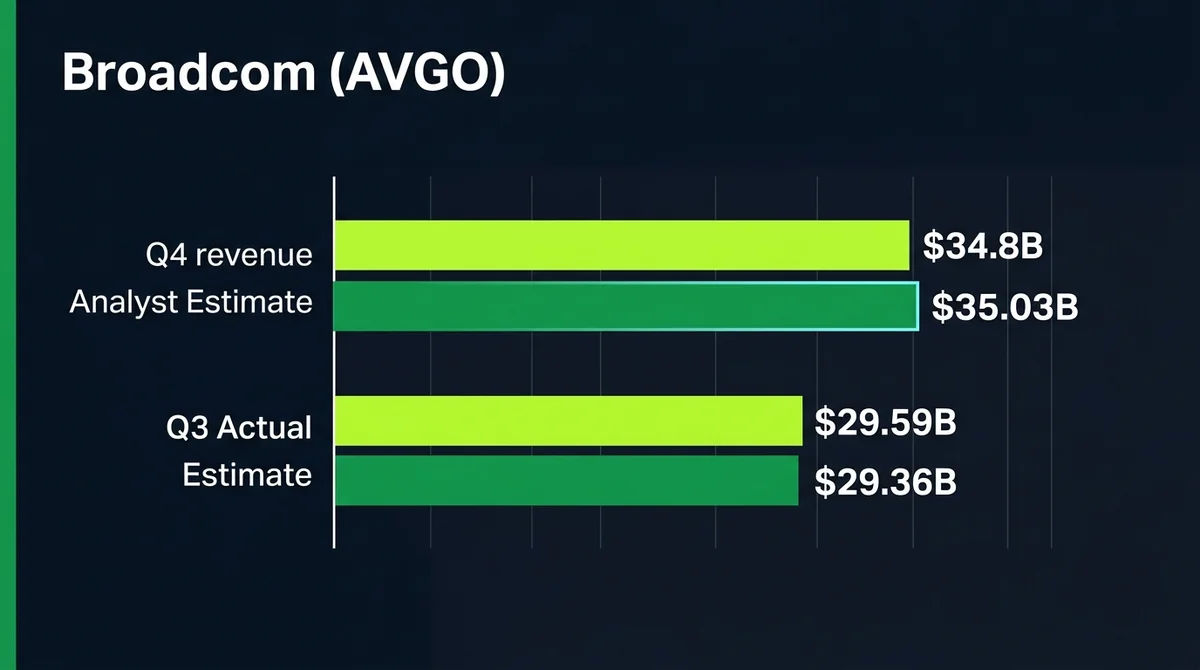
- Broadcom's fiscal Q3 revenue was $29.59 billion, above the LSEG consensus estimate of $29.36 billion.
- Broadcom CEO Hock Tan said the company expects fiscal 2027 AI revenue to double to $115 billion and fiscal 2028 AI revenue to double again to $230 billion.
- Broadcom's fiscal Q3 semiconductor revenue grew more than twofold to $16.7 billion, while infrastructure software revenue was $8.75 billion, slightly below analyst expectations of $8.82 billion.
- Broadcom said OpenAI is preparing tape-out of its second-generation chip and is working with Broadcom to plan a third-generation chip.
- Broadcom expects fiscal Q4 revenue of $34.8 billion, below analyst expectations of $35.03 billion.
Key Data Comparison Table for This Earnings Report
| Metric | Actual / Guidance | Analyst Expectation / Consensus | Comparison |
|---|---|---|---|
| Fiscal Q3 adjusted EPS | $3.32 | $3.24 (LSEG consensus) | Above expectations |
| Fiscal Q3 total revenue | $29.59 billion | $29.36 billion (LSEG consensus) | Above expectations |
| Semiconductor revenue | $16.7 billion | - | Grew more than twofold |
| Infrastructure software revenue | $8.75 billion | $8.82 billion | Slightly below expectations |
| Fiscal Q4 revenue guidance | $34.8 billion | $35.03 billion | Below expectations |
1. Q3 Results Beat Expectations on Both Earnings and Revenue: Adjusted EPS of $3.32 and Revenue of $29.59 Billion Outperform LSEG Consensus
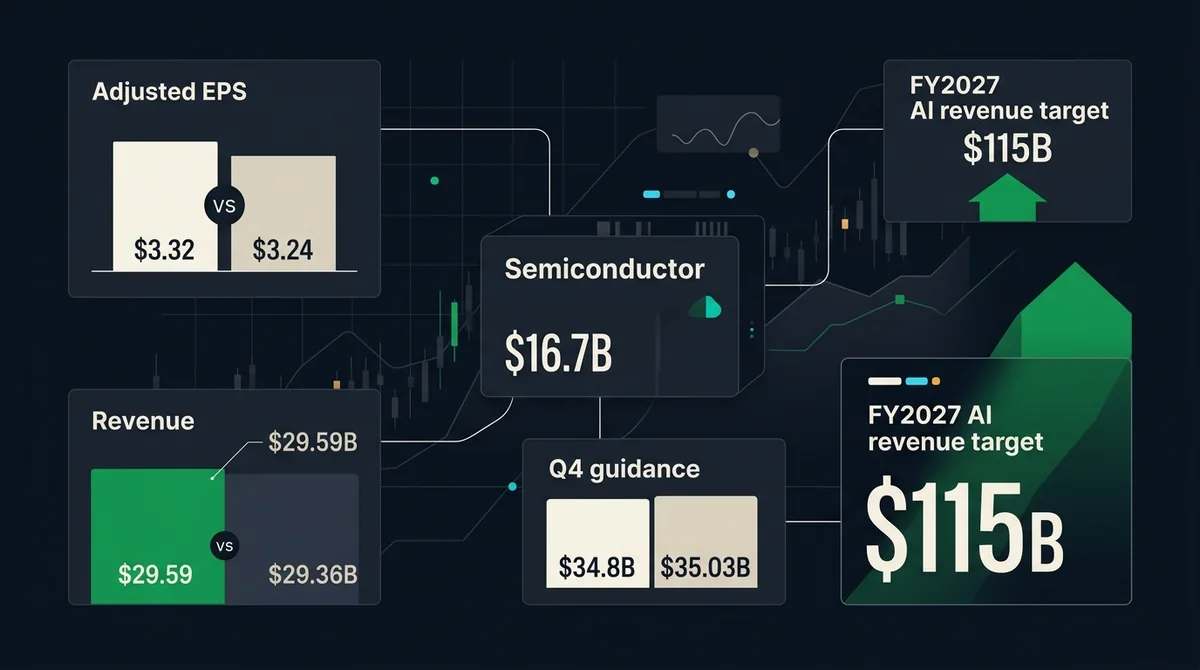
From the realized data for the quarter, Broadcom delivered earnings and revenue that both beat expectations. Adjusted EPS and revenue were both above LSEG consensus. Although the beats were modest, considering that the AI infrastructure segment where the company operates is experiencing large-scale customer orders, this result essentially confirms the conversion of order visibility into financial data. The contrast between long-term targets and short-term guidance discussed in the next section is built on this better-than-expected foundation.
1. Adjusted EPS of $3.32 Surpasses LSEG Consensus of $3.24
CNBC disclosed in its earnings coverage on September 3, 2026, that Broadcom's fiscal third-quarter adjusted EPS was $3.32, above the LSEG consensus estimate of $3.24. The magnitude of the beat was not dramatic, but as a core AI infrastructure supplier, Broadcom's ability to repeatedly outperform sell-side consensus confirms that investment from major cloud providers and AI training clusters continues to convert into orders. The EPS beat came mainly from the quality of revenue growth rather than one-time items, providing relatively solid fundamental support.
From a profitability standpoint, $3.32 corresponds to an already realized and publicly disclosed financial result. The difference between this figure and expectations is often used by traders as a short-term pricing anchor. Broadcom's EPS beat suggests that the market may have been too conservative in pricing the spillover effects of AI capex. If AI revenue can be released in line with management's targets over the next few quarters, the upward elasticity of EPS could further open up; but if the near-term pace suggested by Q4 guidance is weak, the positive signal from this EPS beat could be partially offset. For investors, the quality of quarterly EPS matters more than the beat size, because it indicates the profit source is improved revenue structure rather than cost compression.
2. Revenue of $29.59 Billion Surpasses LSEG Consensus of $29.36 Billion
The same report showed that Broadcom's fiscal third-quarter revenue was $29.59 billion, above the LSEG consensus estimate of $29.36 billion. The revenue beat was also modest, but against the backdrop of overall semiconductor industry inventory adjustments and demand fluctuations in some end markets, this result means that Broadcom's AI-related orders are supporting the overall revenue base and preventing any single business line weakness from stalling growth. The absolute size of $29.59 billion also indicates the company is approaching an annualized revenue run rate of more than $100 billion.
For the market, the significance of the revenue beat extends beyond the current quarter: it validates the scaling logic of AI networking chips, custom ASICs and other businesses. Broadcom management chose this moment to set targets for AI revenue doubling over the next two fiscal years, most likely based on current customer orders and project visibility. The fiscal Q3 revenue beat provides timely short-term data support for this long-term narrative. However, the modest margin of the revenue beat also means the market will not overlook the weak next-quarter guidance. Overall, the revenue size of $29.59 billion and the direction of the beat provide a reasonable starting point for discussing the long-term AI targets later.
2. AI Revenue Doubling Target: CEO Expects $115 Billion in Fiscal 2027 and $230 Billion in Fiscal 2028
What really sparked market discussion this time was not the single-quarter performance itself, but the CEO's doubling targets for AI revenue over the next two fiscal years. In an environment where AI capital spending remains highly active, management's willingness to be so specific about long-term numbers carries strong signaling value. It reflects both predictable customer orders and the fact that Broadcom must deliver in subsequent quarters to honor this optimism.
1. Hock Tan Expects Fiscal 2027 AI Revenue to Double to $115 Billion
CNBC quoted Broadcom CEO Hock Tan as saying the company expects fiscal 2027 AI revenue to double to $115 billion. If this target is achieved, Broadcom's AI-related revenue will reach a very high base within the next two fiscal years and will likely become the largest segment of overall revenue structure. Hock Tan's decision to provide such a specific number during earnings communications is itself a signal of management's confidence in AI demand.
It is worth noting that $115 billion is a future fiscal-year target, not a realized financial figure for the current quarter. It may be based on hyperscale cloud providers' procurement plans, custom AI chip customer projects, and order visibility for networking interconnect products. If these assumptions change, the target may be adjusted. But from a narrative perspective, this number is striking enough to explain why the market assigned greater weight to Broadcom's long-term story after the report. In other words, management is actively raising the market's expectation anchor for the AI business.
2. Fiscal 2028 AI Revenue Doubles Again to $230 Billion
Building on the $115 billion target for fiscal 2027, Hock Tan further expects fiscal 2028 AI revenue to double again to $230 billion. Consecutive doubling targets for two fiscal years mean the AI business must sustain an extremely high compound growth rate and continuously secure new orders and capacity support. A figure of $230 billion exceeds the full-year revenue of many semiconductor peers, so the market's reaction to this number is more about validating whether Broadcom's position in AI infrastructure is deep enough.
Logically, such consecutive doubling targets are often directly tied to large custom chip projects from major customers. If Broadcom can play a key role in next-generation chip projects for customers like OpenAI, its ASIC design, advanced packaging and networking chip businesses could gain a more certain revenue path. However, future fiscal-year targets are management expectations; actual delivery still depends on customer project production schedules and end demand. Investors should distinguish the credibility of "targets" from "realized performance." The more aggressive the long-term targets, the higher the market's sensitivity to near-term guidance, because any pace falling short of expectations could be interpreted as insufficient delivery capability.
3. Semiconductor Revenue Grew More Than Twofold to $16.7 Billion, OpenAI Partnership Plans Next-Generation Chips
Breaking down the business structure, Broadcom's growth is highly concentrated in the semiconductor segment, while the software segment is relatively muted. The semiconductor surge and the advancement of the OpenAI custom chip partnership form the core support for long-term AI targets; the slight miss in software serves as a reminder that not all segments are enjoying the AI dividend equally.
1. Fiscal Q3 Semiconductor Revenue Grew More Than Twofold to $16.7 Billion
CNBC reported that Broadcom's fiscal third-quarter semiconductor revenue grew more than twofold to $16.7 billion. This growth rate is very prominent against the backdrop of slowing overall semiconductor industry growth, indicating that AI-related chip demand has become the absolute engine of company growth. The jump in semiconductor revenue to $16.7 billion from a low base in the same quarter last fiscal year likely reflects concentrated shipments of custom AI chips, switching chips and optical devices, whose customers are typically large-scale AI infrastructure investors.
Semiconductor revenue growing more than twofold also explains why Broadcom has confidence in setting AI revenue doubling targets. However, such high growth may be influenced by the pace of specific customer projects and is not necessarily linearly extrapolatable. If major customer projects enter a gap period, semiconductor revenue growth could decline; but if new projects such as OpenAI proceed as planned, the high base of $16.7 billion may continue to rise. Therefore, this $16.7 billion is both a highlight of the current quarter and a practical constraint after the year-over-year base is significantly raised.
2. Infrastructure Software Revenue of $8.75 Billion Slightly Missed Analyst Expectations of $8.82 Billion
In contrast to the high growth in semiconductor business, Broadcom's fiscal Q3 infrastructure software revenue was $8.75 billion, slightly below analyst expectations of $8.82 billion. This shortfall is small, but it shows that Broadcom's software business did not keep pace with the semiconductor surge, and growth within the overall structure is divided. Infrastructure software usually includes enterprise products such as VMware, whose revenue is relatively stable but short-term growth may be affected by licensing models and customer procurement cycles.
For the market, the slight miss in software does not change the AI narrative, but it reminds investors that if Broadcom's valuation is mainly driven by AI semiconductors, the tepid software performance could become a drag on overall earnings consistency. If software continues to slightly miss over the next few quarters, the market's assumption that Broadcom is a comprehensive AI beneficiary may need revision; if it is only quarterly fluctuation, the impact is limited. In the current AI-dominated phase, the small gap between $8.75 billion and expectations is not enough to change direction, but it at least shows that the quality of internal growth is not completely balanced.
3. OpenAI Second-Generation Chip Tape-Out Underway, Third-Generation Cooperation Planning Advances
Broadcom also stated in this earnings communication that OpenAI is preparing tape-out of its second-generation chip and is working with Broadcom to plan a third-generation chip. Tape-out is a key milestone for a chip design entering the fabrication stage, meaning OpenAI's custom chip project has moved from design to manufacturing verification, and Broadcom as a partner will earn actual revenue contributions in back-end implementation and packaging. The advancement of third-generation cooperation planning further extends the predictability of the partnership.
The value of this information is that it turns Broadcom's AI custom ASIC story from mere rumor into project progress with clear milestones. OpenAI, as one of the most aggressive demand drivers for AI compute, is deeply tied to Broadcom, which may bring sustained design service revenue and post-production chip revenue. However, tape-out is still some distance from high-volume shipment, so near-term financial contributions may be limited, and the larger effect is boosting confidence in the long-term targets for fiscal 2027-2028. In other words, the OpenAI partnership progress is the order foundation for long-term targets, but scaled revenue recognition is not yet visible in near-term financials.
4. Q4 Guidance Falls Short: Revenue Guidance of $34.8 Billion Below Analyst Expectations of $35.03 Billion
Just as the market was digesting the AI revenue doubling target, Broadcom's next-quarter guidance landed below analyst expectations. This combination tends to create divergence: bulls lean toward believing the long-term targets, while bears focus on weak near-term guidance. The key to understanding this contrast is determining whether the Q4 revenue shortfall is a pacing issue or a trend issue.
1. Q4 Revenue Guidance of $34.8 Billion Below Analyst Expectations of $35.03 Billion
CNBC also reported that Broadcom expects fiscal Q4 revenue of $34.8 billion, below analyst expectations of $35.03 billion. This guidance miss is not large, but it appeared in the same earnings report where management set long-term AI revenue doubling targets, creating a clear expectations gap. The market may interpret this as meaning that although the long-term narrative is very strong, near-term revenue release is not yet keeping pace, and there is still uncertainty for the next quarter.
Possible reasons for this weak near-term guidance include some customer projects being deferred from the current quarter, seasonal decline in software business, or AI chip shipment pacing not fully aligned. If actual Q4 revenue ultimately comes in above guidance, then this guidance may simply be management's conservative expectation; if actual revenue falls in line with guidance and below sell-side models, the stock could face short-term pressure. The gap between Broadcom's long-term targets and short-term guidance is effectively testing the market's patience with the AI narrative. The more vividly management paints a long-term doubling picture, the more demanding the market becomes about quarterly actual delivery.
Final Thoughts
Broadcom's earnings report presented a typical "strong long-term, weak short-term" combination: fiscal Q3 earnings and revenue both beat expectations, semiconductor revenue grew more than twofold to $16.7 billion, and the CEO set targets for AI revenue to double in each of the next two fiscal years. At the same time, fiscal Q4 revenue guidance came in below analyst expectations, and software revenue also slightly missed. This structure shows that order visibility for custom AI chips is translating into long-term targets, but near-term revenue release remains constrained by the pace of customer projects.
From a broader macro signal perspective, Broadcom's AI doubling targets are not just company-level optimism; they reflect that the entire AI infrastructure supply chain continues to transmit strong demand signals upstream. If next-generation chips from customers like OpenAI proceed as planned, Broadcom's ASIC business could enter a multi-year cycle of exponentially expanding revenue scale; but if AI capital spending slows in stages, growth could decelerate from a high base. The weak near-term guidance serves as a warning against linear extrapolation of this long-term narrative. For US equities AI trades, the Broadcom case provides an important reference: when long-term targets are grand enough, any near-term guidance miss deserves serious scrutiny rather than being simply ignored.
Risk Disclaimer: Macroeconomic and US stock market fluctuations are severe. This content is for OKX Radar research and observation reference only and does not constitute investment advice.
Investment, AI, RWA
References and verification links
These are the article-level sources stored with this page. Interpret dynamic facts and rules in light of their dates, regions, and subsequent updates.
FAQ
What was Broadcom's fiscal Q3 adjusted EPS? ▼
Broadcom's fiscal third-quarter adjusted EPS was $3.32, above the LSEG consensus estimate of $3.24.
How did Broadcom's fiscal Q3 total revenue perform? ▼
Broadcom's fiscal Q3 revenue was $29.59 billion, above the LSEG consensus estimate of $29.36 billion