OKX Radar US Stocks Daily Watch: KPN, Wells Fargo, and Aker BP: KPN's 2027 Guidance Implies €1.1 Billion Free Cash Flow and €0.25 Dividend, Wells Fargo Q3 EPS Beats While Revenue Misses, Aker BP Downgraded to Hold
Seeking Alpha reports KPN 2027 guidance implies ~€1.1B FCF, €0.25 dividend; Wells Fargo Q3 EPS beat, revenue miss; Aker BP downgraded to hold on demand risk.

Article Citation Summary
Seeking Alpha reports KPN 2027 guidance implies ~€1.1B FCF, €0.25 dividend; Wells Fargo Q3 EPS beat, revenue miss; Aker BP downgraded to hold on demand risk.
1. KPN 2027 Guidance: The Intersection of 20% Capex Reduction and a €0.25 Dividend Target
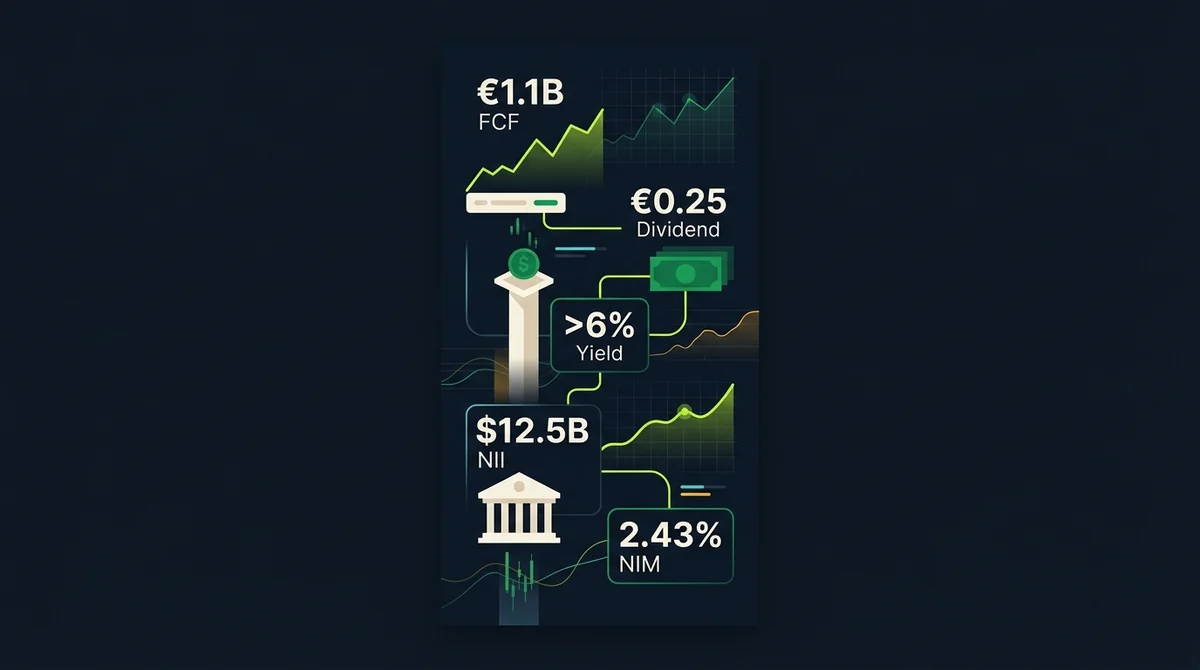
1. A 20% capital expenditure reduction and 7% free cash flow CAGR form the 2027 target mix
According to a Seeking Alpha article published at 10:40 EDT on October 18, 2026, KPN aims to cut capital expenditures by 20% by 2027, while achieving a 3% compound annual growth rate (CAGR) in revenue and EBITDAaL and a 7% CAGR in free cash flow. Cutting capital expenditures is one important path for telecom companies to improve free cash flow; when revenue and EBITDAaL maintain a 3% CAGR, a 20% decline in capital expenditures can release more distributable cash, but this path holds only if network investment efficiency improves rather than sacrificing coverage quality. Existing public reports do not mention the specific business lines or the capital expenditure base for the reduction, so it is impossible to determine whether the reduction stems from adjustments to 5G or fiber buildout pace, or whether the guidance includes deferred investment or accounting standard changes; for readers, this is a long-term target rather than realized performance.
From an observational perspective, the relationship between capital expenditure reduction and 7% free cash flow CAGR is not simply linear. If KPN can maintain 3% revenue and EBITDAaL CAGR through 2027 while capital expenditures fall sharply, free cash flow growth may exceed revenue growth; this combination supports shareholder returns. However, EBITDAaL is a commonly used profitability metric in the telecom industry, covering profit after deducting depreciation, amortization, and lease costs, but the source_facts do not provide details on the calculation method, and public materials have not confirmed the EBITDAaL calculation in this guidance. Therefore, this article only presents '20% capital expenditure reduction,' '3% revenue and EBITDAaL CAGR,' and '7% free cash flow CAGR' as the company's announced target mix side by side, without inferring causality or linking the guidance to stock price movements.
2. Shareholder return calculation implied by approximately €1.1 billion free cash flow and €0.25 per share dividend
According to Seeking Alpha, KPN's 2027 guidance implies approximately €1.1 billion in free cash flow and a dividend of €0.25 per share. This set of figures provides a reproducible clue: if 2027 free cash flow is approximately €1.1 billion and the dividend is €0.25 per share, one could roughly calculate coverage by combining with total shares outstanding. However, source_facts do not provide total shares outstanding or payout ratio, so calculation is not possible; readers should refer to the original article.
From an industry comparison perspective, European telecom companies' dividend policies typically balance free cash flow coverage with debt discipline. KPN's dividend target of €0.25 per share, if based on the current price, would yield more than 6%, indicating that the market's pricing of its 'bond-like' characteristics may be relatively mild. However, the 'current price' is not given a specific value in the source_facts, so the 6% is the result calculated by the original article based on the price at that time; readers reviewing this later should note that the price has changed. If the price rises in the future, the dividend yield implied by the same dividend will fall; if the price falls, the yield will rise accordingly, but this inverse relationship is only a mathematical convention and does not imply an increase in investment value or a decrease in risk.
3. Valuation implications of a dividend yield exceeding 6% at current prices
According to Seeking Alpha, the €0.25 per share dividend implied by KPN's 2027 guidance would yield more than 6% at the current price. If realized, this level would be significantly higher than most European government bond yields and the average dividend yield of the global telecom sector, potentially attracting capital seeking stable cash returns. However, it must be emphasized that a dividend yield above 6% may simultaneously reflect the market's discount for telecom companies' growth prospects, regulatory costs, and network competitive capital expenditures; a high dividend does not mean risk-free income. Investors should not infer that KPN is undervalued solely from the dividend yield figure, because source_facts do not provide the price-to-earnings ratio, enterprise value, or free cash flow yield corresponding to the current stock price.
For the US Stocks Daily Watch, KPN is not a US-listed stock, but as a European telecom operator, its 2027 guidance provides a sample of 'capital expenditure contraction – free cash flow expansion – dividend return uplift' that can be compared with the pricing logic of current-quarter US bank stocks and oil and gas stocks. If KPN can disclose capital expenditure and free cash flow data consistent with the guidance in subsequent quarters, the dividend narrative may be further validated; if capex reduction lags or EBITDAaL growth falls short, the safety margin corresponding to the 6% dividend yield may be re-evaluated by the market. This comparison does not imply a direct linkage between US and European equities, but merely offers an observational perspective on different stable-return assets within the day's global economic cycle.
2. Wells Fargo Q3 Earnings: Divergence Between EPS Beat and Revenue Miss
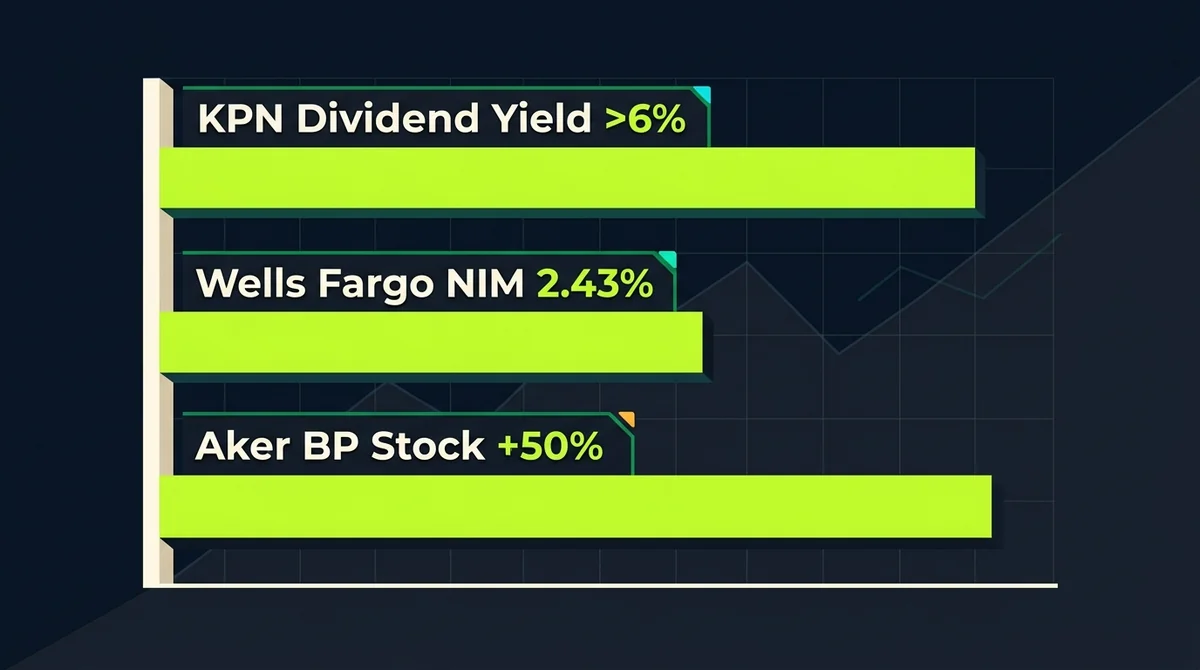
According to a Seeking Alpha article published at 10:11 EDT on October 18, 2026, Wells Fargo's third-quarter earnings per share beat expectations while revenue missed, and the stock was roughly flat for the week. This combination of 'EPS beat, revenue miss' shows that positive earnings surprises can coexist with soft revenue; during earnings season, investors need to break down consensus metrics rather than focusing only on a single beat signal.
Looking at specific data, according to Seeking Alpha, Wells Fargo's third-quarter net interest income increased by $200 million quarter-over-quarter to $12.5 billion, with a net interest margin of 2.43%, loans up 1.7% quarter-over-quarter and 11% year-over-year, and a loan-to-deposit ratio of 69%. Existing public information does not disclose the specific magnitude of the revenue miss, so OKX Radar verification cannot judge the extent to which the revenue shortfall offsets the net interest margin improvement. The quarter-over-quarter increase in net interest income stems from changes in loans, the loan-to-deposit ratio, and other metrics, but it cannot be directly inferred that net interest margin will continue to improve; attention must still be paid to deposit costs and loan pricing pace.
3. Aker BP Rating Downgrade: Recession and Demand-Destruction Risk
According to a Seeking Alpha article published at 09:25 EDT on October 18, 2026, Aker BP focuses on North Sea oil, the stock price has risen about 50% since the previous article, and the author downgraded the rating to Hold due to recession and demand-destruction risk. The original article did not disclose the institution, target price, or specific time window for the downgrade, so OKX Radar only relays the original text and cannot re-verify the rating basis.
A stock price increase driven by rising oil prices does not mean the valuation ceiling rises in tandem. If recession and demand-destruction risks materialize, cash flow expectations for oil equities may be suppressed, limiting further valuation expansion. This downgrade reminds investors that cyclical tail risks in commodity equities should not be ignored merely because of short-term stock price strength.
4. Cross-Company Comparison and the Logic of Individual Stock Divergence in US Earnings Season
1. KPN's defensive dividend characteristics versus Wells Fargo's net interest margin cycle and Aker BP's oil price elasticity
The three companies fall into different macro pricing frameworks. KPN's 2027 guidance centers on a 20% capital expenditure reduction, 7% free cash flow CAGR, and a €0.25 per share dividend, presenting typical defensive dividend characteristics; according to Seeking Alpha, its implied free cash flow is approximately €1.1 billion. Wells Fargo's third quarter reflects divergence in earnings quality within cyclical stocks: according to Seeking Alpha, EPS beat expectations while revenue missed, net interest income rose $200 million quarter-over-quarter to $12.5 billion, net interest margin was 2.43%, loans grew 1.7% quarter-over-quarter and 11% year-over-year, and the loan-to-deposit ratio was 69%. Aker BP is a vehicle for oil price elasticity: according to Seeking Alpha, the company focuses on North Sea oil, the stock price has risen about 50% since the previous article, and the author downgraded the rating to Hold due to recession and demand-destruction risk.
The significance of this comparison is not to predict direction but to identify how the current market balances 'certainty premium' and 'risk discount.' KPN's dividend target offers predictable cash returns, Wells Fargo's earnings show that net interest income remains solid but revenue growth is insufficient, and Aker BP's rating downgrade highlights the asymmetric risk of the oil price cycle. Together they form a sample of individual stock divergence in the day's US stock observation: not all rises or falls stem from the same logic, and the three analyses published close in time should not be simply linked into a causal chain. Wells Fargo's 'EPS beat, revenue miss' combination also shows that positive earnings surprises can coexist with soft revenue; during earnings season, investors need to break down consensus metrics rather than focusing only on a single beat signal.
2. Cross-source comparison of the three source facts and a checklist of reproducible metrics
All three sets of facts come from Seeking Alpha, with the same publication date of October 18, 2026, but publication times of 10:40, 10:11, and 09:25 EDT respectively. This commonality provides traceability, but the three articles are analyses by different authors on different subjects, and one cannot infer causal relationships between events simply because of temporal proximity. From a reproducible metrics standpoint: KPN's 2027 free cash flow of approximately €1.1 billion and dividend of €0.25 per share can be combined with the current stock price to calculate the dividend yield, and the original article already gave a result of 'more than 6%'; this article only identifies that the calculation basis is 'at the current price' and does not require recalculation. Wells Fargo's third-quarter data can be reproduced as: net interest income of $12.5 billion, net interest margin of 2.43%, loans up 1.7% quarter-over-quarter and 11% year-over-year, and loan-to-deposit ratio of 69%. Aker BP's 'up about 50%' and rating downgrade come from the same article; the specific rating basis and time window are not disclosed in source_facts, so it is impossible to determine the starting price and interval between the author and the previous article.
The comparison table below serves as a standalone value-added structure to quickly cross-check key facts, dates, and sources:
| Entity | Key Facts | Date | Source |
|---|---|---|---|
| KPN | Capital expenditure reduction of 20%, revenue/EBITDAaL 3% CAGR, free cash flow 7% CAGR; 2027 guidance implies ~€1.1 billion free cash flow, €0.25 per share dividend, dividend yield >6% | 2026-10-18 10:40 EDT | Seeking Alpha |
| Wells Fargo | Q3 EPS beat, revenue miss; net interest income +$200 million QoQ to $12.5 billion, NIM 2.43%, loans +1.7% QoQ and +11% YoY, loan-to-deposit ratio 69% | 2026-10-18 10:11 EDT | Seeking Alpha |
| Aker BP | Focus on North Sea oil, stock up about 50% since last article, downgraded to Hold on recession and demand-destruction risk | 2026-10-18 09:25 EDT | Seeking Alpha |
This table includes only fields that actually exist in source_facts, and does not add target prices, price change calculations, or revenue shortfalls. If any row lacks a value, readers can refer back to the original article; no extrapolation is required of this article.
3. Reader verification path: check the three original articles item by item by date and metric
Readers are advised to verify as follows: First, the KPN facts correspond to https://seekingalpha.com/article/4954796-koninklijke-kpn-expect-25-percent-dividend-increase-2027?source=feed_all_articles, checking the 20% capital expenditure reduction, 7% free cash flow CAGR, approximately €1.1 billion free cash flow, and €0.25 dividend; second, the Wells Fargo facts correspond to https://seekingalpha.com/article/4955059-wells-fargo-earnings-not-inspiring-enough-7-percent-income-opportunity-is?source=feed_all_articles, checking EPS and revenue relative to expectations, net interest income, net interest margin, loans, and loan-to-deposit ratio; third, the Aker BP facts correspond to https://seekingalpha.com/article/4955053-aker-bp-the-stock-is-unlikely-to-break-out-of-long-term-range-rating-downgrade?source=feed_all_articles, checking the rise of about 50% and the downgrade to Hold.
When reviewing, note that the three articles were published at different times, and the 'current price' only applies to the price at the time each article was written; a later review cannot be directly equated with the price on the writing date. If the original article's target data differ from the citations in this observation, the original article prevails. This article does not assume a causal chain among the three sets of facts; temporal proximity is provided only as the context for side-by-side presentation. For readers who prefer item-by-item verification, you can first locate the metrics consistent with the comparison table in the original articles, then confirm the dates and price timestamps, and finally compare whether there is any deviation between the authors' conclusions and this article's retelling.
Data standards, sources, and boundaries
The cutoff date for this observation is October 18, 2026, and the three Seeking Alpha articles were published at 10:40, 10:11, and 09:25 EDT that day; it does not cover subsequent earnings updates or market trading data. KPN's current stock price is not specifically given in source_facts, so the 'more than 6%' is calculated by the original article based on the price at that time, and this article does not recalculate; the specific magnitude of Wells Fargo's revenue miss, and the institution or target price for Aker BP's downgrade, are not disclosed and are unknown items.
The three sets of facts are temporally close, but existing public information does not confirm a direct causal relationship among them; this article only presents them side by side and does not link them with causal terms such as 'drove,' 'led to,' or 'triggered.' All figures come from source_facts, with no unit conversions or percentage change calculations performed. If readers need further verification, they should refer back to the three original links and pay attention to the writing times and analytical stances of the different authors.
Risk warning: Macroeconomic and US stock market conditions are highly volatile. The content of this article is for OKX Radar research and observation only and does not constitute any investment advice.
References and verification links
These are the article-level sources stored with this page. Interpret dynamic facts and rules in light of their dates, regions, and subsequent updates.
FAQ
What are the core goals of KPN's 2027 guidance? ▼
According to Seeking Alpha, KPN aims to cut capital expenditures by 20% by 2027, while achieving a 3% CAGR in revenue and EBITDAaL and a 7% CAGR in free cash flow; the 2027 guidance implies approximately €1.1 billion in free cash flow, a dividend of €0.25 per share, and a dividend yield exceeding 6% at the current price.
How did Wells Fargo perform in the third quarter? ▼
According to Seeking Alpha, Wells Fargo's third-quarter EPS beat expectations while revenue missed, and the stock was roughly flat for the week; net interest income rose $200 million quarter-over-quarter to $12.5 billion, net interest margin was 2.43%, loans grew 1.7% quarter-over-quarter and 11% year-over-year, and the loan-to-deposit ratio was 69%.
Why was Aker BP downgraded? ▼
According to Seeking Alpha, Aker BP focuses on North Sea oil, the stock price has risen about 50% since the previous article, and the author downgraded the rating to Hold due to recession and demand-destruction risk.
Are the facts about the three companies from the same source? ▼
All three sets of facts come from Seeking Alpha, with the same publication date of October 18, 2026, but publication times of 10:40, 10:11, and 09:25 EDT respectively; this allows for timeliness comparisons.
What is the data cutoff for this article? ▼
As of the publication times of the three Seeking Alpha articles on October 18, 2026, it does not cover subsequent earnings updates or market trading data.