Real Estate and Bitcoin Hybrid Allocation: A New Industry Approach Combining Cash-Flow Assets with Alternative Reserves
Investors combine below-replacement-cost apartments with Bitcoin, preserving cash flow while gaining volatility exposure, with seven deals already completed.

Article Citation Summary
Investors combine below-replacement-cost apartments with Bitcoin, preserving cash flow while gaining volatility exposure, with seven deals already completed.
As Bitcoin becomes further institutionalized, the market has seen attempts to combine real estate with Bitcoin. One approach uses high-quality apartment assets acquired below replacement cost to build a cash safety cushion, then layers Bitcoin on top to gain long-term volatility exposure. Over the past 18 months, this strategy has evolved from scattered experiments into a replicable structured product, with the operator behind it completing seven transactions and forming an initial paradigm in investor structure, deal terms, and refinancing paths.
1. Strategy Starting Point: 'Cash Cows' Below Replacement Cost Plus a Bitcoin Layer
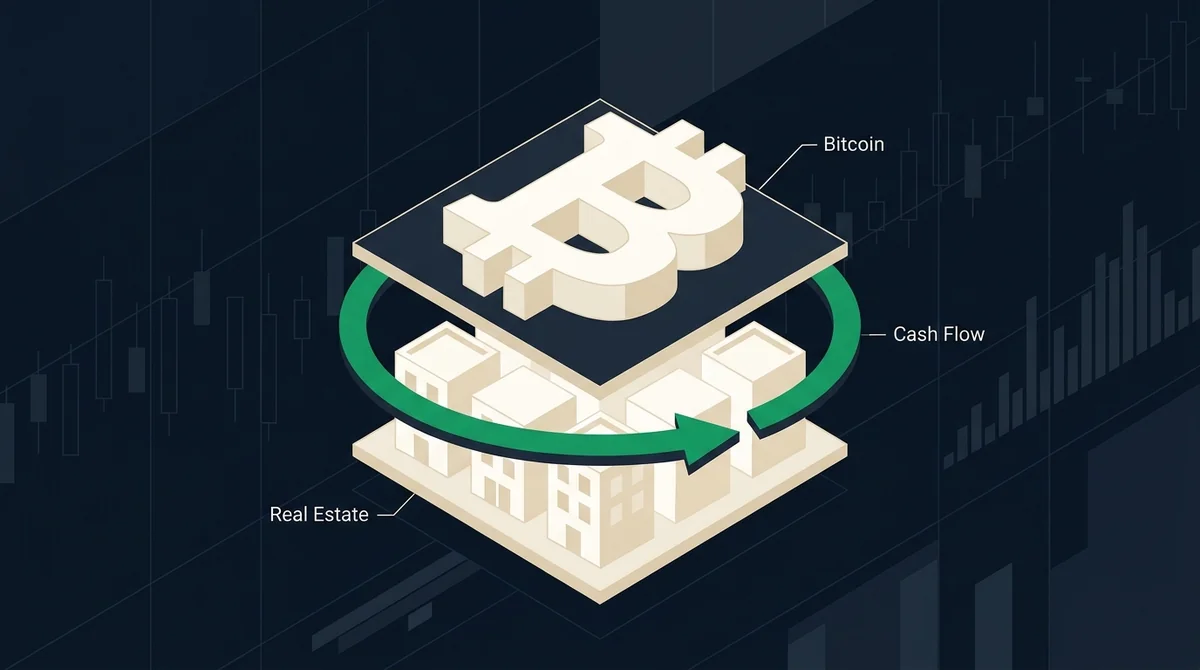
Some investors have long been engaged in large apartment acquisitions. About 18 months ago, they began systematically seeking assets in prime locations that are priced below replacement cost, emphasizing two things: first, the purchase price must be below replacement cost; second, the asset must generate positive cash flow from day one. Once these criteria are met, they are not content to simply hold a 4%–6% cash return; instead, they use Bitcoin as a 'stack,' compressing cash flow to about 3%. The logic is that real estate provides real use value, affordable rents, rent growth, and low volatility; Bitcoin provides volatility and instant liquidity. When combined, the portfolio enjoys stable asset cash flow while also gaining exposure to a high-volatility asset.
2. Deal Practice: Buy the Building First, Then the Coins, Gradually Adjust the Ratio
In the early days, the first deal had a real estate to Bitcoin investment ratio of about 85:15. Initially it was only to test market response, and investors responded quickly: the average age rose by about 15 years, the average investment amount increased about fourfold, 50% of investors had never previously participated in any of their real estate projects, and 80% had never held Bitcoin. This shows the strategy attracts not native Bitcoin holders, but a group of conservative investors who want exposure without directly dealing with storage, custody, and short-term price swings.
A typical first deal: a property appraised at about $85 million was purchased for about $72 million, effectively using the purchase discount of roughly $13–14 million directly to allocate to Bitcoin, rather than just leaving it as a real estate discount. Investors thus hold positions in both real estate and Bitcoin, waiting for rents and Bitcoin prices to gradually improve.
The timing of Bitcoin purchases is not entirely fixed. Because the fund raises capital gradually during the fundraising process, the operating sequence is to first purchase the real estate, then purchase Bitcoin in batches as funds arrive. The first deal paid for the real estate and Bitcoin in cash, with total fundraising of about $87 million, no debt on the property, and monthly free cash flow of about $350,000; after fees, an additional 4–5 Bitcoin are bought each month, essentially dollar-cost averaging using cash flow. Later, as net operating income improves, there are plans to refinance the asset after about 45 days, obtaining roughly $45 million in debt at an interest rate of about 5.5%, and giving investors the choice of returning the principal or continuing to buy Bitcoin. Ultimately about 80% of investors chose to increase Bitcoin exposure, causing the deal structure to shift from the initial 85/15 to a higher Bitcoin weighting, while still retaining cash flow and tax amortization.
3. Using Real Estate as a 'Trojan Horse': Long-Term Perspective and Downside Tolerance
One key to this strategy is investor education. The operator does not directly promote Bitcoin; instead, they first show the real estate: prime location, below replacement cost, positive cash flow from day one, no need for construction or renovation, no need for short-term exit. Investors realize this is a decade-long allocation, so when Bitcoin prices pull back from highs, there is no significant redemption pressure in the portfolio. The operator says that during Bitcoin's correction from about $108,000 down to the $58,000–60,000 range, it attracted about 3,000 investor participants, received no complaints about panic due to the decline, and instead had people ask 'are you still buying?' These people do not read Bitcoin whitepapers or watch the market hourly; they care more about whether real estate rents will grow and whether Bitcoin can bring gains after several years. If Bitcoin falls to an extreme scenario, they still have real estate and rent growth; if Bitcoin rises, they can choose to sell the real estate, return principal, and continue holding Bitcoin, or do the reverse.
4. Core Changes in Deal Terms: Removing Preferred Returns and Reintroducing Them
Traditional institutional real estate deals often include preferred return (pref) clauses: pension funds and other investors require about 8% preferred return, and beyond that threshold, profits are split in ratios like 85/15. This structure quickly erodes deal returns when cash distributions are delayed and interest rates rise. The early difference in this strategy was the removal of preferred returns, switching to zero preferred return for investors and an 80/20 profit split, which helped raise about $2 billion and allowed the purchase of assets at lower cost when institutional capital retreated. Later, in larger deals, preferred returns were reintroduced: for example, a property deal of about $235 million combined with about $100 million in Bitcoin gave investors an 8% preferred return, with the Bitcoin portion sharing upside 50/50. This design was questioned by some commentators as 'too greedy,' but the operator responded that compared to some structures with a fixed 12% coupon and no upside sharing, 8% plus 50% upside sharing is actually more attractive, and it set a fundraising record.
5. Finding Cheap Assets and Cheap Capital from Institutional Distress
Current institutional real estate transactions face redemption pressure. Pension funds are demanding exits after five-year lock-up periods, large buyers are trading assets among themselves creating a 'washing machine effect,' and traditional preferred return clauses further exacerbate cash flow pressure. In contrast, participants who raise funds from retail investors, because such capital is long-term, diversified, and discretionary, can bypass institutional capital pools to directly acquire discounted assets and hold them longer with more flexible terms. At the industry level, this 'retail-first, no preferred return, layered with Bitcoin' model is being seen as a phase-specific arbitrage.
6. Portfolio Goal: Fewer, Better Real Estate + More Bitcoin
After 18 months, the portfolio under this strategy holds about 2,700 Bitcoin while operating about 16,000 apartment units. The operator had set a target of 100,000 units, but later concluded that in the US there do not exist 100,000 units that simultaneously meet prime location, community amenities, and maintenance conditions; a more realistic path is to focus on 25,000 selected high-quality units and aim to hold 10,000–15,000 Bitcoin. Even if the real estate target is reduced by about 75%, this portfolio could still exceed the asset size of most domestic large real estate investors. At the same time, current real estate and Bitcoin prices are both in discount zones, so new deals can increase both asset types at lower cost.
Even if two buildings are similar in construction year, materials, unit type, and management level, whether Bitcoin is layered on may become a long-term differentiator. Bitcoin as an asset requires no handling of tenants, repairs, property competition, concession competition, or daily operations; while real estate provides discretionary cash flow and rent growth. The key to the portfolio is not choosing one or the other, but using cash flow and refinancing tools to connect the two.
7. Bitcoin as Collateral and Future Financing Paths
The long-term logic of this strategy also includes viewing Bitcoin as superior collateral. Compared with real estate, which often takes two to three years of legal proceedings before banks can foreclose, Bitcoin can be liquidated 24/7. The operator purchased Bitcoin with a 5.5% real estate mortgage, and if Bitcoin appreciates significantly in the future, part of the gains could be used to repay high-interest real estate debt, or lower-cost funds could be borrowed against that asset. A more distant assumption is that mainstream long-term lenders (such as Fannie Mae, Freddie Mac, and insurance capital) will, after understanding this combination, be willing to provide financing against a two-asset package of 'real estate + Bitcoin,' rather than only lending against less liquid real estate. If a property purchased for about $230 million combined with about $100 million in Bitcoin becomes a portfolio of nearly $1 billion after Bitcoin rises fivefold, lenders may be more inclined to recognize both types of collateral.
The market is also discussing that companies that buy and hold Bitcoin directionally may face duration risk if prices stagnate or decline for a long time; while a real estate + Bitcoin portfolio, because it retains stable cash flow and physical assets, may provide some buffer against such tail scenarios. However, this still depends on the actual trajectory of Bitcoin prices and changes in refinancing conditions.
8. Future Paths: Listing and Real Estate Tokenization
There may be two subsequent options for this model: first, after the model is proven, take the operating entity public; second, tokenize previously accumulated real estate transactions, providing liquidity to original investors on the secondary market while opening entry to more allocators. Whichever path is taken, the core is to combine long-term, low-liquidity real estate with high-liquidity, high-volatility Bitcoin, connected through structured cash flow and refinancing tools.
In OKX Radar's industry observation, this hybrid strategy of 'cash-flow assets layered with alternative reserves' is gradually moving from a single institution's experiment into a research sample that can be discussed and dissected. For investors who want to understand the risk-return characteristics of real estate and crypto assets, tracking the terms design, Bitcoin buying cadence, and refinancing structure of such hybrid strategies may be more valuable than simply focusing on short-term price fluctuations.