New York Stock Exchange Plans to Launch Tokenized US Stocks, XRP Price Path Back in Focus
NYSE partners with Blockchain.com to bring tokenized US stocks to 44 million crypto accounts, with the markets focused on XRP liquidity and price path.

Article Citation Summary
NYSE partners with Blockchain.com to bring tokenized US stocks to 44 million crypto accounts, with the markets focused on XRP liquidity and price path.
Recently, the New York Stock Exchange announced a partnership with Blockchain.com to bring tokenized US stocks into the crypto market. Meanwhile, more specific analysis has emerged around XRP's liquidity, regulatory positioning, and price path.
NYSE and Blockchain.com: Tokenized US Stocks Extended to 44 Million Accounts
The New York Stock Exchange has signed a new agreement with Blockchain.com to bring tokenized US stocks to 44 million crypto accounts. The news is seen by the market as the latest move by traditional finance and crypto companies to adopt tokenization technology after the SEC provided relevant guidance. Previously, the Clarity Act failed to pass, but the SEC has signaled that tokenized stocks can be put on-chain, and Wall Street and crypto companies have accelerated their plans accordingly.
From a funding perspective, XRP whales bought approximately $2 billion worth of XRP in the 96 hours after the Clarity Act failed to pass. Analysts believe that large investors began positioning early because XRP remains one of the few crypto assets in the United States with relatively clear legal status.
Meanwhile, officials at the Commodity Futures Trading Commission (CFTC) also stated that US markets must be prepared for large-scale tokenization and 24/7 trading on blockchains. Such remarks further reinforced expectations that tokenized assets will enter mainstream markets.
Regulatory 'Five-Year Exemption' and Bipartisan Support
In discussions about the SEC relaxing related restrictions, the market is focusing on the so-called 'five-year exemption.' Some analysts argue that if tokenized trading based on this exemption takes root and scales in the United States, it will be difficult to reverse later, because by then the entire market infrastructure will already have been built around it. At the same time, tokenization technology itself should not be over-politicized; its development in the US market has a foundation of bipartisan support, helping to maintain US competitiveness in related markets.
Some also add that even without a formal Clarity Act, short-term regulatory adjustments will provide room for the industry to move forward; once the market has spent years building a complete system, it is unlikely to be easily overturned in the future.
XRP Liquidity and Potential 'Gap' Repricing
In explaining why XRP's price could be repriced sharply in one go, the analysis pointed to insufficient order book depth. Compared with TradFi, the order books for XRP and the entire crypto market are still relatively thin: the total crypto market cap is about $3 trillion, the global equity market cap is about $600 trillion, and the gold market is about $30 trillion, so traditional market derivatives are more robust. However, adoption of perpetual contracts and options in crypto markets is increasing, and liquidity is higher than in the past.
The analysis mentioned that when it earlier launched a fund product for XRP, it participated as a market maker and held more XRP than other participants; at that time it held about 300 million XRP, of which 100 million were in the fund. Later, as CME launched XRP futures, some liquidity migrated to CME.
Because current liquidity is insufficient, gaps remain in the chart. If a short squeeze or a burst of buying occurs, the price could jump upward through multiple levels until new sellers appear. Retail investors might place limit orders near $5, $8, $10, $13, or even $20 and $25, but if the price breaks above $25, orders above may thin out significantly until institutions begin buying at scale.
If the CFTC and SEC clearly state that they will prioritize XRP Ledger and XRP because of their clarity, it could bring significant demand. The analyst said he personally believes that products similar to BlackRock ETFs could appear at that point, but this remains an opinion rather than hard data. He estimates that the XRP available to trade on exchanges, OTC desks, and dark pools at any given time is roughly between 1 billion and 2 billion tokens, or possibly even less; if a $20 billion inflow occurs in a short period, the XRP price could rise exponentially before price discovery.
Similar situations have occurred in previous liquidity shortages: Kraken recorded XRP at around $90, and Upbit approached $100, before quickly falling back as liquidity replenished. Shane Ellis's theory also mentions that Bitfinex faced liquidity strain related to Tether issues and may have chosen XRP to provide liquidity because XRP had the most trading pairs with Tether; the theory suggests that XRP could have reached $500 on that exchange alone. Overall, this repricing stems more from market supply and demand dynamics than from administrative or systemic repricing; in the future, if the Bank for International Settlements (BIS) issues some form of tiered classification, it could further affect XRP's positioning.
S-Curve and Expectations of a 'Sudden Takeoff'
On whether XRP's price will rise slowly or spike suddenly, mainstream analysis leans toward a 'one-time spike.' Technology adoption typically follows an S-curve: new technology grows slowly in the early stage, then reaches a tipping point where network effects begin to reinforce themselves, and finally enters a steep acceleration phase. This process is often not linear but completes mass adoption within a relatively short period.
Recent price movements have been used to support this framework: after falling below $1, XRP has risen more than 50% over the past five weeks. Such volatility is both a source of opportunity and risk in crypto markets.
From the perspective of speculation versus utility, the early flat phase of the S-curve corresponds to the speculative stage, after which real utility drives assets into a larger capital allocation cycle. Analysts believe that the market size of the real investment stage could be much larger than the speculative stage, because investors are willing to commit several times or even 10 times the capital to real applications. The internet's adoption took about 14 years, and this process may be shorter for crypto assets.
Valuation Divergence: Meme Assets vs. Real-World Companies
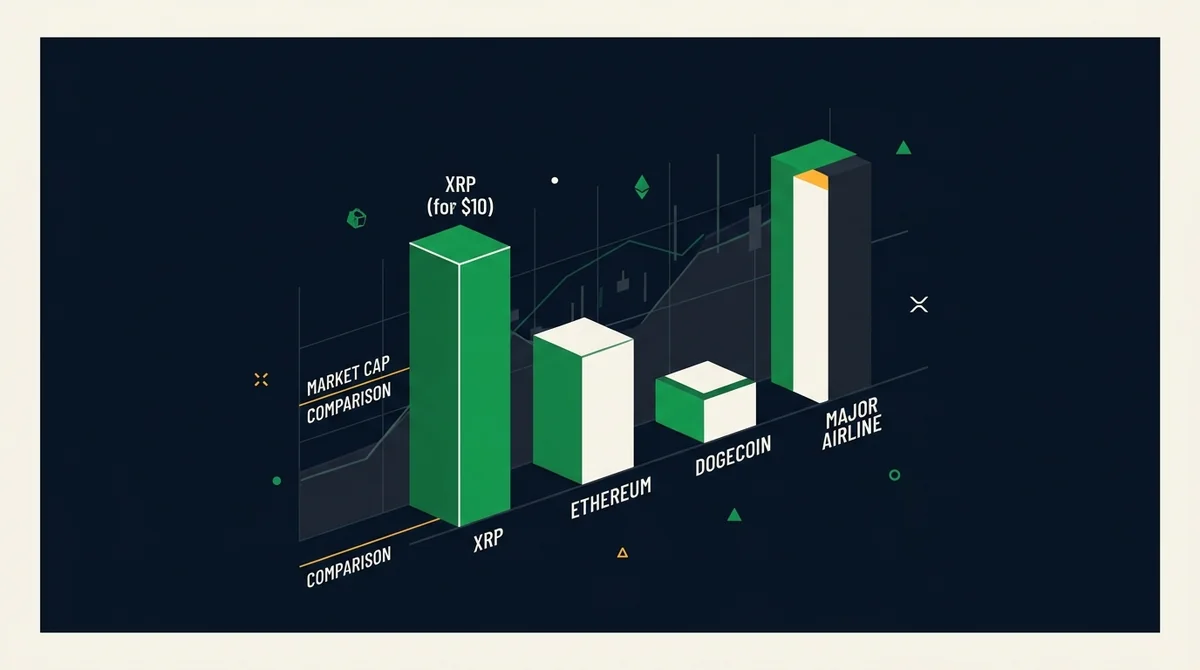
On valuation, the discussion repeatedly noted that the market's pricing logic is still immature. Take Dogecoin as an example: its total market cap is about $16 billion, yet it has almost no practical use; by comparison, a major airline with systemic influence on the US economy has a total market cap of only about $8.8 billion. This contrast shows that valuation factors in the crypto market are not yet fully understood, and metrics such as network transaction volume and total asset value could influence future pricing.
Some investors who previously focused only on Bitcoin and Ethereum in the early days have begun to change their views, believing that these two blockchains alone are not enough to cover the entire market and that other blockchain assets should also be held. Meanwhile, a person with 35 years of commodity trading experience and long-standing skepticism toward XRP also pointed out, based on long-term charts, that XRP could eventually rise to $5.40.
However, even if XRP rises to $5, it may still belong to the speculative stage. The stage truly driven by utility will only come after new products such as tokenized US stocks are officially launched and begin to generate real usage. Currently, crypto market gains stem more from institutional early positioning based on expectations 6 to 8 months ahead.
Taking market cap comparison as an example, Ethereum is currently around $323 billion. If XRP reaches $10, its market cap would be about $620 billion; Ethereum has previously been in a higher market cap range. If the market enters an expansion phase, related assets could see bubble-like tops.
Overall, the New York Stock Exchange's tokenized stock plan marks further progress in the integration of traditional finance and crypto markets. For price expectations of assets like XRP, current market views remain dominated by opinions and speculation; liquidity, regulatory implementation, and the release of real utility will be key variables going forward.