In the Tokenization Wave, Why Bet on Infrastructure Over Assets Themselves?
From settlement upgrades to Chainlink's net inflows, why Layer 1s, oracles, and builders may hold more long-term value than tokenized assets themselves.
Article Citation Summary
From settlement upgrades to Chainlink's net inflows, why Layer 1s, oracles, and builders may hold more long-term value than tokenized assets themselves.
Why Tokenization Is Underestimated
The market may be severely underestimating the scale of on-chain trading activity over the next decade. As several key figures have pointed out, all assets will eventually move on-chain: the SEC chair has said so, and so has the CEO of BlackRock, the world's largest asset manager.
The core problem tokenization aims to solve is that existing financial infrastructure still operates at a level from the 1920s. Stock settlement uses T+1, relying on a system as complex as a 'Rube Goldberg machine,' involving numerous intermediaries and the movement of funds between different stages. Traditional stock markets trade only six and a half hours a day, five days a week, which no longer matches today's globalized, instant, always-on world. Speeding up the current ecosystem to 24/7/365 would require lengthy iteration, whereas tokenization can accomplish all of this instantly: assets can move globally around the clock and achieve instantaneous settlement. For securities flows, tokenization is like replacing traditional mail with email—an inevitable evolution.
Hold Infrastructure, Not Tokenized Assets Themselves
For investors, holding tokenized assets themselves does offer some marginal benefits, such as 24/7 trading, easier staking and lending, and greater functionality. But if you simply tokenize an ETF or Tesla stock, at the end of the day it is still that ETF or Tesla stock—most returns still come from the underlying asset itself; even if it is more flexible, the difference is not huge.
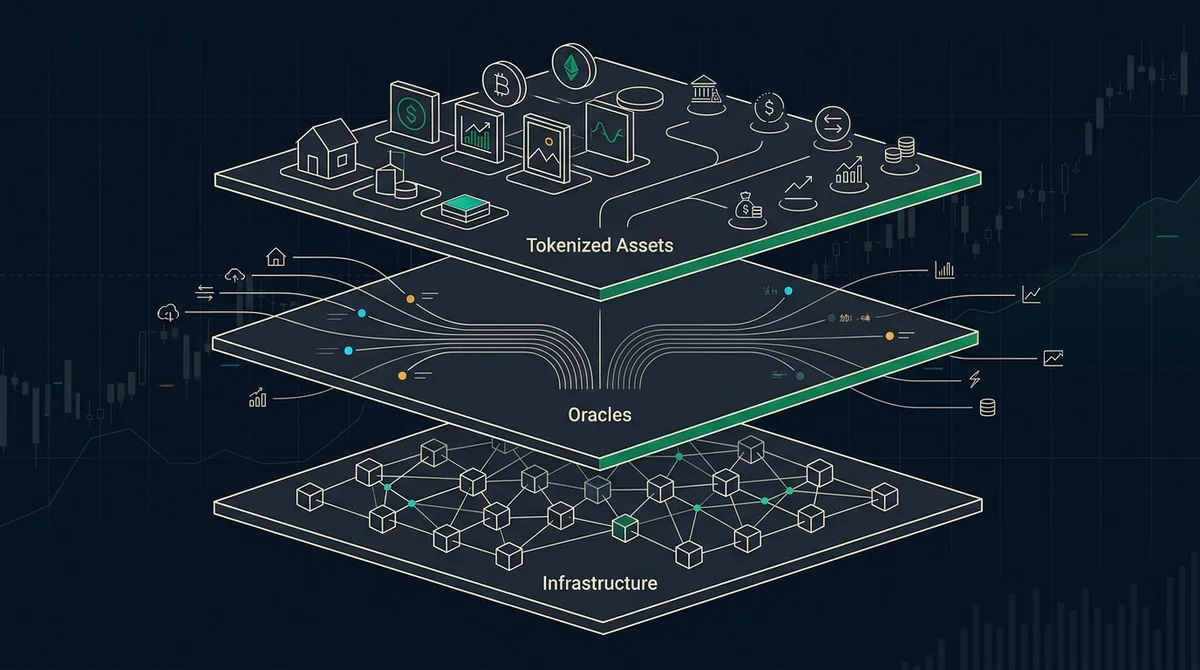
To truly benefit from the tokenization wave, you must hold the infrastructure that makes it possible. This includes high-performance Layer 1s that serve as the foundation for tokenization, such as Ethereum and Solana; oracle providers that connect blockchains to the real world and supply real-world information, such as Chainlink; and companies actively building in this space. This is a once-in-decades upgrade of the global financial ecosystem, and every similar transformation brings huge opportunities—investors need to position themselves early.
Chainlink: The Data Bridge Connecting Blockchain to the Real World
Chainlink stands out prominently in these discussions. One way to understand blockchain is this: Ethereum or Solana is like a powerful computer without an internet connection—it can perform complex calculations, but if it needs to know a stock price, a bond price, a currency value, or the outcome of an event, there must be a bridge to obtain off-chain data. Chainlink holds an overwhelming share of this market, roughly 70% to 80%, serving as the link between blockchain and the real world.
Therefore, if the thesis that 'more real-world assets will come on-chain' holds, then nearly all of these assets will have to interact with Chainlink. This is an important narrative supporting its long-term value. Notably, a Chainlink spot ETF launched in December 2025, and Bitwise's product launched in early January 2026; since then, despite prolonged weak market sentiment, there has not been a single week of net outflows. This may indicate that investors have understood its critical position: as a foundational component for global markets to function over the coming decades, its current valuation of only about $6–7 billion remains relatively small and attractive, leading to sustained and steady inflows.
The Financial System in Ten Years: 24/7 Trading and the Spread of DeFi-Style Lending
One immediate change is that there is 'no off switch.' In the traditional financial world, markets close at 4 p.m. on Friday, rest over the weekend, and reopen at 9:30 a.m. on Monday—that rhythm will disappear. In the future, markets will trade 24/7/365, and investors will need to build systems to cope with this. This is broadly a good thing: for example, if a major geopolitical event occurs, you can immediately rebalance your portfolio instead of waiting for the market to open.
Another major change is that all traditional assets will be able to plug into services already available in DeFi today. People will find it much easier to borrow against their existing assets or use them as callable resources. In traditional finance, such services are typically reserved for high-net-worth clients: a customer holding $100,000 or $1 million at Schwab can borrow stocks under certain conditions, but DeFi makes this extremely simple. Once the tokenized world arrives, the services enjoyed by today's wealthiest investors will be extended to all investors via DeFi protocols.
Financial Inclusion and Potential Risks
Tokenization has the potential to become the most powerful financial inclusion tool in history: anyone in the world with a mobile phone can hold these tokens and self-custody them, thereby gaining a piece of the world's highest-quality assets, including real estate, bonds, and even U.S. private credit. For many people who currently lack such access, this is a huge opening.
But there are also downside risks. First, market liquidity is lower at night and on weekends because people are asleep; if a shock event occurs, heavy selling could happen in a low-liquidity environment. Second, more leverage will accumulate in the system, which can bring both value and risk, similar to the liquidation events that have occurred in crypto markets. Therefore, tokenization is not perfect in every respect—it is both inevitable and beneficial to most people, but traditional markets may also begin to experience the low-liquidity shocks and leverage blow-ups seen in crypto markets, which is worth watching.
Institutional Entry: Validation and Regulatory Capture Risks Coexist
Large institutions are fully committing to tokenization—for example, BlackRock, JPMorgan, and major exchanges—which is highly validating in itself. The crypto industry has long argued that in an age when Amazon can deliver goods within seconds, restricting stock trading to 9:30 a.m.–4:00 p.m. and settling T+1 (or T+2 just a few years ago) seems absurd. Wall Street is recognizing this and realizing that it must build capabilities in this area.
At the same time, some Wall Street players are attempting to influence how tokenization is implemented through regulatory capture—for example, pushing for tokenization to occur only on quasi-private chains or within small ecosystems, or limiting legal protections for DeFi innovators, and trying to distort relevant legislation through lobbying. What should be guarded against is that the resulting ecosystem should be open, permissionless, with reasonable constraints around anti-money laundering, KYC, and so on, truly benefiting users, reducing costs, and increasing uptime. Whenever disruption happens, there are attempts at regulatory capture; ultimately technology wins, but banks will indeed try to capture some of the value in ways that are not favorable to end investors.
Centralization Concerns and Trade-offs: Striving for Better, Not Perfect
New technologies such as electronic trading or ETFs often increase efficiency while concentrating power at the top. Tokenization will likely do the same: large Layer 1s such as Ethereum and Solana will continue to dominate; large asset managers will still try to control asset creation. But the expectation should not be to achieve perfection, but to become better.
Take ETFs as an example: they did give rise to industry giants and caused some market distortions due to the rising share of passive investing, but they also compressed fees from 1% all the way down to 10 basis points, saving everyone hundreds of billions of dollars annually. From fixed commissions of $200 per share to zero-commission in the Robinhood era, there are negative effects as well, but the net effect is an improvement. The financial ecosystem has been continuously refining itself; tokenization may bring imperfect results, but it promises to dramatically reduce costs and greatly increase financial inclusion. We should seek the benefits and limit the negative impacts, while acknowledging that new risks will emerge.
Future Outlook: DeFi and the Trading Scale of Agentic Finance
Beyond tokenization, DeFi is also severely underestimated. After a boom-and-bust cycle, many people have stopped paying attention to DeFi, but protocols like Aave and Uniswap have the potential to be 100x larger than they are today and become critical financial infrastructure. Moreover, the rise of agentic finance will reshape markets—it is not just about the existing TradFi asset market and the tokenized asset market being the same size; rather, the number of on-chain assets and tradable varieties will increase dramatically, and trading activity could grow 10x, 100x, or more over the next decade. Once we enter the world of agentic finance, it will be an order-of-magnitude expansion. This point is clearly underestimated by the market. Brian Armstrong has also publicly discussed this trend and seems to always be ahead of the curve.