OKX Radar US Stocks Daily: FDTX, Newmont, and Lazard International Strategic Equity Portfolio: AI Infrastructure ETF Gets Buy Rating, Gold Giant Downgraded, and International Portfolio Outperforms EAFE in Q2
FDTX gets Buy rating; Newmont Q2 free cash flow $2.2B cut to Hold; Lazard intl portfolio tops MSCI EAFE; market shifts to cash flow and valuation rebalancing.

Article Citation Summary
FDTX gets Buy rating; Newmont Q2 free cash flow $2.2B cut to Hold; Lazard intl portfolio tops MSCI EAFE; market shifts to cash flow and valuation rebalancing.
OKX Radar Research Team Guest Columnist @OKXRadar 2026 This article is approximately 4,800 characters and takes about 12 minutes to read.
The AI infrastructure trade remains the most certain mainline in US equities, but the valuation rebalancing signal reflected in Newmont's downgrade suggests the market no longer indiscriminately rewards thematic exposure; capital is shifting from simply chasing growth to a more discerning review of cash flow, margin of safety, and relative returns. FDTX's Buy rating, the gold giant's Hold rating, and Lazard's international portfolio's outperformance together form three cross-sections of this judgment. As an independent market observation media, OKX Radar continuously tracks US equities and global macro clues. This article is compiled from public reports and company disclosures and does not constitute investment advice.
AI Summary
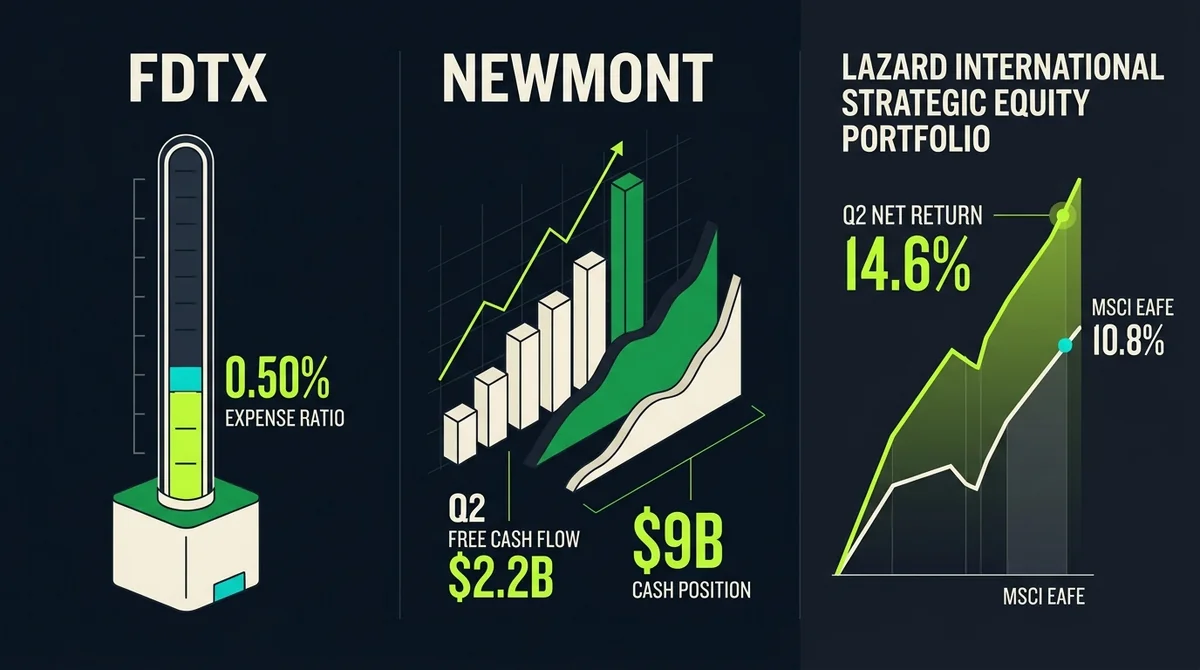
Core View: An actively managed AI infrastructure ETF receives a Buy rating due to its relatively low fee and concentrated holdings; Newmont, despite delivering a strong quarterly free cash flow, is downgraded to Hold because its valuation no longer offers a margin of safety; Lazard International Strategic Equity Portfolio significantly outperforms its benchmark driven by AI capital expenditure. Together, these three confirm that AI remains the core narrative in global equities, but valuation constraints have begun to emerge.
Key Points:
- Fidelity Disruptive Technology ETF (FDTX) is an actively managed ETF investing in approximately 50 companies focused on disruptive technology, with an emphasis on AI computing and infrastructure, and receives a Buy rating.
- FDTX's active management fee is 0.50%, and the portfolio focuses on AI infrastructure market leaders such as NVDA, TSM, MSFT, AMZN, GOOG, and META.
- Newmont Corporation reported second-quarter free cash flow of $2.2 billion, reaffirmed its 2026 guidance, and maintained a $9.0 billion cash position for dividends and buybacks.
- Newmont Corporation's stock rating was downgraded to Hold, with analysts noting that its valuation has caught up and no longer offers a margin of safety.
- Lazard International Strategic Equity Portfolio posted a second-quarter net return of 14.6%, outperforming the MSCI EAFE index's 10.8% gain over the same period.
- Lazard noted in its commentary that AI capital expenditure dominates global equity headlines, driving strong returns in semiconductor and technology hardware sectors, while developed-market bank stocks continue to perform well.
| Name | Core Signal | Key Data | Rating/Performance |
|---|---|---|---|
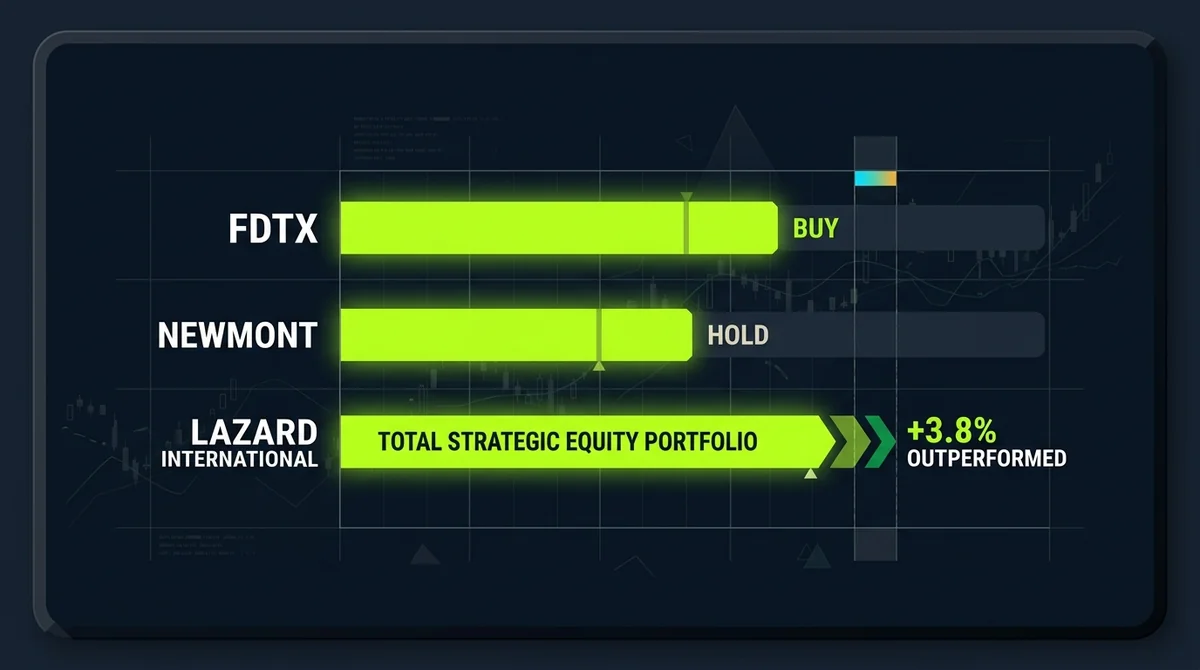
| FDTX | Actively managed AI infrastructure ETF | 0.50% fee, holdings include NVDA, TSM, MSFT, AMZN, GOOG, META | Buy |
| Newmont | Strong cash flow but valuation lost margin of safety | Q2 free cash flow $2.2B, cash position $9.0B | Downgraded to Hold |
| Lazard International Strategic Equity Portfolio | International portfolio outperforms benchmark | Q2 net return 14.6% vs MSCI EAFE 10.8% | Outperformed by 3.8 percentage points |
I. FDTX Holds Core AI Infrastructure Portfolio at 0.50% Fee and Receives Buy Rating
1. Actively managed ETF FDTX covers about 50 disruptive technology companies, with NVDA, TSM, MSFT, AMZN, GOOG, and META forming the portfolio's mainline
Answering "What is FDTX?": The positioning of Fidelity Disruptive Technology ETF (FDTX) is very clear: it is not a broad technology index fund, but an actively managed ETF investing in approximately 50 companies focused on disruptive technology, with an emphasis on AI computing and infrastructure. According to an article published by Seeking Alpha on August 27, 2026, FDTX received a Buy rating. Behind this rating is the high concentration of the portfolio structure: AI infrastructure market leaders such as NVDA, TSM, MSFT, AMZN, GOOG, and META form the portfolio's mainline. These companies are not evenly distributed across all corners of the tech sector, but are concentrated in AI computing, semiconductors, cloud infrastructure, and platform layers, precisely corresponding to the complete chain of AI capital expenditure from chips to the cloud.
The significance of active management in the AI theme lies in its ability to dynamically adjust exposure to about 50 companies, rather than passively accept the rear-view mirror bias of market-cap weighting. FDTX provides this active selection at a management fee of 0.50%, which is not high compared with many thematic active products. From the perspective of position construction, the portfolio's focus on NVDA, TSM, MSFT, AMZN, GOOG, and META essentially buys the "water sellers" and "road builders" of AI infrastructure, rather than simply betting on a single application scenario. This is highly consistent with the current market environment where AI capital expenditure dominates global equity headlines.
2. 0.50% management fee combined with AI computing and infrastructure exposure supports the Buy rating and relative outperformance
A 0.50% management fee is relatively restrained among active ETFs. For long-term holders, fee differences are amplified by compounding; while FDTX maintains the flexibility of active management, it does not push fees to a level that erodes excess returns. The Buy rating given by Seeking Alpha is not just recognition of the AI theme, but also affirmation of the product design and cost structure.
From a market perspective, FDTX's portfolio covers almost the most core listed companies in AI infrastructure. NVDA and TSM correspond to computing power and manufacturing, while MSFT, AMZN, GOOG, and META represent cloud infrastructure and platform-layer capital expenditure. When AI capital expenditure continues to dominate global equity headlines, these companies' earnings visibility and order visibility are relatively higher. The Buy rating and relative outperformance judgment are precisely based on this structural exposure. However, it should be noted that concentrated holdings also imply higher volatility than broad-based indices; if AI capital expenditure expectations show marginal slowdown, the portfolio's adjustment space will be the real test of active management capability.
II. Newmont Reports Q2 Free Cash Flow of $2.2 Billion, but Rating Downgraded to Hold
1. $2.2 billion quarterly free cash flow and $9.0 billion cash position provide ammunition for dividends and buybacks
Answering "Why was Newmont downgraded?": The direct reason is that its valuation has caught up and no longer offers a margin of safety, rather than deterioration in fundamentals. Newmont Corporation reported second-quarter free cash flow of $2.2 billion, reaffirmed its 2026 guidance, and maintained a $9.0 billion cash position for dividends and buybacks. These figures are not bad for any mining company: $2.2 billion in quarterly free cash flow shows strong cash conversion ability driven by high gold prices, while the $9.0 billion cash position provides ample buffer for shareholder returns. Seeking Alpha recorded these data in an article on August 27, 2026, but also pointed out the subtlety of the subsequent rating action.
The coexistence of strong cash flow and a rating downgrade precisely illustrates that the market's judgment on gold giants is shifting from "whether they make money" to "whether the valuation is expensive." $2.2 billion in free cash flow and a $9.0 billion cash position were originally conventional reasons to support dividends and buybacks; but when the stock price has fully priced in rising gold prices, cost control, and shareholder return expectations, these positive factors may not be sufficient to form a new buying catalyst. Analysts noted that the valuation has caught up and no longer offers a margin of safety—a typical value rebalancing signal.
2. Rating downgraded to Hold: market has caught up with valuation, gold giant no longer offers margin of safety
Newmont's stock rating being downgraded to Hold is not due to deteriorating fundamentals, but because the margin of safety between valuation and fundamentals has disappeared. The analyst view cited by Seeking Alpha is blunt: the market has caught up with the valuation, and the gold giant no longer offers a margin of safety. For a company with strong free cash flow and ample cash position, this rating change may surprise some investors, but it reflects a broader shift in market psychology—when everyone sees rising gold prices and cash generation ability, the risk-reward of continuing to chase higher begins to decline.
From an industry logic perspective, gold stocks, as assets akin to "bond-like + metal option," have stock prices highly sensitive to interest rates, the dollar, and risk appetite. Newmont's $2.2 billion quarterly free cash flow and $9.0 billion cash position give it defensive qualities in dividends and buybacks; but the downgrade means the market believes these defensive qualities are already fully priced. For analysts, a Hold rating is not a negation of company quality, but an acknowledgment that at current price levels, waiting for a more suitable entry point or clearer earnings surprise signals is more reasonable than continuing to add positions.
III. Lazard International Strategic Equity Portfolio Q2 Net Return 14.6%, Outperforming MSCI EAFE's 10.8%
1. 14.6% vs 10.8%: International portfolio's excess return comes from AI capital expenditure and strong technology hardware sector performance
Answering "How did Lazard's international portfolio perform over the same period?": Lazard International Strategic Equity Portfolio posted a second-quarter net return of 14.6%, while the MSCI EAFE index rose 10.8% over the same period, for an excess return of 3.8 percentage points. The specific source of this performance was pointed out in Lazard's quarterly commentary: AI capital expenditure dominates global equity headlines, driving strong returns in semiconductor and technology hardware sectors. Seeking Alpha reported the portfolio's commentary on August 27, 2026, with a clear data chain.
It is worth noting that this is an international strategic equity portfolio, with a benchmark of MSCI EAFE—generally considered to be dominated by developed markets in Japan and Europe. Achieving a 14.6% net return under such a benchmark, and explicitly attributing the excess return to AI capital expenditure and technology hardware, shows that the AI trade has spilled over from US equities to the globe. Semiconductor and technology hardware sectors in Europe and Japan also have globally competitive companies, and Lazard's portfolio clearly captured this round of global AI infrastructure investment cycle. A lead of 14.6% versus 10.8% is not common in international equity portfolios.
2. Developed-market bank stocks continue to perform well, AI capital expenditure dominates global equity headlines
Lazard's commentary also mentioned that developed-market bank stocks continue to perform well. This does not contradict AI capital expenditure dominating global equity headlines: bank stocks benefit more from interest rate environment, credit demand, and capital market activity, while the AI trade is more concentrated in semiconductors and technology hardware. The simultaneous appearance of these two threads in Lazard's quarterly commentary indicates that the international portfolio is not a single-theme bet, but retains exposure to the financial sector beyond AI infrastructure.
From a global market perspective, AI capital expenditure dominating headlines is not just a US phenomenon. Semiconductor equipment, materials, and technology hardware companies in Japan and Europe are also capturing demand from the global AI supply chain. The gap between Lazard International Strategic Equity Portfolio's Q2 net return and MSCI EAFE largely comes from the strength of these sectors. Developed-market bank stocks continuing to perform well also provides another source of return for the portfolio. This differs from FDTX's focus on US AI core holdings and Newmont's expression of valuation constraints, but together points to the same macro backdrop: global capital is reallocating around AI infrastructure while remaining sensitive to cash flow and valuation.
In Closing
AI capital expenditure simultaneously drives ETF core holdings, global equity headlines, and international portfolio excess returns—a point that appears repeatedly in the three sets of data. FDTX's Buy rating is built on the AI infrastructure mainline composed of NVDA, TSM, MSFT, AMZN, GOOG, and META; Lazard International Strategic Equity Portfolio's Q2 net return of 14.6% beats MSCI EAFE's 10.8%, and its excess return also comes from semiconductors and technology hardware; even in Lazard's commentary, AI capital expenditure is explicitly called the dominant force in global equity headlines.
But the gold giant's downgrade reminds the market that no matter how strong the cash flow or how ample the cash position, it cannot replace a margin of safety. Newmont's Q2 free cash flow of $2.2 billion and cash position of $9.0 billion still led to a downgrade to Hold after the valuation caught up. This contrast shows that although the AI theme and gold assets seem unrelated, they collectively experienced the same process of "price catching up with narrative": when positives are fully priced, the reason to buy no longer automatically holds.
The three signals collectively point to the same logic: high-certainty AI infrastructure is being priced, and the market is beginning to examine valuation and margin of safety more critically. For column readers, FDTX's Buy rating does not mean blindly chasing in, and Newmont's Hold rating does not equate to being bearish on its fundamentals; the truly valuable signal is that global capital remains on the offensive along the AI capital expenditure mainline, but at the individual stock level it has begun to re-measure valuation with the yardstick of cash flow.
The AI infrastructure trade remains the mainline, but Newmont's downgrade signals that capital is shifting from simply chasing themes to a rebalancing between cash flow and valuation. How long this rebalancing process will last and how it unfolds may need to be verified by financial reports and capital expenditure data over the next few quarters.
Risk Warning: Macroeconomic and US equity market volatility is severe. This article is for OKX Radar research observation reference only and does not constitute any investment advice.
References and verification links
These are the article-level sources stored with this page. Interpret dynamic facts and rules in light of their dates, regions, and subsequent updates.
FAQ
What is FDTX? ▼
Fidelity Disruptive Technology ETF (FDTX) is an actively managed ETF investing in approximately 50 companies focused on disruptive technology, with an emphasis on AI computing and infrastructure, and receives a Buy rating. Its active management fee is 0.50%, and the portfolio focuses on AI infrastructure market leaders such as NVDA, TSM, MSFT, AMZN, GOOG, and META.
Why was Newmont downgraded? ▼
Newmont's stock rating was downgraded to Hold, with analysts noting that its valuation has caught up and no longer offers a margin of safety. Although the company reported second-quarter free cash flow of $2.2 billion, maintained a $9.0 billion cash position, and reaffirmed its 2026 guidance, the market has fully priced in these positives.
How did Lazard International Strategic Equity Portfolio perform in Q2? ▼
Lazard International Strategic Equity Portfolio posted a second-quarter net return of 14.6%, outperforming the MSCI EAFE index's 10.8% gain over the same period. The excess return came from AI capital expenditure, strong returns in semiconductor and technology hardware sectors, and continued good performance from developed-market bank stocks.
What is the core logic of the current US AI trade? ▼
AI capital expenditure dominates global equity headlines, driving strong returns in semiconductor and technology hardware sectors, benefiting both FDTX and Lazard portfolios; however, Newmont's downgrade signals that the market is shifting from simply chasing themes to a rebalancing between cash flow and valuation.