OKX Radar US Stock Daily Watch: Siemens, Defense Tech, and Hydreight: Siemens AI Digital Twin Drives Growth, Defense Ammunition Replenishment and Hydreight Rating Adjustment
Siemens +8%, orders +14%, digital margin 19.5% validate AI twin; defense restocking extends runway; Hydreight +12% QoQ, margin 19.4%, rating cut to Buy.

Article Citation Summary
Siemens +8%, orders +14%, digital margin 19.5% validate AI twin; defense restocking extends runway; Hydreight +12% QoQ, margin 19.4%, rating cut to Buy.
OKX Radar Editorial Team
Guest Columnist
@OKXRadar
September 2, 2026
This article is about 4,800 Chinese characters; full reading time about 12 minutes
Introduction: When the market no longer pays for pure revenue growth, earnings visibility, margin quality, and inventory restocking logic have become new anchors for structural allocation in US stocks in September 2026.
AI Summary
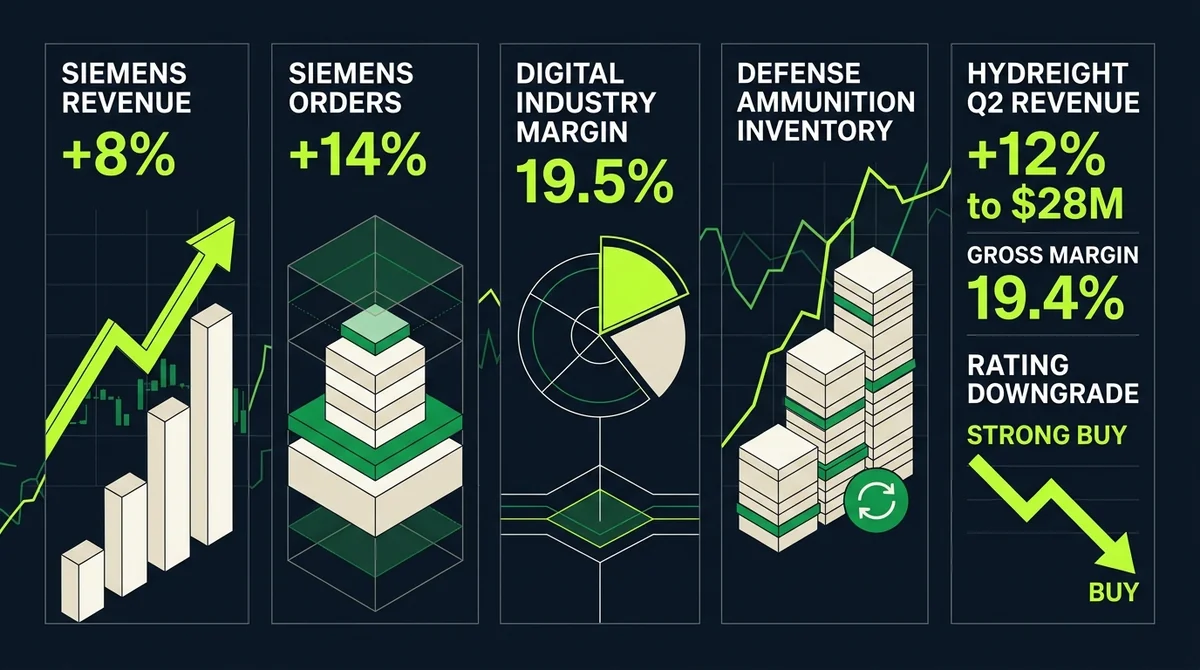
Core viewpoint: This issue of US stock watch focuses on key signals from three companies: Siemens, with 8% revenue growth, 14% order growth, and 19.5% digital industries margin, validates the performance boost from AI digital twin and European re-industrialization for industrial leaders; defense ammunition inventory restocking accelerates due to the Iran conflict, extending the earnings runway for defense tech; Hydreight, despite revenue up 12% QoQ to $28 million, saw gross margin fall to 19.4%, triggering a rating downgrade from Strong Buy to Buy, while long-term upside of nearly 100% remains. Capital is shifting from pure growth narrative to validation of earnings visibility and margin quality.
Key points:
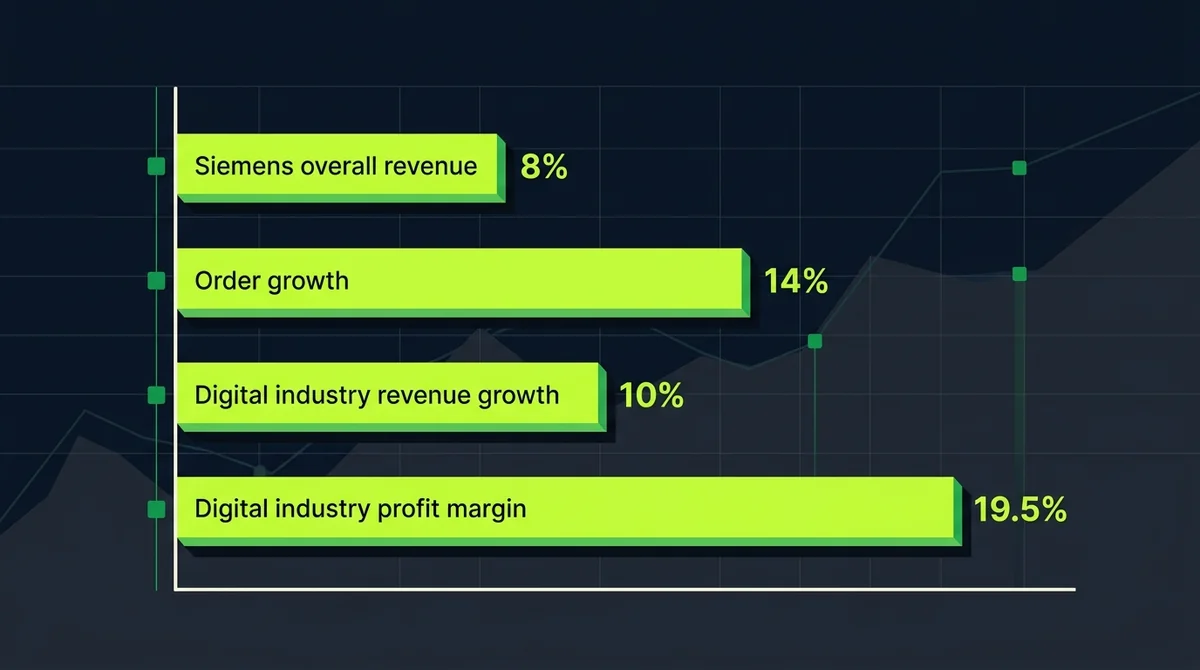
- Siemens' latest earnings show revenue growth of 8%, order growth of 14%, digital industries revenue growth of 10%, and margin of 19.5%.
- Siemens benefits from European re-industrialization, using digital twin and AI to improve efficiency and competitiveness.
- Ammunition inventory replenishment has become a core driver of defense procurement, and the recent Iran conflict has intensified ammunition consumption.
- Hydreight Technologies was downgraded from Strong Buy to Buy due to slower growth and margin pressure in Q2 2026.
- Hydreight Technologies' Q2 2026 revenue grew 12% QoQ to $28 million, while gross margin fell to 19.4%.
- Analyst valuations show Hydreight Technologies still has nearly 100% upside by 2028.
Quick Overview of Key Data for Three Companies
| Company/Theme | Key Metric | Data/Conclusion |
|---|---|---|
| Siemens | Overall revenue growth | 8% |
| Siemens | Order growth | 14% |
| Siemens Digital Industries | Revenue growth / Margin | 10% / 19.5% |
| Defense Ammunition | Core driver | Inventory replenishment; Iran conflict accelerates consumption |
| Hydreight | Q2 2026 revenue QoQ growth | 12% to $28 million |
| Hydreight | Gross margin | 19.4% |
| Hydreight | Rating adjustment | Strong Buy → Buy; nearly 100% upside by 2028 |
1. Siemens AI Digital Twin: 8% Revenue Growth and 14% Order Growth Validate Re-industrialization Logic
1. Digital Industries Revenue Up 10%, Margin 19.5%: AI Digital Twin Turning into Margin Support
Siemens' latest earnings show overall revenue growth of 8% and order growth of 14%, with digital industries revenue up 10% and margin reaching 19.5%. Behind these figures is the substantive leap of AI digital twin from concept to profitability. The 19.5% margin in digital industries is not accidental; it is an efficiency premium generated after AI capabilities are embedded into manufacturing processes. According to OKX Radar's aggregation of Seeking Alpha report on September 2, Siemens' digital industries business, while growing revenue, maintained a relatively high margin, indicating that AI digital twin has moved from the R&D investment phase to the profit contribution phase. Order growth of 14% is significantly higher than revenue growth of 8%, implying a clear buffer for future revenue recognition, which provides strong earnings visibility to the market. If European manufacturing capital expenditure continues to recover, Siemens' digital industries margin may have further room for improvement.
The macro backdrop of this change is the advancement of European re-industrialization. Re-industrialization is not simply about increasing the number of factories, but about restructuring production systems with digitalization and intelligence. Siemens, as a leader in industrial automation and software, has digital twin capabilities that precisely match this demand. The 14% order growth may be a direct reflection of re-industrialization policies taking effect. The market's repricing of Siemens is essentially a confirmation of the long-term theme of "AI + industry." Unlike AI applications in the consumer internet era, industrial AI requires deep industry know-how and data accumulation, and Siemens' barriers in this regard are difficult to replicate quickly.
Furthermore, the 19.5% margin in digital industries means Siemens has taken a key step in productizing AI capabilities. Digital twin is not only used for internal cost reduction, but has become an externally delivered solution, and customers are willing to pay a premium for efficiency gains. This shift in business model makes Siemens less of a pure hardware supplier and more of an industrial software and service platform. If digital industries margin can remain above 19% in subsequent quarters, the market's valuation logic for Siemens may switch from traditional industrial stock to a tech-enabled industrial stock.
2. European Re-industrialization Boosts Siemens Orders; Digital Twin and AI Form Differentiated Competitiveness
Siemens benefits from European re-industrialization, using digital twin and AI to improve efficiency and competitiveness. From the 14% order growth, European manufacturing capital expenditure is shifting from maintenance investment to upgrade investment. Driven by re-industrialization policies, demand for smart manufacturing and green manufacturing across European countries has risen significantly, and Siemens, as a key supplier, has dual support from policy and demand for its order book expansion. The combination of digital twin and AI enables Siemens to provide customers with full-lifecycle digital solutions from design, simulation to operation and maintenance, a capability that is clearly scarce among traditional industrial automation vendors. Therefore, Siemens' competitiveness lies not only in products but also in data- and algorithm-driven services. If European re-industrialization policies continue to strengthen, Siemens' order growth is likely to remain higher than revenue growth, forming a virtuous cycle of "orders first, performance follow-up."
From a market perspective, Siemens' earnings data provides investors with a window to observe European industrial recovery. The 8% revenue growth is not explosive, but the 14% order growth and 19.5% digital industries margin suggest that earnings quality is improving. Against a backdrop of high interest rates and heightened macro uncertainty, the market is more willing to pay a premium for such certainty. The "AI + re-industrialization" narrative represented by Siemens may become one of the options in the US industrial sector that combines defensiveness and growth. It should be noted that although order growth is strong, converting it into revenue takes time, and delivery capability in the next few quarters will be a key verification point. If supply chain or energy costs fluctuate, margins could also be squeezed, though current data does not yet show this risk.
2. Defense Ammunition Replenishment: Iran Conflict Intensifies Consumption, Inventory Restocking Extends Defense Tech Earnings Runway
1. Ammunition Inventory Replenishment Becomes Core Driver of Defense Procurement; Conflict Consumption Accelerates Demand Release
Ammunition inventory replenishment has become a core driver of defense procurement. The recent Iran conflict has intensified ammunition consumption, driving continued replenishment demand. The earnings visibility of defense tech companies has thus been extended. According to OKX Radar's aggregation of Seeking Alpha report on September 2, ammunition inventory replenishment has become a core driver of defense procurement, and the recent Iran conflict has intensified ammunition consumption. This change means the focus of defense procurement is shifting from large-scale platform orders (such as fighter jets, ships) to continuous replenishment of consumable ammunition. Platform procurement has long cycles, large single amounts but low frequency, while ammunition replenishment is high-frequency, rigid demand. The rapid consumption of ammunition due to the Iran conflict has caused inventory levels in relevant countries to drop sharply, quickly triggering replenishment demand. Defense tech companies have thus gained a longer earnings runway than before, with significantly improved revenue recognition cycles and order visibility.
From the perspective of the industrial chain, ammunition inventory replenishment involves upstream materials, midstream manufacturing, and downstream integration. As the conflict continues, ammunition consumption may exceed peacetime production pace, forcing national defense departments to increase procurement or even launch emergency inventory programs. For defense tech companies, this means existing orders will be converted into revenue faster, and profit expectations will be revised upward. However, attention should also be paid to short-term fluctuations caused by capacity bottlenecks and delivery cycles. If geopolitical tensions escalate further, ammunition replenishment demand may continue to exceed expectations, providing sustained catalysts for the defense tech sector.
Another important implication of this logic is that structural changes in defense procurement may reshape sector valuations. The market used to price defense stocks with "platform upgrade cycles," but now "ammunition consumption and replenishment" provides a more stable cash flow expectation. Even if geopolitical conflicts ease, already-depleted inventory levels are sufficient to support years of replenishment demand. Therefore, the earnings runway for defense tech companies is significantly extended, and the market may need to reassess their long-term growth anchors.
Key drivers of defense ammunition replenishment:
- Iran conflict leads to rapid ammunition consumption and declining inventory levels.
- Ammunition replenishment is high-frequency, rigid demand, not constrained by single platform delivery cycles.
- Replenishment cycle can continue for years even if conflict eases.
- Defense procurement focus shifts from platform orders to consumable ammunition.
3. Hydreight Rating Adjustment: Revenue Up 12% QoQ to $28 Million, but Gross Margin Falls to 19.4% Triggering Downgrade from Strong Buy to Buy
1. Slowing Growth and Margin Pressure: Q2 2026 Revenue Up 12% QoQ but Gross Margin Falls to 19.4%
Hydreight Technologies was downgraded from Strong Buy to Buy due to slower growth and margin pressure in Q2 2026. According to OKX Radar's aggregation of Seeking Alpha report on September 2, Q2 2026 revenue grew 12% QoQ to $28 million, but gross margin fell to 19.4%. Revenue is still growing, but the rapid decline in gross margin reveals pressure on the cost side or from competition. The 12% QoQ growth is not bad in absolute terms, but shows signs of slowing compared to previous quarters. A gross margin of 19.4% for a high-growth healthcare company means that scale expansion has not yet been fully converted into profit quality. The downgrade to Buy rather than Sell indicates that analysts believe the long-term logic is not broken, but short-term profit quality needs to be reassessed.
The core contradiction of this change is: the market is willing to pay a premium for revenue growth, but only if growth is accompanied by stable or improving margins. Hydreight's revenue growth remains, but the decline in gross margin challenges the profit assumptions in valuation models. If the company cannot effectively control costs and improve gross margin in subsequent quarters, the basis for the current Buy rating may further weaken. Conversely, if gross margin stabilizes and rebounds, there is also the possibility of an upgrade from Buy back to Strong Buy. From the earnings data, the combination of 12% revenue growth and 19.4% gross margin suggests the company may be sacrificing some profit quality for market share, and the sustainability of this strategy needs close monitoring.
Hydreight Q2 2026 Key Data Comparison:
| Metric | Value | Direction |
|---|---|---|
| Revenue QoQ growth | 12% | Slowed from previous quarters |
| Revenue absolute | $28 million | Growth |
| Gross margin | 19.4% | Down from expectations |
| Rating | Strong Buy → Buy | Downgrade |
2. Downgrade Does Not Change Long-term Upside: Analysts Expect Nearly 100% Upside by 2028
Analyst valuations show Hydreight Technologies still has nearly 100% upside by 2028. This expectation is based on the dual assumptions of continued revenue growth and margin recovery. Nearly 100% upside means analysts believe the current price does not fully reflect the company's long-term growth potential. However, it is worth noting that whether this expectation materializes largely depends on the trajectory of gross margin. If gross margin continues to decline, even with revenue growth, profit realization may fall far short of expectations. The downgrade from Strong Buy to Buy is more a response to short-term margin fluctuations than a denial of the long-term track. The market needs to distinguish between "growth slowdown" and "value destruction": revenue is still growing, long-term upside has not been falsified, but profit quality has become a key variable for whether valuation can be realized. For investors watching this stock, the change in gross margin in subsequent earnings will become a more important observation indicator than revenue growth.
This rating adjustment case also reflects a common preference in the current US stock market: analysts and investors are becoming less tolerant of high-growth companies. In an environment of rising capital costs and heightened macro volatility, the market places greater emphasis on the quality and stability of margins. Hydreight's long-term upside has not been falsified, but the short-term rating downgrade itself is a direct reflection of the market's demand for profit quality. If the company can significantly improve gross margin through scale effects or operational optimization before 2027, the current downgrade may become a medium- to long-term entry window.
Final Thoughts
The core signal of this issue of US stock watch is: under macro and geopolitical disturbances, capital prefers assets with earnings visibility, margin support, and reasonable valuation over pure revenue growth. Siemens, with order growth higher than revenue growth and digital industries margin, demonstrates the profit realization capability of industrial AI and re-industrialization; defense ammunition inventory replenishment, catalyzed by the Iran conflict, constitutes a more certain source of demand; Hydreight's rating adjustment reminds that high-growth healthcare companies need to trade margin quality for valuation trust. The three together outline the current preference for structural allocation in US stocks: from "storytelling" to "looking at profits," from "high growth" to "high quality." This shift is not a short-term style drift, but a rational return under the resonance of macro interest rates and geopolitical risks.
For the overall US stock market, the intersection of three clues—industrial AI, defense restocking, and healthcare growth—reflects the diversified paths of capital seeking "certainty premium." Siemens represents profit improvement from digital upgrade of traditional industries, defense tech represents rigid demand driven by geopolitical conflict, and Hydreight reminds the market that growth must match profit quality. In the remainder of 2026, this "quality first" preference may continue to dominate the structural market in US stocks. Investors need to focus not on the short-term fluctuations of a single company, but on the changes in market pricing logic reflected by these signals.
Risk Warning: Macro economy and US stock market volatility are severe. This article is for OKX Radar research and observation reference only and does not constitute any investment advice.
Tags: Investment, AI, RWA
References and verification links
These are the article-level sources stored with this page. Interpret dynamic facts and rules in light of their dates, regions, and subsequent updates.
FAQ
How did Siemens perform in its latest earnings? ▼
Siemens' latest earnings show revenue growth of 8%, order growth of 14%, digital industries revenue growth of 10%, and margin of 19.5%.
Why has the earnings visibility of defense tech companies been extended? ▼
Ammunition inventory replenishment has become a core driver of defense procurement. The recent Iran conflict has intensified ammunition consumption, driving continued replenishment demand, thereby extending the earnings runway for defense tech companies.
Why was Hydreight downgraded from Strong Buy to Buy? ▼
The downgrade was due to slower growth and margin pressure in Q2 2026. Revenue grew 12% QoQ to $28 million, but gross margin fell to 19.4%.
What is Hydreight's long-term upside potential? ▼
Analyst valuations show Hydreight Technologies still has nearly 100% upside by 2028.
What is Siemens Digital Industries' margin? ▼
Siemens Digital Industries' margin is 19.5%, with revenue growth of 10%.