OKX Radar US Stocks Daily Watch: Market Dynamics: Nvidia's Strong Earnings and Positive Forward Guidance, Fed Chair's Hawkish Remarks Raise Rate Hike Expectations
Nvidia's strong earnings and rare positive guidance meet Fed Chair Warsh's hawkish rate hike signal, putting US stocks in an earnings-tightening tug-of-war.

Article Citation Summary
Nvidia's strong earnings and rare positive guidance meet Fed Chair Warsh's hawkish rate hike signal, putting US stocks in an earnings-tightening tug-of-war.
OKX Radar Editorial Team Guest Columnist @OKXRadar August 31, 2026 About 5,000 words; reading time about 12 minutes.
When Nvidia used rare positive forward guidance to further solidify the anchor for AI chip prosperity, Federal Reserve Chair Warsh's hawkish remarks simultaneously put a September rate hike back on the table. Certain favorable earnings signals and monetary tightening alarms resonated in the same week, and short-term US stock pricing is shifting from one-sided prosperity trading to a tug-of-war between fundamental resilience and interest-rate sensitivity. Based on the latest public information from late August 2026, this article dissects the market implications of Nvidia's earnings signal, the dividend increase wave, and the collision with monetary policy expectations.
AI Summary
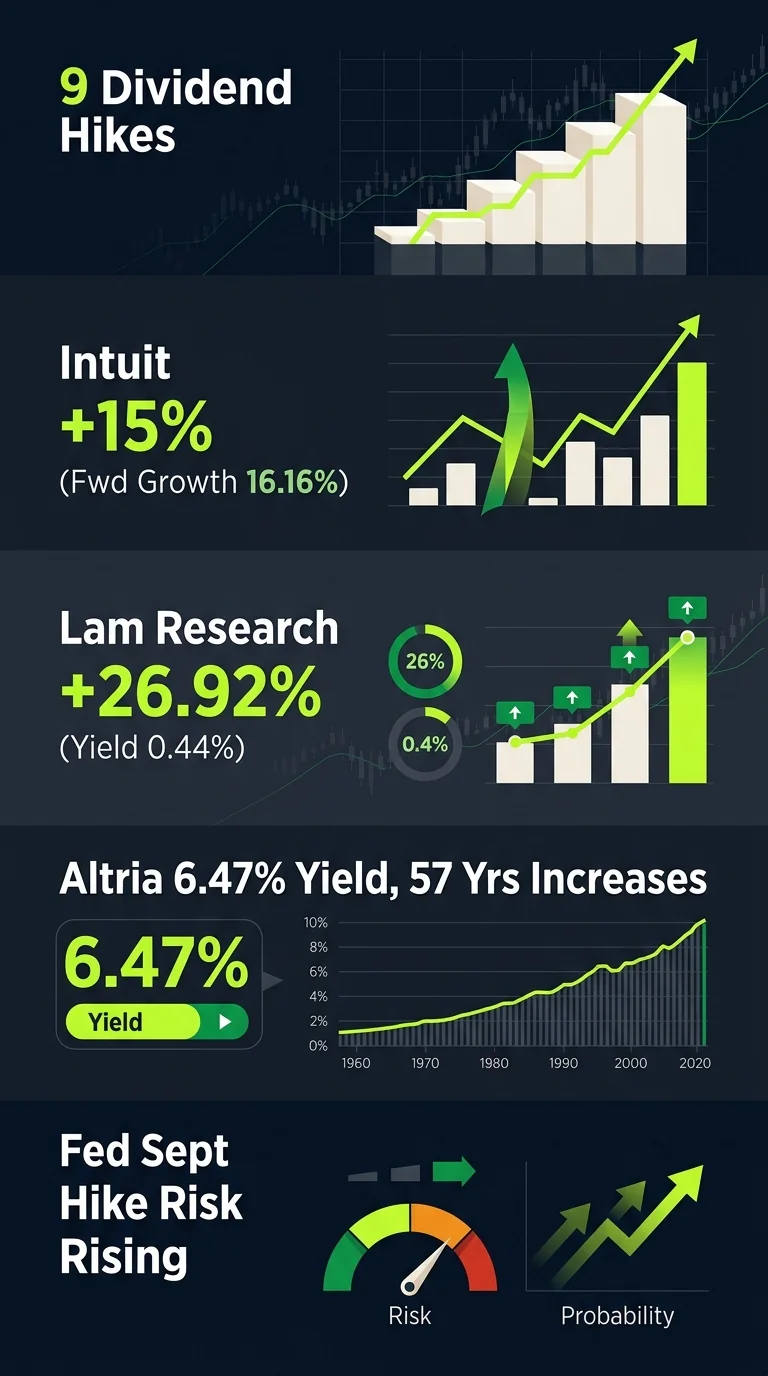
Core view: This week, US stocks oscillated between earnings upgrade signals and monetary tightening alarms. Nvidia's strong earnings and rare positive forward guidance provided leader-level validation for chip and even broader AI computing demand, while nine stocks including Intuit, Lam Research and Altria raised dividends collectively, showing that corporate cash flow and willingness to return capital are still rising. However, Fed Chair Warsh's hawkish remarks increased the possibility of a September rate hike, creating valuation pressure on high-valuation tech stocks and long-duration assets. The tug-of-war between the two will determine the near-term direction.
Key points:
- Nvidia reported strong results in its latest earnings release and provided rare positive forward guidance.
- During the week of August 22 to 28, nine stocks announced dividend increases, including Intuit, Lam Research and Altria Group.
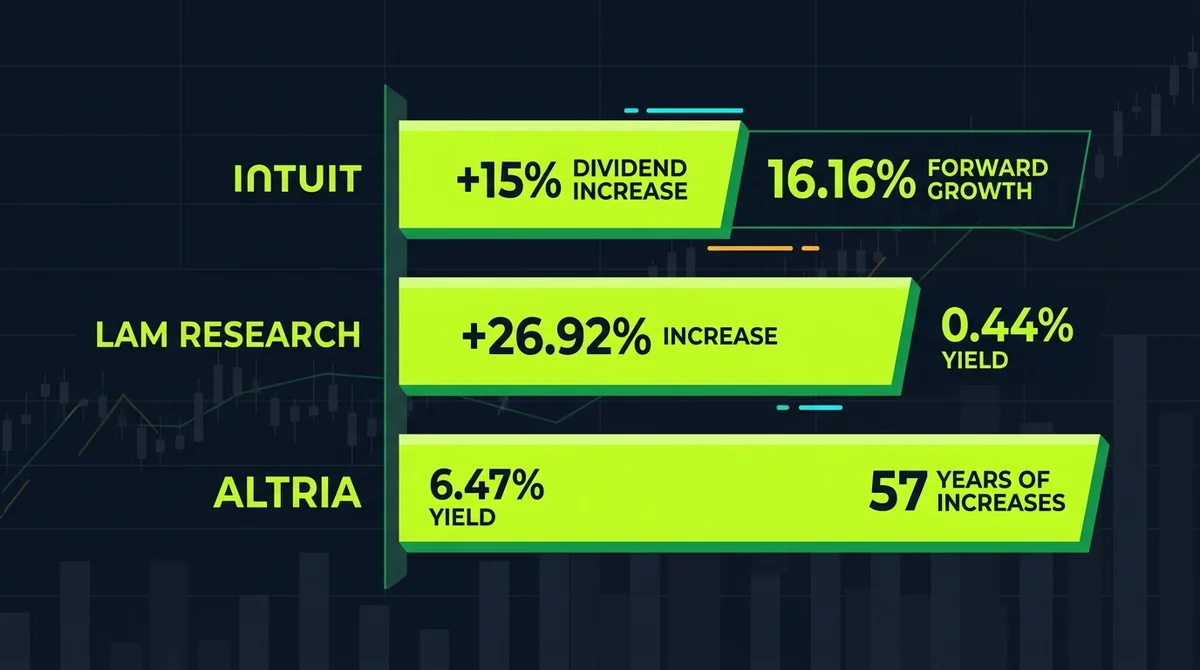
- Intuit raised its dividend by 15%, with a forward dividend growth rate of 16.16%.
- Lam Research increased its dividend by 26.92%, with a dividend yield of 0.44%.
- Altria Group offers a 6.47% dividend yield and has increased its dividend for 57 consecutive years.
- Fed Chair Warsh's hawkish remarks raised the likelihood of a September rate hike.
1. Nvidia's Strong Earnings and Rare Positive Forward Guidance: Further Solidifying the Chip Sector's Prosperity Anchor
1. Nvidia's Latest Earnings Are Strong: Positive Forward Guidance Provides Incremental Confirmation for AI Chip Demand
Nvidia's earnings report became the most important single catalyst for US stocks this week. According to a Seeking Alpha report dated August 30, 2026, Nvidia reported strong results in its latest earnings release and provided rare positive forward guidance. This was not an ordinary delivery of results; rather, at a time when the market was divided over the sustainability of AI capital spending, the company actively used forward guidance to convey demand visibility. Over the past few quarters, investors repeatedly questioned whether AI chip orders could persist through the second half of 2026, and Nvidia's statement amounted to a direct validation from the leading company.
From an industry perspective, Nvidia's forward guidance matters because its data center business has become a thermometer for global AI computing investment. If the guidance had merely met expectations, the market might have viewed it as high-level stagnation; but the phrase 'rarely positive' indicates that management's confidence in next-stage orders, supply chain, and customer capital spending is above the previous market baseline. For the chip sector, this is not just a company-level positive, but another reinforcement of the prosperity anchor. It should be noted that the source facts do not provide specific guidance figures or revenue growth rates, so 'positive forward guidance' cannot be equated with a specific growth rate; a more prudent judgment is that Nvidia provided directional positive confirmation at a key juncture.
2. From Nvidia to the Semiconductor Supply Chain: Leading-Company Guidance Strengthens Chip Sector Earnings Expectations
The transmission of Nvidia's forward guidance to the semiconductor supply chain first shows up in earnings expectations. When a leading company gives a positive signal, the market tends to revise up demand assumptions for upstream equipment, materials, advanced packaging, and HBM, among other segments. In the headline of that report, Seeking Alpha directly stated 'Tech Rallies In September: I'm Adding Software And Chip Stocks', which means some institutional strategies have already positioned software and chips as September allocation directions. However, this headline is an institutional opinion rather than an established fact, and in the main text it can only serve as a reference for observing market sentiment.
Based on past experience, Nvidia's performance after each earnings report often determines the short-term direction of the Philadelphia Semiconductor Index. If the positive forward guidance is subsequently validated by orders from supply chain companies, the chip sector's earnings expectations could see a second round of upward revisions; but if rate hike expectations rise at the same time, valuation elasticity will be suppressed. Therefore, Nvidia's earnings and forward guidance form support on the earnings side, not an unconditional positive on the valuation side. For investors, it is important to distinguish between 'earnings upgrades' and 'valuation expansion' as two completely different driving logics.
2. Dividend Increase Wave: Intuit, Lam Research and Altria Collectively Boost Shareholder Returns
1. August 22-28: Nine Stocks Announce Dividend Increases, Led by Intuit, Lam Research and Altria
While Nvidia's earnings attracted attention, another quieter force gathered this week. According to a dividend announcement summary published by Seeking Alpha on August 30, 2026, during the week of August 22 to 28, nine stocks announced dividend increases, including Intuit, Lam Research and Altria Group. That number is not unusual by itself, but the composition deserves attention: the leading companies span three different sectors—software, semiconductor equipment, and defensive consumer—indicating that abundant cash flow is not an isolated phenomenon in any single industry.
The emergence of a dividend increase wave often means that corporate managers have higher confidence in the sustainability of their cash flow. Especially in an environment where macro interest rates remain high in 2026, companies choosing to raise dividends rather than expand buybacks or make blind capital expenditures show that they prefer to retain long-term shareholders through stable cash returns. The collective action of these nine stocks provides a layer of real support for US stock earnings that is independent of stock price fluctuations.
2. Intuit Raises Dividend by 15% with a 16.16% Forward Growth Rate: Cash Flow Confidence from a Software Leader
Intuit's dividend adjustment is the most typical. According to the same source, Intuit raised its dividend by 15%, with a forward dividend growth rate of 16.16%. Software companies usually rely more on growth than dividend yield; Intuit's willingness to raise its dividend by a double-digit percentage shows that its subscription-based model can still generate stable and predictable free cash flow in 2026. For the market, the signal conveyed by this move is more important than the absolute dividend yield: even amid increased AI investment, mature software platforms still have room to improve shareholder returns.
From a financial logic perspective, a 15% dividend increase is not a radical shift in capital allocation but a gradual upgrade in returns. The 16.16% forward dividend growth rate further indicates that management remains optimistic about the next phase of earnings growth. If the software sector later experiences earnings misses, dividend growth could slow; but current data at least demonstrate that Intuit's cash flow safety margin is sufficient to support its return commitments.
3. Altria Group Has Increased Dividends for 57 Consecutive Years: The Defensive Value Behind a 6.47% Dividend Yield
Unlike growth companies, Altria Group's dividend record is itself a scarce asset. Seeking Alpha data show that Altria Group offers a 6.47% dividend yield and has increased its dividend for 57 consecutive years. Fifty-seven consecutive years of dividend increases means the company has maintained absolute stability in cash returns through multiple economic cycles, regulatory cycles, and shifts in consumer habits. In the current environment of rising rate hike expectations, the 6.47% dividend yield provides defensive capital with a considerable relative return.
However, defensive value is not without cost. The industry in which Altria operates has long faced regulatory challenges and declining consumption volumes, and its high dividend yield partly reflects the market's lower growth expectations. For shareholders, the key question is whether the 57-year record can continue in the future. If macro interest rates remain high, Altria's dividend yield attractiveness will decline relatively, but its history of consecutive dividend increases remains an important buffer for its valuation. Lam Research's dividend increase is also noteworthy: according to the source facts, Lam Research increased its dividend by 26.92%, with a dividend yield of 0.44%. The 26.92% increase is far higher than traditional dividend growth, showing that semiconductor equipment companies saw significantly improved cash flow during this AI capital spending cycle, although the yield remains low because of the high stock price.
3. Fed Chair Warsh Turns Hawkish: Rising September Rate Hike Expectations Create Valuation Pressure
1. Fed Chair Warsh's Hawkish Remarks Put a September Rate Hike Back on the Table
Earnings-side positives did not give the market complete relief. According to a Seeking Alpha report on August 30, 2026, Fed Chair Warsh's hawkish remarks increased the likelihood of a September rate hike. The background to this statement is not complicated: with inflation's decline proving uneven and the labor market still resilient, some Fed officials are cautious about pivoting to easing prematurely. Warsh's remarks brought a September rate hike back from a 'tail risk' onto the table.
For the market, what matters is not whether a September rate hike actually happens, but the change in probability itself. If the probability rises from 20% to 40%, even if the hike does not ultimately materialize, it will push front-end rates higher and weigh on valuations. The source facts do not provide specific probability figures, so the main text can only qualitatively point out that rate hike expectations have risen; no probability values should be fabricated.
2. Transmission Path of Rising Rate Hike Expectations to High-Valuation Tech Stocks and Long-Duration Assets
Rising rate hike expectations first hit high-valuation tech stocks and long-duration assets. Valuations of such assets are highly sensitive to discount rates, and any signal of monetary tightening compresses the present value of their future cash flows. Although Nvidia's earnings improved the earnings side, its valuation side is still pulled by the risk-free rate. In other words, if earnings are revised up 10% while the discount rate rises 50 basis points, the stock price may not rise. This is precisely the core contradiction in US stocks right now.
Looking further, long-duration assets also include unprofitable tech companies, small- and mid-cap growth stocks, and some crypto assets. The Fed's hawkish signal will simultaneously tighten liquidity expectations and reduce overall market risk appetite. Therefore, before the September FOMC meeting, any change in wording related to rate hikes could amplify market volatility, especially in an environment where earnings catalysts weaken after earnings season.
4. Three Forces Converge: The Collision of Earnings Prosperity, Shareholder Returns, and Monetary Policy Expectations
1. Nvidia's Positive Guidance and Dividend Increase Wave Together Point to Corporate Sector Fundamental Resilience
Putting Nvidia's earnings together with the dividend increase wave reveals another side of the corporate sector. Nvidia's positive forward guidance shows that AI demand is still expanding, while dividend hikes from Intuit, Lam Research, Altria and others show that cash flow across different industries has not systematically deteriorated. The combination points to continued fundamental resilience in the US corporate sector in 2026. This resilience is not a single-point burst, but a broad distribution from high growth to defensiveness.
It should be noted that fundamental resilience does not necessarily mean stock prices will rise. When the interest rate environment tightens, earnings growth must outrun valuation contraction to generate positive returns. Current market pricing is trying to weigh these two factors: if corporate earnings continue to be revised up, the impact of rising rates may be partially offset; if rate hike expectations intensify further, earnings support may fail. Therefore, this week's combination of 'earnings upgrades + monetary tightening' actually pushes the market into a stage requiring more precise pricing.
2. The Fight Between Fed Hawkish Signals and Fundamental Positives Will Determine Near-Term Volatility Direction
The verdict on near-term direction ultimately falls on the contest between Fed hawkish signals and fundamental positives. Demand-side confidence represented by Nvidia and monetary tightening expectations represented by Warsh are competing for pricing power on the same timeline. The market may see back-and-forth across different trading days: gains driven by earnings may be given back after hawkish remarks, and defensive inflows from dividend increases may weaken when rates rise.
From a broader macro perspective, this contest is not unique to 2026, but this week it has been compressed to an extreme around the September FOMC meeting. If a September rate hike materializes, high-valuation sectors could face a rapid round of valuation clearing; if the hike is delayed, the earnings support from Nvidia and the dividend increase wave will reassert dominance. At present, the source facts only tell us that the likelihood of a rate hike has increased, far from enough to form a definitive conclusion, so investors should focus on the change in probability itself rather than betting on a single outcome.
Final Thoughts
This week, US stocks saw both earnings upgrade signals and monetary tightening alarms. On one side, Nvidia's rare positive forward guidance and nine stocks collectively raising dividends show that the corporate sector remains resilient in terms of AI demand and cash flow; on the other side, Fed Chair Warsh's hawkish remarks brought the risk of a September rate hike back to the market. The two are not contradictory, but they have created confusion in short-term pricing.
The significance of Nvidia's earnings is that it uses confirmation from a leading company to reduce the probability that AI chip demand will be falsified; the significance of the dividend increase wave is that it uses real shareholder returns to prove that companies have not chosen to contract. Warsh's remarks, however, remind us that interest-rate tail risk has never truly left. Together, the three form a complex but understandable market picture: earnings support and valuation pressure coexist.
Looking ahead, before the September FOMC meeting, any economic data or official remarks could trigger volatility. For US stock observers, what matters is not predicting gains or losses on any given day, but identifying changes in the driving structure—when earnings upgrade signals are stronger than interest-rate compression, the market can maintain resilience; otherwise, valuation contraction will dominate the adjustment. This article is based on public information as of August 30, 2026, and does not make definitive judgments about future trends.
Risk warning: Macroeconomic conditions and the US stock market are highly volatile. This content is for OKX Radar research observation only and does not constitute investment advice.
Investment, AI, RWA, Finance
References and verification links
These are the article-level sources stored with this page. Interpret dynamic facts and rules in light of their dates, regions, and subsequent updates.
FAQ
What are the key points from Nvidia's latest earnings report? ▼
According to a Seeking Alpha report on August 30, 2026, Nvidia reported strong results in its latest earnings release and provided rare positive forward guidance, offering direct validation from a leading company for AI chip demand.
Which companies announced dividend increases between August 22 and 28? ▼
Nine stocks announced dividend increases that week, including Intuit, Lam Research and Altria Group; Intuit raised its dividend by 15%, Lam Research increased by 26.92%, and Altria has increased its dividend for 57 consecutive years.
What impact do Fed Chair Warsh's hawkish remarks have on the market? ▼
Warsh's hawkish remarks raised the likelihood of a September rate hike and could create valuation pressure on high-valuation tech stocks and long-duration assets.
What is the situation with Intuit's dividend adjustment? ▼
Intuit raised its dividend by 15%, with a forward dividend growth rate of 16.16%.
What is Altria Group's dividend yield and consecutive years of increases? ▼
Altria Group offers a 6.47% dividend yield and has increased its dividend for 57 consecutive years.
What was Lam Research's dividend change? ▼
Lam Research increased its dividend by 26.92%, with a dividend yield of 0.44%.