OKX Radar US Stocks Daily Watch: Nvidia, Legal & General and Friday US Stocks Preview: Nvidia Contributes to S&P 500 Gains, Legal & General Downgraded
In August 2026, Nvidia led S&P 500 gains amid narrow breadth, Legal & General was downgraded, and Fed Chair Warsh's Jackson Hole speech may reset rate pricing.

Article Citation Summary
In August 2026, Nvidia led S&P 500 gains amid narrow breadth, Legal & General was downgraded, and Fed Chair Warsh's Jackson Hole speech may reset rate pricing.
OKX Radar Editorial
Guest Columnist
@OKXRadar
August 28, 2026
This article is about 5,200 Chinese characters and takes about 18 minutes to read.
When one company's contribution to index gains is significantly ahead while breadth narrows, the seemingly steady rise actually reflects the market's deep dependence on a handful of high-momentum stocks. This is precisely the situation facing U.S. stocks in late August 2026, and it will be repriced around Federal Reserve Chair Warsh's Jackson Hole speech.
AI Summary
Core view: In the last trading week of August 2026, concentration risk in the U.S. stock market's rally, macro policy signals, and corporate governance changes all surfaced at the same time. Nvidia's significant contribution to S&P 500 gains contrasted with narrow breadth; Legal & General's core operating profit rose 7% but was downgraded due to weakness in its institutional retirement division; Warsh's Friday Jackson Hole speech will reshape rate pricing; CrowdStrike's 20.5% single-day surge shows that AI security demand is being repriced by the market; Apple's CEO transition coincided with a pullback from high stock prices, and the market entered a recalibration period.
Key elements:
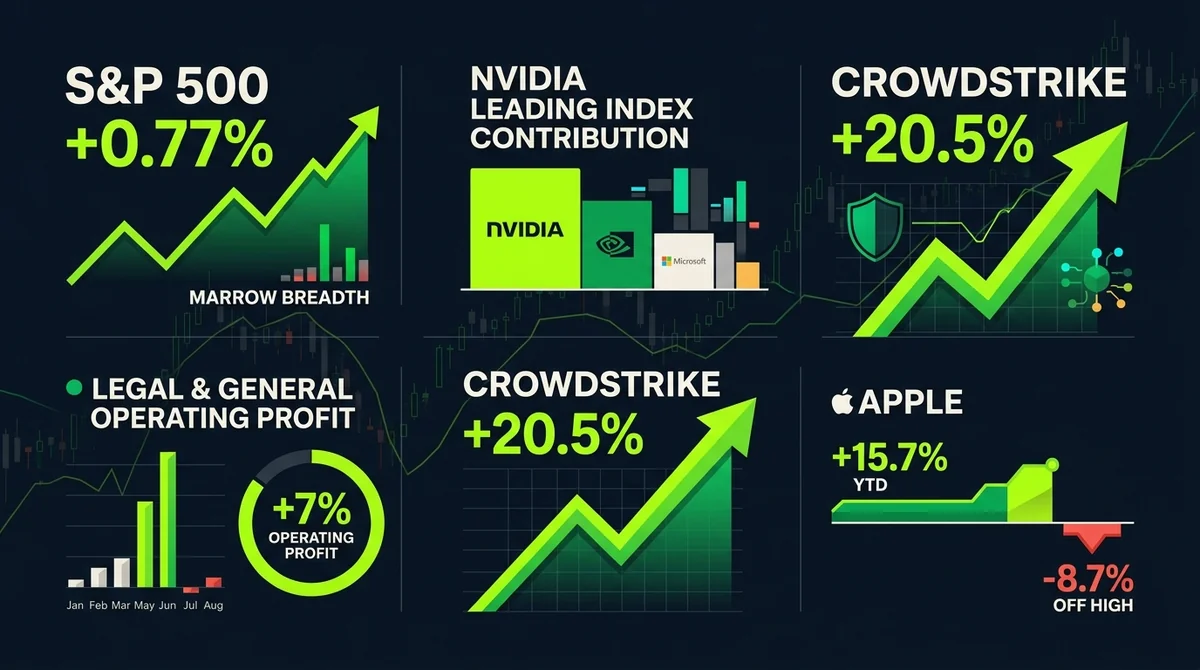
- On Thursday, the S&P 500 rose 0.77%, but breadth was narrow; Nvidia's contribution to the index's gain was significantly ahead of other stocks.
- Legal & General's first-half core operating profit rose 7%, with asset management and retail businesses offsetting weakness in the institutional retirement division; analysts downgraded the stock to neutral.
- Federal Reserve Chair Warsh will speak at Jackson Hole at 10 a.m. ET on Friday.
- CrowdStrike surged 20.5% on Thursday; CEO George Kurtz said: "The recognition that AI attackers have already arrived has formed, and this is driving growth momentum."
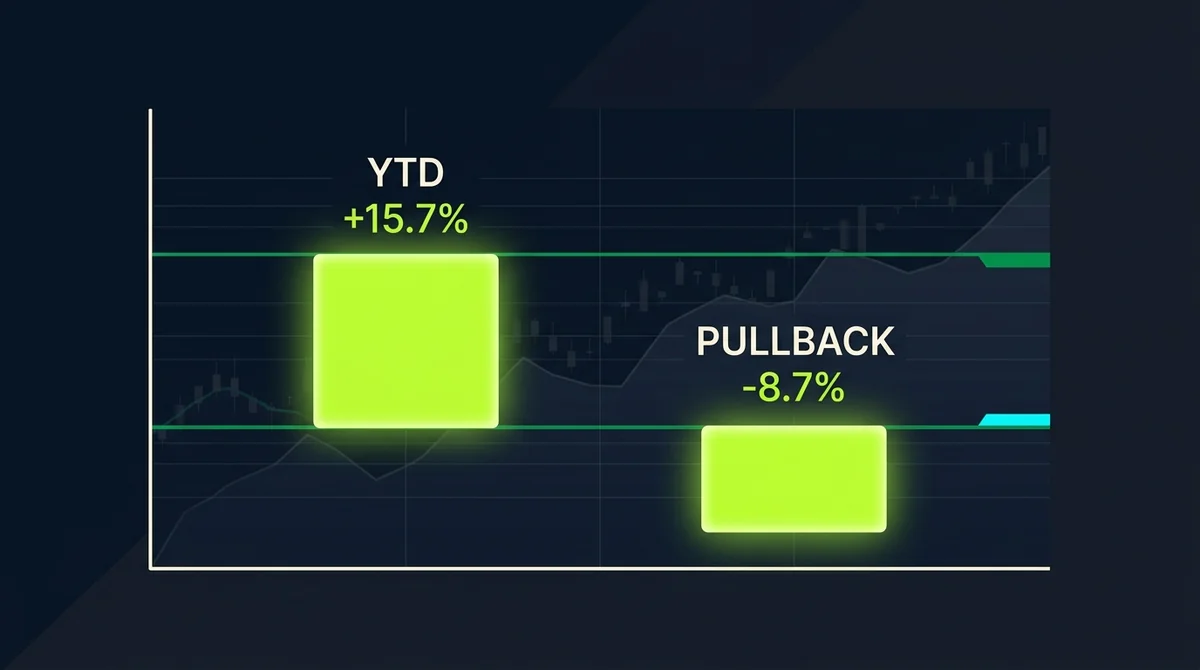
- Apple CEO Tim Cook will step down, and John Ternus will take over on September 1; Apple's stock is up 15.7% year to date but down 8.7% from its July 29 high.
1. Nvidia's Contribution to S&P 500 Gains Is Significantly Ahead, Narrow Breadth Exposes Index Concentration Risk
1. Nvidia's Contribution to Index Gains Is Significantly Ahead of Other Stocks: A Single Stock Props Up the Index
Thursday's S&P 500 rose 0.77%, seemingly a moderate upward move, but after breaking down the contribution structure, it is clear that Nvidia's contribution to the index's gain was significantly ahead of other stocks. This data comes from a Seeking Alpha report on August 28, 2026. When a single stock's contribution to a broad index reaches a leading level, it means the index's rise is not driven by broad sector rotation but by Nvidia and the high-momentum sector where it sits. Nvidia's trajectory is therefore no longer just an individual company event, but directly related to the direction and pace of the S&P 500.
This structure is not uncommon in the late stages of a bull market, but it often comes with fragility. When Nvidia's contribution is significantly ahead, the index's exposure to a single company or a single trading theme (AI computing power) rises. If the company later disappoints on earnings, guidance, or valuation, the index's pullback could be amplified. More importantly, narrow breadth weakens the sustainability of the trend, because a healthy rebound usually requires participation from more stocks, not just support from a few heavyweights.
2. S&P 500 Rises 0.77% but Breadth Is Narrow: A Few Momentum Stocks Mask Market Divergence
On the same trading day when the S&P 500 rose 0.77%, breadth was narrow. Seeking Alpha's report specifically highlighted this: Nvidia's contribution was significantly ahead, but the market's internal divergence did not improve. Narrowing breadth shows that most constituent stocks did not strengthen in tandem; a few momentum stocks masked the market's internal divergence. If this structure persists, it may mean that capital is seeking certainty in crowded local trades while avoiding broader valuation repricing.
For the subsequent market, we need to watch whether other sectors can take over. If heavyweight sectors such as financials, energy, and consumer cannot provide breadth support, then the index's high-level momentum at current levels may lack true breadth. The market may repeatedly fluctuate at high levels, and any macro negative could trigger rapid deleveraging of concentrated positions. The combination of Nvidia's leading contribution and narrow breadth should be viewed as a warning sign of short-term pricing fragility, rather than a simple confirmation of strength.
2. Legal & General Core Operating Profit Rises 7%, Downgrade to Neutral Reflects More Fair Risk-Adjusted Returns
1. Core Operating Profit Rises 7%: Asset Management and Retail Businesses Offset Weakness in Institutional Retirement Division
Legal & General's first-half core operating profit rose 7%. According to Seeking Alpha, this growth was driven by both asset management and retail businesses, which together offset weakness in the institutional retirement division. A 7% increase is not a bad result in itself, but after breaking down the business lines, the structural divergence is very clear: asset management and retail businesses showed resilience, while the institutional retirement division was a drag. This divergence is not merely cyclical; it more likely reflects a long-term shift in business focus — retail and asset management require sustained client inflows and product innovation, while the institutional retirement business faces pressure from liability-side costs and investment returns.
While core operating profit rose 7%, the market's reaction was not positive. This reminds us that profit growth alone cannot support valuation; the quality of the business structure and risk-adjusted returns are the core variables in pricing. When growth sources are concentrated in a few divisions while another core division remains under pressure, the market will demand a higher uncertainty discount.
2. Analysts Downgrade to Neutral: Institutional Retirement Drag and Risk-Adjusted Return Assessment
Analysts downgraded the stock to neutral, an action reported by Seeking Alpha that clearly relates to an assessment of risk-adjusted returns. A downgrade to neutral means analysts believe the current price already fairly reflects the company's mixed fundamentals. Weakness in the institutional retirement division offset the strengths of asset management and retail, making the overall risk-reward no longer clearly attractive.
From an investment logic perspective, a downgrade is not a wholesale rejection of the company's profitability, but a recalibration of the balance between potential returns and risks assumed. Legal & General's business mix makes it relatively sensitive to interest rates and capital market fluctuations, especially the liability side of its institutional retirement division. When risk-adjusted returns are assessed as "fair," the case for overweight weakens, which is a common path for a rating downgrade from buy or outperform to neutral.
3. Resilience in Retail and Asset Management Businesses Stands Out: But Not Enough to Sustain Higher Rating Expectations
Although the retail and asset management businesses showed resilience, they were not strong enough to sustain higher rating expectations. This indicates that the market is beginning to scrutinize Legal & General with a stricter benchmark: not only looking at growth, but also at the certainty of growth and risk exposure. The resilience of retail and asset management deserves recognition, but their scale and growth slope are not yet sufficient to fully cover the drag from the institutional retirement division. Therefore, the downgrade to neutral can be understood as a rational return to risk pricing.
The lesson for current U.S. stocks is that even a company with rising profits can be downgraded due to internal business structure and risk-reward assessment. The market is shifting from simply chasing profit growth to a pricing framework that places more emphasis on risk-adjusted returns. Legal & General's experience is not isolated, but a microcosm of this macro pricing trend.
3. Warsh's Friday Jackson Hole Speech: 10 a.m. ET Policy Signal Will Reshape Rate Pricing and Risk Appetite
1. Warsh to Speak Friday at 10 a.m. ET: Jackson Hole Focus Falls on Fed Policy Path
Federal Reserve Chair Warsh will speak at Jackson Hole at 10 a.m. ET on Friday. This event is the most important macro event of the remaining trading week, confirmed by CNBC in a report on August 27, 2026. The Jackson Hole symposium has always been a key window for the Fed to release policy signals, and as Fed Chair, Warsh's wording will directly map to expectations for the future rate path. If the speech leans hawkish, the market may raise expectations for further rate hikes or maintaining high rates; if it leans dovish, it may trigger a rebound in risk assets. Regardless of direction, the speech itself will cause volatility.
In terms of timing, Friday at 10 a.m. ET is shortly after the U.S. stock market opens, meaning the market will digest the speech content in real time during the trading session. Given that the S&P 500's breadth is currently narrow and the index relies heavily on a few stocks like Nvidia, any change in policy signals could amplify market volatility. Growth stocks and interest-rate-sensitive sectors are particularly vulnerable because their valuations are more sensitive to changes in discount rates.
2. Market Turns Cautious Before Speech: Risk Assets May Recalibrate Rate Expectations Based on Wording
Before Warsh's speech, the U.S. stock market entered a wait-and-see state. CNBC reported that risk assets may recalibrate rate expectations based on the wording. This caution itself reflects uncertainty about policy direction. For some time, rate path expectations have been volatile, and the market urgently needs a clearer anchor from Jackson Hole. If Warsh clearly states that controlling inflation remains the priority, it may suppress risk appetite; if he emphasizes financial stability or growth risks, it may push risk assets higher.
For the daily U.S. stock watch, Friday's speech is likely to become a short-term watershed for risk appetite. Especially against the backdrop of increased volatility in large tech stocks such as Apple and Nvidia, policy signals will directly affect capital allocation decisions on growth stocks. The pattern of market caution before the speech and repricing after is typical for major macro events. Investors need to pay attention not only to the dot-plot style rate direction, but also to Warsh's comprehensive judgment on economic resilience, inflation stickiness, and financial conditions.
4. CrowdStrike Surges 20.5% in a Day: Recognition That AI Attackers Have Arrived Drives Revaluation of Security Sector Growth Momentum
1. CrowdStrike Rises 20.5% on Thursday: Recognition That AI Attackers Have Arrived Creates Growth Momentum
CrowdStrike surged 20.5% on Thursday, a significant single-day gain. CNBC reported this data that day. The catalyst was not just earnings or orders, but CEO George Kurtz's statement: "The recognition that AI attackers have already arrived has formed, and this is driving growth momentum." The core of this statement is that the market is beginning to transform AI security demand from a conceptual theme into verifiable, priceable growth momentum. CrowdStrike's stock reaction shows that capital is willing to pay a premium for this cognitive shift.
The recognition that AI attackers have already arrived means that the demand side of the cybersecurity industry is undergoing structural change. Traditional defense systems are difficult to deal with AI-driven automated attacks, and enterprises need smarter, more real-time security solutions. CrowdStrike, as a platform for modular endpoint security and cloud security, naturally benefits from this trend. Although the 20.5% single-day gain contains an emotional component, it is indeed supported by the logic of long-term demand upgrading.
2. George Kurtz's Comments Strengthen Security Demand Expectations: AI Security Becomes an Independent Growth Narrative
George Kurtz's comments not only explained this quarter's growth, but also sent a signal to the market: AI security will become an independent growth narrative. In the past, cybersecurity was often seen as a defensive sector within IT spending with limited valuation elasticity. But the emergence of AI attackers changed that perception. Security is no longer just a cost center, but may become a necessary precondition for enterprise digitalization and the implementation of AI applications. This narrative upgrade is strengthening the valuation logic of the entire cybersecurity sector.
For the U.S. stock market, CrowdStrike's rise may drive capital to reassess the earnings visibility of the AI security track. If more security vendors later confirm accelerating AI-related demand, the cybersecurity sector may switch from a "value sector" to a "growth sector." Of course, a single-day surge also means short-term valuations need to be digested, and whether it can continue depends on whether actual orders and revenue growth can fulfill the narrative. But at least this week, AI security has become one of the market's focal points.
5. Apple CEO Transition Confirmed: Cook Steps Down, Ternus Takes Over on September 1, Stock Pulls Back 8.7% from High
1. Cook Steps Down, Ternus Takes Over on September 1: Apple Enters a New Leadership Cycle
Apple CEO Tim Cook will step down, and John Ternus will take over on September 1. This management change was confirmed by CNBC in a report on August 27, 2026. A CEO transition usually means the company enters a new leadership cycle, and strategic priorities, capital allocation, and product pacing may all adjust. During Cook's tenure, Apple was pushed toward services and ecosystem growth. After Ternus takes over, the market will watch whether he continues the existing strategy or shifts to a new product innovation cycle, such as AI terminals, spatial computing, or the decision on the automotive business.
The transition timing is very clear: taking over on September 1 means the new CEO will soon face the next quarter's earnings and product launch window. The market already has divergent views on Apple's long-term growth narrative, and the leadership handover adds further uncertainty. Investors will closely track Ternus's first public comments and organizational adjustments after taking office.
2. Up 15.7% Year to Date, Down 8.7% from July 29 High: Market Pricing Divergence Amid High-Level Pullback
Apple's stock is up 15.7% year to date, but has pulled back 8.7% from its July 29 high. These two figures also come from CNBC's report. The year-to-date positive return shows that Apple was still favored by capital overall in 2026, but the high-level pullback indicates that the market saw clear profit-taking or risk aversion at key levels. The CEO transition and the high-level stock pullback occurring simultaneously reinforces short-term pricing divergence. Part of the capital believes Apple's services ecosystem and AI terminal narrative are still enough to support high valuations, while another part worries about execution risks brought by the new leadership cycle.
As a heavyweight in the S&P 500, Apple's stock fluctuations have an important impact on the index. The current 8.7% pullback has not yet changed the upward trend for the year, but if market expectations further weaken after the new CEO takes office, it could put additional pressure on the index. The high-level pullback itself is also a facet of this round of U.S. stock concentration risk: once heavyweight stocks enter adjustment, the support for the index's rise will clearly weaken.
Final Thoughts
From Nvidia's concentrated contribution and Legal & General's downgrade, to Warsh's speech, CrowdStrike's AI security narrative, and Apple's leadership transition, this week's market faces three variables simultaneously: macro policy, individual stock momentum, and corporate governance. These three are not isolated: narrow breadth exposes the index's dependence on a few high-momentum stocks, while the explosion of the AI security narrative provides a new growth mainline, and Apple's transition reminds us that corporate governance changes can amplify valuation volatility at high levels.
Narrow breadth and high-level pullbacks suggest short-term pricing fragility, while AI security and policy signals may become the next watershed for risk appetite. If Warsh's speech leans hawkish, high-valuation growth stocks will face greater pullback pressure; if the wording leans dovish, independent narratives such as AI security may receive more accommodative liquidity support. The market is seeking a new equilibrium between macro policy and individual stock narratives. Concentration risk, AI security momentum, and the rate path will jointly determine the next direction of U.S. stocks.
Risk warning: Macroeconomic and U.S. stock market volatility is severe. This content is for OKX Radar research observation reference only and does not constitute investment advice.
Investment, AI, RWA, Finance
References and verification links
These are the article-level sources stored with this page. Interpret dynamic facts and rules in light of their dates, regions, and subsequent updates.
FAQ
How much did the S&P 500 rise on Thursday? What was the breadth like? ▼
The S&P 500 rose 0.77% on Thursday, but breadth was narrow; Nvidia's contribution to the index's gain was significantly ahead of other stocks.
How much did Legal & General's first-half core operating profit grow? How did the rating change? ▼
Legal & General's first-half core operating profit rose 7%, with asset management and retail businesses offsetting weakness in the institutional retirement division; analysts downgraded the stock to neutral.
When is Warsh's speech at Jackson Hole? ▼
Federal Reserve Chair Warsh will speak at Jackson Hole at 10 a.m. ET on Friday.
What was CrowdStrike's gain on Thursday? What was the driving force? ▼
CrowdStrike surged 20.5% on Thursday. CEO George Kurtz said the recognition that AI attackers have already arrived has formed, which is driving growth momentum.
When is Apple's CEO transition? How has the stock performed? ▼
Apple CEO Tim Cook will step down, and John Ternus will take over on September 1. Apple's stock is up 15.7% year to date, but down 8.7% from its July 29 high.