OKX Radar Daily US Stock Watch: Nvidia, Legal & General and Friday's US Stocks: Nvidia Leads S&P 500 Gains, Apple CEO Transition and Fed Chair Speech in Focus
Nvidia-led S&P 500 gains mask narrow breadth; Legal & General downgraded; Apple CEO change and Fed Jackson Hole speech coincide; cybersecurity stocks diverge.

Article Citation Summary
Nvidia-led S&P 500 gains mask narrow breadth; Legal & General downgraded; Apple CEO change and Fed Jackson Hole speech coincide; cybersecurity stocks diverge.
OKX Radar Editorial Team Guest Columnist @OKXRadar
August 28, 2026
This article is approximately 5,200 Chinese characters and takes about 14 minutes to read.
From an editorial perspective, when the S&P 500's 0.77% gain appears to signal a return to an upward channel, the index's internal structure reveals a more concerning fact: breadth is narrowing rapidly, and a handful of tech heavyweights—especially Nvidia—are almost single-handedly propping up the market's surface-level prosperity. On the same day, Legal & General posted profit growth yet faced a downgrade, Apple's CEO transition and the Fed chair's Jackson Hole speech approached simultaneously, and the cybersecurity sector showed extreme divergence driven by the AI threat narrative. These parallel events collectively point to the same conclusion: US stock pricing in late August 2026 is shifting from broad gains driven by macro liquidity to a high-volatility phase dominated alternately by single-stock concentration, corporate governance events, and thematic fundamental verification.
AI Summary
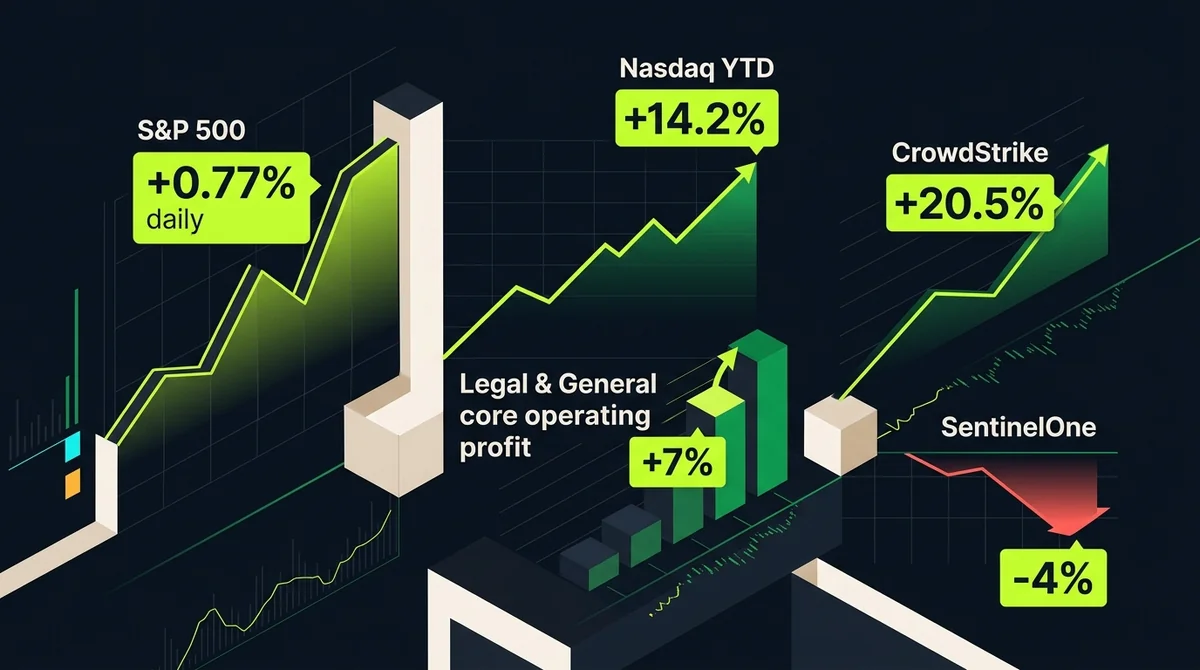
Core Viewpoint: Friday's US stock pricing faces the resonance of four-fold divergence: Nvidia-driven index gains mask insufficient market breadth; Legal & General's earnings resilience failed to prevent a downgrade, indicating stricter valuation standards; Apple's CEO transition and the Fed chair's speech coincide on the same day, intertwining company-specific risk with macro policy signals; cybersecurity stocks show extreme divergence with CrowdStrike surging and SentinelOne falling under the AI threat narrative. Index-level gains do not equate to a healthy market environment, and structural fragility is accumulating.
Key Elements:
- As of writing, the S&P 500 was on track to close Thursday up 0.77%, but breadth was narrow, with Nvidia's contribution to the index significantly ahead of other stocks.
- Legal & General Group's core operating profit grew 7% in the first half, with asset management and retail businesses offsetting weakness in institutional retirement, and the company's rating was downgraded to neutral.
- The Nasdaq Composite on Thursday posted its best single-day performance since August 4, with the S&P 500 up 12.9% year-to-date and the Nasdaq up 14.2% year-to-date.
- Fed Chair Kevin Warsh will speak at Jackson Hole at 10 a.m. ET on Friday.
- Apple CEO Tim Cook will step down, with John Ternus taking over on September 1.
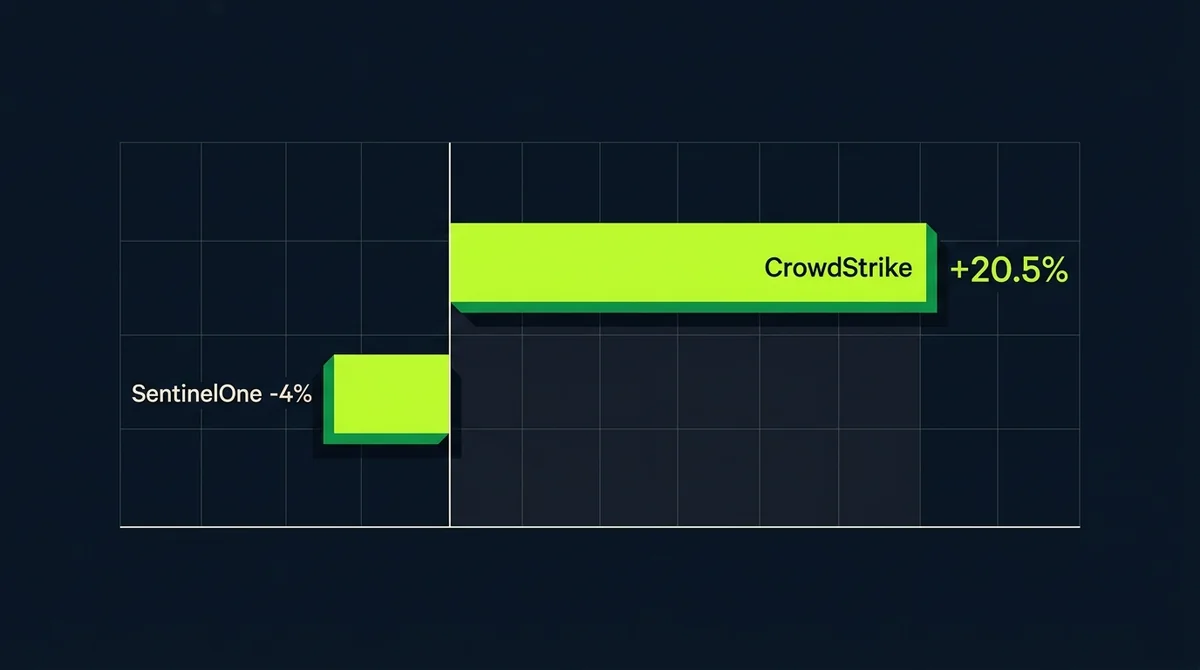
- Cybersecurity stock CrowdStrike rose 20.5% on Thursday, while SentinelOne fell about 4% in after-hours trading. CrowdStrike's CEO said "AI threats are already here."
Key Data at a Glance:
| Indicator | Data/Event | Source/Notes |
|---|---|---|
| S&P 500 Thursday gain | 0.77% | Seeking Alpha, as of writing |
| S&P 500 breadth | Narrow, with Nvidia's contribution significantly ahead of other stocks | Seeking Alpha |
| Nasdaq Thursday performance | Best single-day performance since August 4 | CNBC |
| S&P 500 YTD gain | 12.9% | CNBC |
| Nasdaq YTD gain | 14.2% | CNBC |
| Legal & General core operating profit | Up 7% | Seeking Alpha |
| Legal & General rating | Downgraded to neutral | Seeking Alpha |
| Apple CEO transition | Tim Cook steps down, John Ternus takes over on September 1 | CNBC |
| Fed Chair speech | Kevin Warsh at Jackson Hole, 10 a.m. ET Friday | CNBC |
| CrowdStrike Thursday gain | 20.5% | CNBC |
| SentinelOne after-hours performance | Down about 4% | CNBC |
I. Nvidia Props Up S&P 500 Gains Almost Single-Handedly; Narrowing Breadth Exposes Structural Fragility
Section Summary: Nvidia alone supports S&P 500 gains, and narrowing breadth reflects insufficient market breadth; index gains cannot represent a broad risk appetite recovery.
1. S&P 500 on track to close Thursday up 0.77%, but breadth narrow: Nvidia's contribution significantly ahead of other stocks
From an editorial perspective, as of writing, the S&P 500 was on track to close Thursday up 0.77%. The gain itself is not particularly large, but what truly deserves attention is its internal composition. According to Seeking Alpha, the S&P 500's breadth was quite narrow, with Nvidia's contribution to the index significantly ahead of other stocks. This means that if Nvidia were removed from the index, the S&P 500's Thursday gain might shrink drastically, possibly even approaching flat. In a healthy market environment, index gains are usually accompanied by synchronized strength in most constituent stocks, but the current situation is the opposite: a few ultra-large-cap tech stocks are pulling the index while many stocks are not participating in the gains. This phenomenon is not new, but its reappearance in August 2026 reflects that the market's pricing of AI computing power demand has become highly concentrated in leading companies.
Another direct consequence of narrowing breadth is that the index's performance increasingly fails to represent the true temperature of the overall market. Investors who only observe the intraday gains of the S&P 500 or Nasdaq may easily conclude that market sentiment is positive; however, after dissecting the contribution structure, it becomes clear that the index is supported by the alpha of a few stocks, not a broad recovery in risk appetite. From a strategic perspective, this rising concentration means that once heavyweight stocks like Nvidia experience a technical pullback or news-driven disturbance, the index could face larger volatility. Seeking Alpha's headline pointed out the implication of "Nvidia filling in," which is more like a structural dependency than a sustainable rotation. When a few companies continuously serve as the index engine, the market's fragility is not reflected in the magnitude of gains but in the potential for violent reflexive corrections that could occur at any time due to shifts in expectations for these headliners.
2. Nasdaq posts best single-day performance since August 4, with tech weights driving a 14.2% year-to-date gain
From an editorial perspective, on the same day, the Nasdaq Composite posted its best single-day performance since August 4. The positive signal in this data is undeniable. According to CNBC, the S&P 500 is up 12.9% year-to-date, and the Nasdaq is up 14.2% year-to-date. These numbers are not striking on a full-year basis, but combined with the day's contribution structure, the tech sector's pull on the Nasdaq's gains is even more pronounced. The Nasdaq is inherently tech-heavy, and its outperformance is often related to capital inflows into the AI supply chain, semiconductors, software services, and other areas. Nvidia, as a core AI computing target, occupies a unique position within tech weights, and its single-day performance has an amplified impact on the Nasdaq.
The 14.2% year-to-date gain ostensibly reflects market recognition of tech profitability, but deeper down, the sustainability of this gain depends on two conditions: first, whether AI-related capital expenditure can continue to translate into revenue growth for leading companies; second, whether the market can tolerate the coexistence of high valuations and high concentration. If macro liquidity tightening signals emerge in the coming weeks, or if Nvidia's earnings guidance disappoints, the Nasdaq could face greater pullback pressure than the S&P 500. The current structure resembles a crowded trade in the pursuit of certainty: the market is placing a large amount of bets on a few verified AI core assets, which itself exacerbates the index's fragility. Therefore, Thursday's "best single-day performance" should not be simply interpreted as trend reinforcement; rather, it should be seen as further accumulation of concentration risk. Once the rotation of tech weights stalls, the Nasdaq's excess return relative to the S&P 500 may quickly narrow, and the relationship between the two is precisely the key to understanding the structural risks of US stocks in 2026.
II. Legal & General Core Operating Profit Up 7%, Asset Management and Retail Offset Institutional Retirement Weakness, Rating Downgraded to Neutral
Section Summary: Legal & General's core operating profit grew 7%, but institutional retirement business was weak and the rating was downgraded to neutral; growth structure receives more attention than growth rate.
1. First-half core operating profit up 7%, with asset management and retail businesses as main support
From an editorial perspective, British insurance and asset management group Legal & General Group released what appears to be a contradictory combination: core operating profit grew 7%, yet the company's rating was downgraded to neutral. According to Seeking Alpha, Legal & General's core operating profit grew 7% in the first half, with asset management and retail businesses offsetting weakness in institutional retirement. From a business structure perspective, the resilience of asset management and retail is the main source of profit growth, indicating that the company has some counter-cyclical capability in its diversified revenue layout. Especially in an environment of fluctuating interest rates and increased difficulty in pension liability management, asset management can provide stable fee income, while retail business maintains growth through product innovation and customer stickiness, jointly offsetting the decline in institutional retirement.
However, profit growth alone is not enough to support a higher valuation. Institutional retirement, long one of Legal & General's core segments, has shown weakness that exposes deeper issues: amid uncertain interest rate paths, longevity risk, and stricter regulatory capital requirements, the risk-adjusted return of this business is declining. What the market sees is not a simple one-off shock but structural headwinds. When profit growth is mainly driven by non-core businesses while the core business is weak, investors naturally reassess the company's long-term growth quality. The Legal & General case illustrates that the market's valuation logic for the insurance and asset management sector has changed in 2026: profit growth alone is not enough; the structure and sustainability of growth are equally critical.
2. Institutional retirement business weak; downgrade to neutral reflects risk-reward reassessment
From an editorial perspective, the downgrade to neutral is not a wholesale denial of the company's fundamentals but a recalibration of the risk-reward ratio. Seeking Alpha's headline directly pointed out that "risk-adjusted returns now look fair," implying that the market may have previously embedded overly high expectations. Weakness in institutional retirement, combined with the downgrade, will push the stock into a repricing period. For Legal & General, the resilience of asset management and retail can provide some support but cannot fully fill the valuation gap left by institutional retirement.
From a broader industry perspective, Legal & General's experience is not an isolated case. The insurance and asset management sector faces common challenges in 2026: expectations of lower interest rates compress spread income, changes in pension transfers and retirement product demand push up liability management costs, and the regulatory environment imposes stricter capital adequacy requirements. Against this backdrop, investors' trust threshold for profit growth has clearly risen, and a single quarter of profit growth is no longer sufficient to earn a premium. Legal & General's downgrade can be understood as the market applying a stricter standard to test the earnings quality of every insurance asset management company. Once this standard is established, companies in the industry that rely on a single business or have poor growth quality may face similar valuation pressure, and changes in the attitudes of rating agencies and sell-side analysts will further influence capital allocation within the financial sector through expectation gaps.
III. Apple CEO Transition and Fed Chair Friday Speech Coincide, Market Faces Dual Signals from Corporate Governance and Monetary Policy
Section Summary: Apple CEO transition and Fed chair speech coincide on Friday; corporate governance events and macro policy signals will jointly reshape risk asset prices within the same trading window.
1. Tim Cook steps down, John Ternus becomes Apple CEO on September 1; transition timing becomes a pricing focus
From an editorial perspective, Apple's management transition is a company-specific event that cannot be ignored in Friday's US stock pricing. According to CNBC, Apple CEO Tim Cook will step down, and John Ternus will take over on September 1. This arrangement means that with only a few days until the new CEO officially assumes office, the market will have to absorb the uncertainty of the transition in a short period. During Tim Cook's tenure, Apple maintained a stable product rhythm and strong supply chain management capabilities, with market value and profitability at the top of the industry; John Ternus, who previously oversaw hardware engineering for a long time, is seen by the market as continuing Apple's hardware innovation and supply chain vertical integration. Even so, CEO transition is itself one of the most sensitive corporate governance events, and any speculation about strategic direction, product roadmap, or management stability could trigger stock price volatility.
From a pricing perspective, Apple, as a heavyweight in both the S&P 500 and Nasdaq, has a CEO transition impact that extends beyond the company itself, transmitting through index weights to the entire market. Friday happens to be the last trading day before the transition officially takes effect, and market participants need to balance company-specific risk with overall risk appetite. If investors believe John Ternus can smoothly continue Apple's hardware-led strategy, the transition may be absorbed as a neutral-to-positive signal; conversely, if the market worries that the management change brings strategic wavering, Apple's stock price fluctuation could be amplified through the index and affect market sentiment. The uniqueness of this event is that it is not driven by earnings reports or macro data but purely by corporate governance, which increases the unpredictability of pricing.
2. Fed Chair Kevin Warsh to speak at Jackson Hole at 10 a.m. ET Friday; monetary policy tone will influence risk appetite
From an editorial perspective, approaching simultaneously with the Apple CEO transition is Fed Chair Kevin Warsh's speech at Jackson Hole. According to CNBC, Fed Chair Kevin Warsh will speak at Jackson Hole at 10 a.m. ET Friday. The Jackson Hole symposium has always been an important window for global central bank policy signals, and the market will closely watch Warsh's remarks on inflation, employment, economic growth, and the future interest rate path. With US stocks at high levels, any hint of monetary policy tightening or maintaining high rates for longer could directly suppress risk appetite; if the speech leans dovish, emphasizing economic resilience but controllable inflation, it could provide further support for tech weight stocks.
The 10 a.m. Friday speech, coinciding with the approach of Apple's CEO transition, creates a temporal overlap that forces the market to digest two completely different types of signals on the same day: one is micro-level corporate governance change, the other is macro-level monetary policy guidance. This combination of dual disturbances is not common historically and requires investors to react to both heavyweight stocks and overall market pricing in a very short time. From the OKX Radar observation perspective, this "company-specific + macro policy" collision on the same day is more likely to trigger intraday liquidity fluctuations and rising volatility. Especially when market breadth is already narrow, even a slight change in macro signals can be amplified into index-level swings. Therefore, Friday's US stock pricing is not driven by a single factor but by corporate governance and monetary policy jointly reshaping risk asset prices in a short period.
IV. Cybersecurity Stocks Diverge: CrowdStrike Surges 20.5% in a Single Day While SentinelOne Falls 4% After Hours; AI Threat Narrative Accelerates Pricing
Section Summary: CrowdStrike rose 20.5% while SentinelOne fell about 4% after hours; the cybersecurity sector is entering a fundamental verification phase, and the AI threat narrative is no longer a blanket reason for gains.
1. CrowdStrike CEO says "AI threats are already here," stock surges 20.5% in a single day
From an editorial perspective, the cybersecurity sector showed extreme divergence on Thursday, with CrowdStrike's performance particularly outstanding. According to CNBC, cybersecurity stock CrowdStrike rose 20.5% on Thursday, and its CEO said "AI threats are already here." This statement directly linked AI with cybersecurity demand and quickly ignited market expectations for AI-driven security spending. As AI large models and intelligent agents accelerate penetration across industries, attackers' methods are also evolving rapidly. AI is being used to generate more sophisticated phishing emails, automate vulnerability exploitation, and evade defense systems in real time, shifting enterprise security protection demand from traditional rule engines to AI-native detection and response platforms. CrowdStrike, as a leading platform in this field, saw its 20.5% single-day gain reflect the market's willingness to pay a high premium for the "AI + security" narrative.
However, it is important to note that the source facts do not provide specific financial triggers for CrowdStrike's gain, such as earnings data or order guidance. Therefore, the 20.5% gain should be understood more as sentiment-driven pricing propelled by the CEO's remarks and the AI threat narrative, rather than fact-based pricing based on disclosed performance. This implies that the gain may contain a significant component of market expectations, and if fundamental verification is lacking, the stock faces pullback risk. For observers, CrowdStrike's rise provides a clear sample: when the AI theme resonates with cybersecurity demand, capital rapidly concentrates in leaders, but this concentration itself plants the seeds of increased volatility.
2. SentinelOne falls about 4% after hours; intra-sector divergence highlights fundamental differences
From an editorial perspective, in sharp contrast to CrowdStrike's surge, SentinelOne fell about 4% in after-hours trading. According to CNBC, SentinelOne fell about 4% after hours, making the internal divergence in the cybersecurity sector even more glaring. Both are cybersecurity companies under the AI threat narrative, yet CrowdStrike and SentinelOne moved in opposite directions, indicating that the market is not treating "AI + security" as a blanket benefit but is carefully distinguishing each company's platform capabilities, customer structure, and earnings quality. CrowdStrike's popularity may be related to its leading position in endpoint detection and response, cloud-native architecture, and AI-native capabilities; SentinelOne's decline may reflect investor uncertainty about its competitive position, profitability path, or expectation fulfillment.
This intra-sector divergence marks the AI theme's transition from "concept resonance" to "fundamental verification." In the early stages of a theme, capital often buys the entire sector broadly, lifting related stocks; but as expectations heat up, the market begins to screen for true beneficiaries, and pseudo-concept or less competitive companies are quickly abandoned. The differing performances of CrowdStrike and SentinelOne are a direct manifestation of this screening process. For the overall US stock market, the divergence in cybersecurity also reminds us that even if the AI mainline remains active, it should not be viewed as monolithic. Capital flows and pricing logic within the sector have become more refined, bringing both structural opportunities and increased stock-picking difficulty.
Final Thoughts
From an editorial perspective, observing Thursday's and Friday's upcoming events together, one can see that US stock pricing in late August 2026 is entering a complex phase of intertwined factors. Nvidia's single-handed support of S&P 500 gains reflects structural risks of narrowing breadth and rising index concentration; Legal & General's profit growth met with a downgrade shows that the market's valuation standards for the insurance and asset management sector are becoming stricter; Apple's CEO transition and Fed Chair's Jackson Hole speech coincide on the same day, compressing company-specific risk and macro policy signals into the same trading window; and the divergence in cybersecurity stocks signals that the AI theme has entered a critical period of fundamental verification. These four signals are not isolated; together they outline a core trend: the market is shifting from broad gains driven by macro liquidity to a high-volatility environment dominated by individual stock alpha, governance events, and sub-industry logic.
In such a phase, surface-level index gains often create an optimistic illusion, but what truly determines market direction are the structural changes hidden beneath. Nvidia's strength cannot conceal the fact that most stocks are not participating; Legal & General's profit growth failed to prevent a downgrade, showing that quality and structure matter more than growth rate alone; Apple's CEO transition and the Fed chair's speech, if handled well, may be absorbed, but if mishandled, could become volatility amplifiers; the divergence in AI cybersecurity tells us that even the strongest narrative needs fundamental support. The OKX Radar editorial team believes that when observing Friday's and subsequent market action, rather than fixating on whether the index can continue to set new highs, it is better to focus on these structural variables—they are the true anchors determining the market's risk-reward ratio.
Risk Warning: Macroeconomic and US stock market volatility is intense. This content is for OKX Radar research observation reference only and does not constitute investment advice.
Tags: Investment, AI, RWA, Finance
References and verification links
These are the article-level sources stored with this page. Interpret dynamic facts and rules in light of their dates, regions, and subsequent updates.
FAQ
What was the main driver of the S&P 500's Thursday gain? ▼
According to Seeking Alpha, as of writing the S&P 500 was on track to close Thursday up 0.77%, but breadth was narrow, with Nvidia's contribution to the index significantly ahead of other stocks.
When does Apple's CEO transition take effect? ▼
Apple CEO Tim Cook will step down, and John Ternus will take over on September 1.
When will Fed Chair Kevin Warsh speak? ▼
Fed Chair Kevin Warsh will speak at Jackson Hole at 10 a.m. ET on Friday.
Why did cybersecurity stocks diverge? ▼
CrowdStrike rose 20.5% on Thursday and its CEO said "AI threats are already here"; SentinelOne fell about 4% after hours, showing intensifying divergence within the cybersecurity sector.
How did Legal & General perform in the first half? ▼
Legal & General Group's core operating profit grew 7% in the first half, with asset management and retail businesses offsetting weakness in institutional retirement, but the company's rating was downgraded to neutral.