OKX Radar US Stock Daily Watch: Terrestrial Energy Receives Buy Rating with $9 Target Price; Replaceable Core Unit Design Reduces Supply Chain Risk
Seeking Alpha rates Terrestrial Energy a Buy at $9 target; core/fuel design cut supply risk; Texas site progress aids execution; deep discount offers re-rating.

Article Citation Summary
Seeking Alpha rates Terrestrial Energy a Buy at $9 target; core/fuel design cut supply risk; Texas site progress aids execution; deep discount offers re-rating.
OKX Radar Editorial Team (Reviewed by Editorial Team) @OKXRadar Date: September 2026
While the market continues to debate the commercialization timeline for small modular reactors, Terrestrial Energy has already assembled four key elements: a near-term Buy rating, a technological moat, regulatory and site certainty, and a deeply discounted valuation. This is creating a re-rating window for a nuclear newcomer that has not yet been fully priced in.
AI Summary
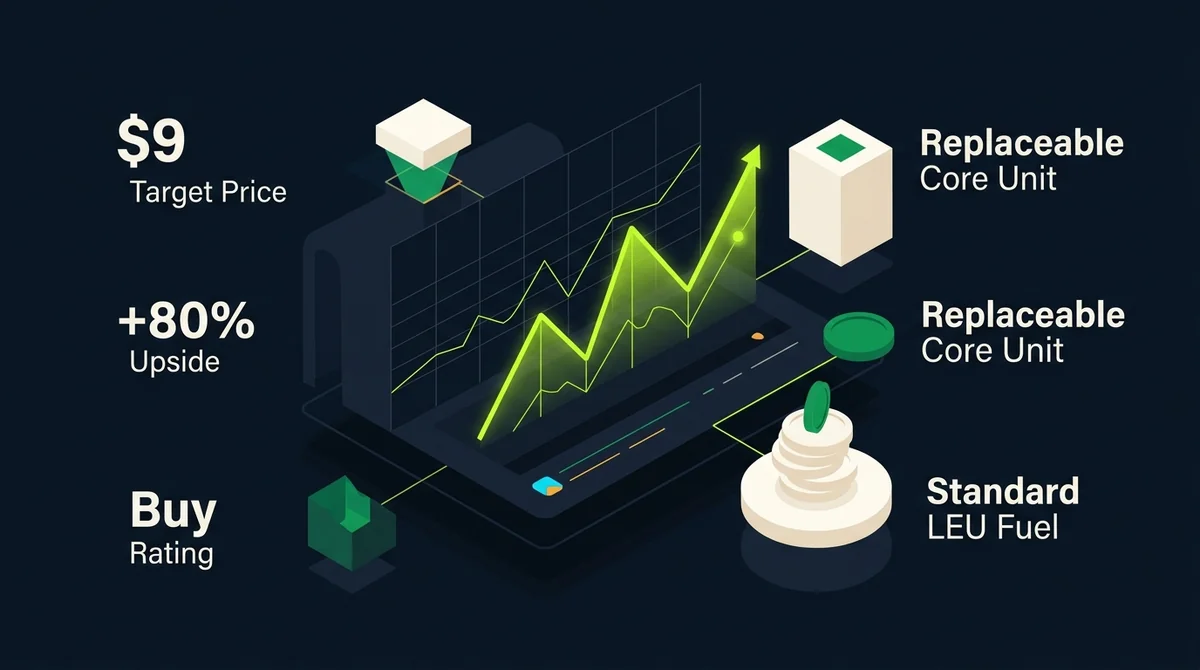
Core Viewpoint: Seeking Alpha authors give a Buy rating with a $9 target price and about 80% upside; replaceable core units and standard low-enriched uranium fuel create dual moats of recurring revenue and supply chain security; regulatory progress, control of the Texas A&M-RELLIS site, and a strong cash position reduce execution risk; a deep discount relative to peers means positive factors are not yet fully priced in, creating a window for valuation repair.
Key Elements:
- Buy Rating: The Seeking Alpha article author gives a "Buy" rating with a $9 target price, implying about 80% upside from current levels.
- Technical Design: Replaceable core units and standard low-enriched uranium fuel design can bring recurring revenue and reduce supply chain risk.
- Project Progress: The company has made regulatory progress, controls the Texas A&M-RELLIS site, and has a strong cash position.
- Valuation Status: Terrestrial Energy's valuation is at a deep discount relative to peers.
| Key Element | Specific Content |
|---|---|
| Buy Rating | Seeking Alpha author gives a "Buy" rating with a $9 target price, implying about 80% upside from current levels |
| Technical Design | Replaceable core units bring recurring revenue; standard low-enriched uranium fuel reduces supply chain risk |
| Project Progress | Regulatory progress made; control of Texas A&M-RELLIS site; strong cash position |
| Valuation Status | Valuation at a deep discount relative to peers, positive factors not yet fully priced in |
I. Buy Rating and $9 Target Price: Seeking Alpha Author's Bullish Call with 80% Upside
1. Seeking Alpha Author Gives Buy Rating: $9 Target Price, About 80% Upside from Current Levels
A Seeking Alpha article published on September 3, 2026, gives Terrestrial Energy (IMSR) a "Buy" rating with a $9 target price, about 80% upside from current levels. This view comes from a third-party independent research platform, not from company management or a traditional sell-side report.
The 80% gap between the $9 target price and the current market price suggests the author believes the market has significantly undervalued the company's long-term value. The article's title directly links it to the power shortage driven by AI computing expansion in 2026, providing a demand-side narrative for the Buy rating.
This rating is not an isolated signal. Amid the re-pricing of nuclear power assets, the author's choice of "Buy" rather than "Hold" indicates an expected risk-reward ratio skewed to the long side. However, the Seeking Alpha author's view remains a personal research opinion, and the target price carries uncertainty from model assumptions. Observers should focus on the reasoning chain behind the target price: the urgent demand for stable power from AI data centers, and the potential advantages of small modular reactors in construction timeline and siting flexibility.
2. Rating and Target Price Together Form a Near-Term Catalyst, Pointing to Market Expectations of Nuclear Asset Re-pricing
The Buy rating and the $9 target price together form a near-term catalyst. The 80% gap between the target price and the current price measures the positive factors not yet digested by the market, giving investors a concrete re-rating path.
However, near-term catalysts can be amplified or quickly fade with market sentiment. Nuclear assets are inherently volatile; regulatory decisions, project progress, and macro interest rates all affect discount rates and risk premiums. The rating and target price should be seen as a starting point for re-pricing expectations, not a definite outcome. Truly sustained catalysts depend on the company's actual delivery on subsequent regulatory, commercial contract, and construction milestones.
II. Replaceable Core Units and Standard Low-Enriched Uranium Fuel: Recurring Revenue and Supply Chain Risk Reduction Form the Core Business Logic
1. Replaceable Core Unit Design Brings a Recurring Revenue Model
The replaceable core unit design brings a business model distinct from traditional nuclear equipment suppliers: recurring revenue. After a reactor operates for a certain number of years, the core components need replacement, generating multiple replacement cycles over the full life of each unit. This model is similar to 'razor and blades': the initial equipment sale is only the starting point, and core unit replacement constitutes a long-term, predictable revenue stream.
The recurring revenue model strengthens the company's valuation anchor. Under a discounted cash flow framework, stable and repeatable revenue enjoys a higher valuation multiple than one-time equipment sales. But this model presupposes that the reactor is first built and put into operation. Currently, the design is still in the technical narrative stage, with a considerable project cycle remaining before recurring revenue can be realized.
2. Standard Low-Enriched Uranium Fuel Reduces Supply Chain Risk
The choice of standard low-enriched uranium fuel is a key design for supply chain security. Highly enriched uranium or specialty fuels face stricter safety regulation and fewer qualified suppliers, while standard low-enriched uranium has a mature global supply chain with stronger procurement substitutability, reducing uncertainty in fuel acquisition.
From a cost perspective, because the supply chain for standard low-enriched uranium is mature, price fluctuations are typically smaller than for specialty fuels, helping to control operating costs and set more stable long-term electricity prices. When AI data centers sign long-term power purchase agreements, buyers often require a certain fuel supply plan; standard low-enriched uranium makes it easier for Terrestrial Energy to meet this requirement.
3. The Two Design Features Together Form a Technological and Commercial Moat Different from Peers
Replaceable core units bring stable cash flow, and low-enriched uranium fuel reduces supply chain risk; together they address the issues of recurring revenue and fuel supply security in nuclear asset operations. These issues are precisely the weaknesses exposed by many small modular reactor competitors during commercialization.
Against the backdrop of AI power shortages, data center customers are more concerned about 'whether stable power can be supplied for the next twenty years' and 'whether fuel sources are secure.' Terrestrial Energy's design combination directly addresses these two core concerns. But the moat still depends on actual operating data: whether core unit replacement costs are controllable and whether low-enriched uranium fuel performs to standard in its own reactor design. These are still written technical advantages, not yet validated by commercial operation.
III. Regulatory Progress and Texas A&M-RELLIS Site Control: Key Validation from Technical Narrative to Project Execution
1. Regulatory Progress Made, Approval Path Gradually Clarifying
One of the greatest uncertainties in nuclear projects is regulatory approval. Terrestrial Energy has made regulatory progress, meaning the company has entered the substantive stage of regulatory engagement rather than remaining at the conceptual design stage.
The value of a gradually clarifying approval path lies in reducing the risk premium in the discount rate. If the company can form effective communication with regulators at an early stage, the subsequent approval timeline may be faster than peers. However, the article does not disclose specific regulators, time nodes, or approved documents; the description of 'progress' remains vague. Observers should combine this information with subsequent specific regulatory announcements and not over-interpret a single wording.
2. Control of Texas A&M-RELLIS Site Provides a Certain Construction Foundation
Controlling the Texas A&M-RELLIS site is a key step to move a nuclear project from paper to physical implementation. The Texas A&M-RELLIS campus is located in Texas and has R&D, engineering, and industrial supporting resources, with obvious locational advantages. Controlling the site also reduces time and cost for land acquisition, demolition, and preliminary negotiations.
The site and regulatory progress form a positive cycle. Regulatory approval requires clear site information; controlling a specific parcel means the company can conduct geological, hydrological, safety, and environmental assessments for that parcel, submitting more complete application materials. If key tests or construction permits are subsequently obtained, the valuation logic will shift from a 'technology company' to a 'project company'.
3. Strong Cash Position Supports Subsequent Capital Expenditure and Operating Investment
Nuclear projects have large capital expenditure and long construction cycles, and the company has almost no operating cash flow before generating revenue. A strong cash reserve allows the company to avoid high-cost financing or excessive equity dilution, preserving more value for shareholders.
In the 2026 interest rate environment, a cash-rich nuclear project company can pay for regulatory, engineering, and site development expenses and has stronger financing bargaining power. The combination of regulatory progress, site control, and a strong cash position jointly reduces the uncertainty of transforming the project from technical narrative to actual execution. However, 'strong cash position' is a relatively qualitative description; the company has not disclosed specific amounts, so it should not be extrapolated to cover all construction costs.
IV. Deep Valuation Discount: Pricing Gap Relative to Peers Provides Re-rating Space
1. Current Valuation at a Deep Discount Relative to Peers
The Seeking Alpha article clearly points out that Terrestrial Energy's valuation is at a deep discount relative to peers. Under the 2026 AI power theme, many nuclear and power infrastructure companies have seen valuation expansion, with some peers already pricing in growth expectations for the next several years. By comparison, Terrestrial Energy's valuation is lower, and the market has not yet given it a similar valuation multiple.
The deep discount partly reflects the market's cautious attitude toward a project not yet launched, concerns about regulatory cycles, and the reality that the company has not yet generated scale revenue. But precisely because of this, when positive factors gradually materialize, the elasticity of discount narrowing will be greater. The deep discount provides a potential margin-of-safety framework, but it cannot be the sole reason for a bullish view; it must be observed together with technical design, regulatory progress, and site progress.
2. Discount, Buy Rating, Technical Design, and Project Progress Form an Expectation Gap
The company simultaneously has a third-party Buy rating, a unique technical route, a clear site, and regulatory progress, yet still trades at a deep discount, indicating a gap between market pricing and positive fundamental signals. This gap may stem from information asymmetry: the Seeking Alpha article has relatively limited reach, and mainstream institutions have not yet intensively covered it; it may also stem from risk appetite: some investors remain skeptical about the commercialization timeline of small modular reactors.
But the other side of the expectation gap is risk. The market sometimes does not ignore positive signals but has already priced in negative factors such as overly long project cycles, insufficient technical validation, or intensifying industry competition. Observers cannot simply assume that 'the discount will inevitably repair'; they should track quarterly project progress, regulatory dynamics, and cash burn to judge whether conditions for discount convergence are maturing. As of September 2026, Terrestrial Energy's expectation gap remains significant, but no definitive directional breakthrough has yet formed.
Final Thoughts
Terrestrial Energy is showing positive signals simultaneously in four dimensions: rating, technology, project execution, and valuation, collectively pointing to a re-rating opportunity not yet fully priced by the market. The Buy rating and $9 target price provide a near-term bullish signal; replaceable core units and low-enriched uranium fuel form long-term barriers; regulatory progress, site control, and cash position reduce execution risk; deep valuation discount provides a re-rating window. The four dimensions reinforce each other.
From a broader market context, the expansion of AI computing power in 2026 is driving a structural rise in power demand, and nuclear power, as a stable and clean baseload power source, is re-entering investors' field of vision. If Terrestrial Energy can advance reactor design at the Texas A&M-RELLIS site, it may benefit from data centers' strong demand for long-term power purchase agreements.
Nuclear project cycles are lengthy, and regulatory, funding, and technical risks coexist. The current positive signals come more from third-party research and the company's disclosed progress than from confirmed firm orders or grid-connected operation. For observers, the focus is not the 'Buy' conclusion itself, but whether the logic chain continues to strengthen as the project progresses: whether regulatory milestones appear, whether the site enters substantive construction, whether cash burn remains within a safe range, and whether the valuation discount begins to narrow.
Editorial Review Note
This article is compiled from the views of a Seeking Alpha third-party author. OKX Radar's editorial team has not independently verified the target price, upside, or technical descriptions. The $9 target price and about 80% upside are the Seeking Alpha author's model assumptions, and past performance does not represent the future. This article aims to present a complete picture of the current bull and bear logic for this target, not to provide a one-way trading recommendation.
Risk warning: Macroeconomic and US stock market fluctuations are severe. This content is for OKX Radar research observation reference only and does not constitute any investment advice.
References and verification links
These are the article-level sources stored with this page. Interpret dynamic facts and rules in light of their dates, regions, and subsequent updates.
FAQ
What is Seeking Alpha's rating and target price for Terrestrial Energy? ▼
Seeking Alpha author gives Terrestrial Energy (IMSR) a "Buy" rating with a $9 target price, 80% upside from current levels.
What are the advantages of Terrestrial Energy's replaceable core units and low-enriched uranium fuel design? ▼
Replaceable core units bring recurring revenue, and standard low-enriched uranium fuel reduces supply chain risk.
What certain progress has Terrestrial Energy made in project implementation? ▼
The company has made regulatory progress, controls the Texas A&M-RELLIS site, and has a strong cash position.
Why is Terrestrial Energy's valuation attractive? ▼
The company's valuation is at a deep discount relative to peers, positive factors are not yet fully reflected, and there is room for valuation repair.