OKX Radar US Stock Daily Watch: Alphabet, Terrestrial Energy, UiPath: Alphabet Gets Buy Rating with $432 Price Target, Terrestrial Energy Target $9, UiPath Downgraded
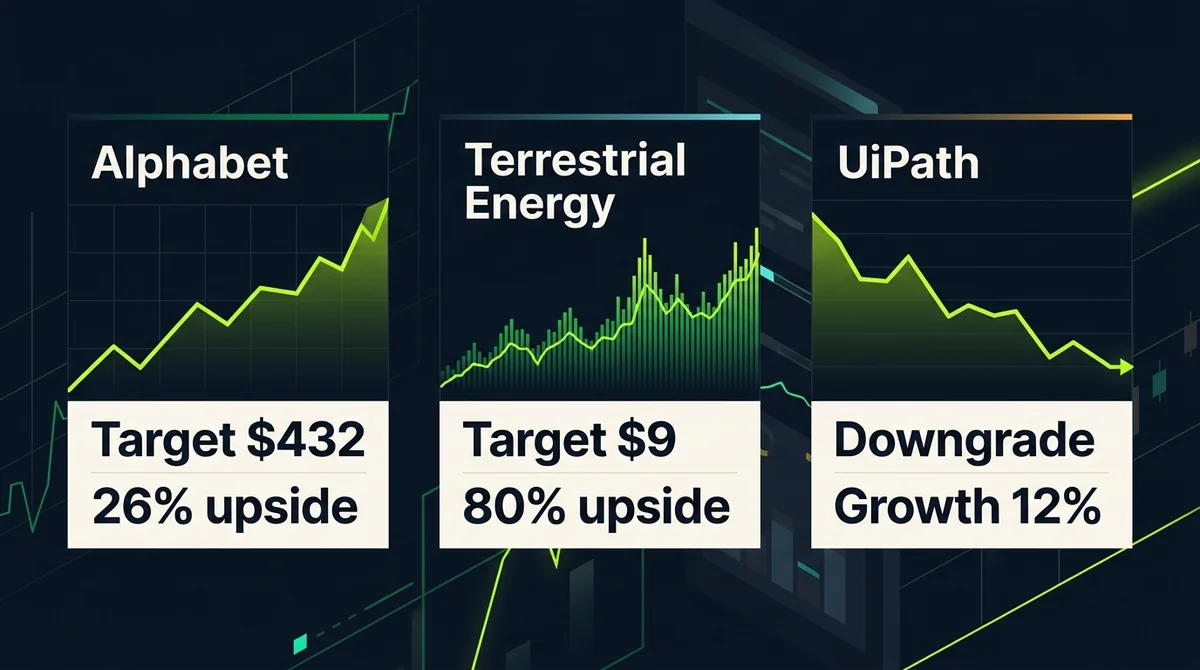
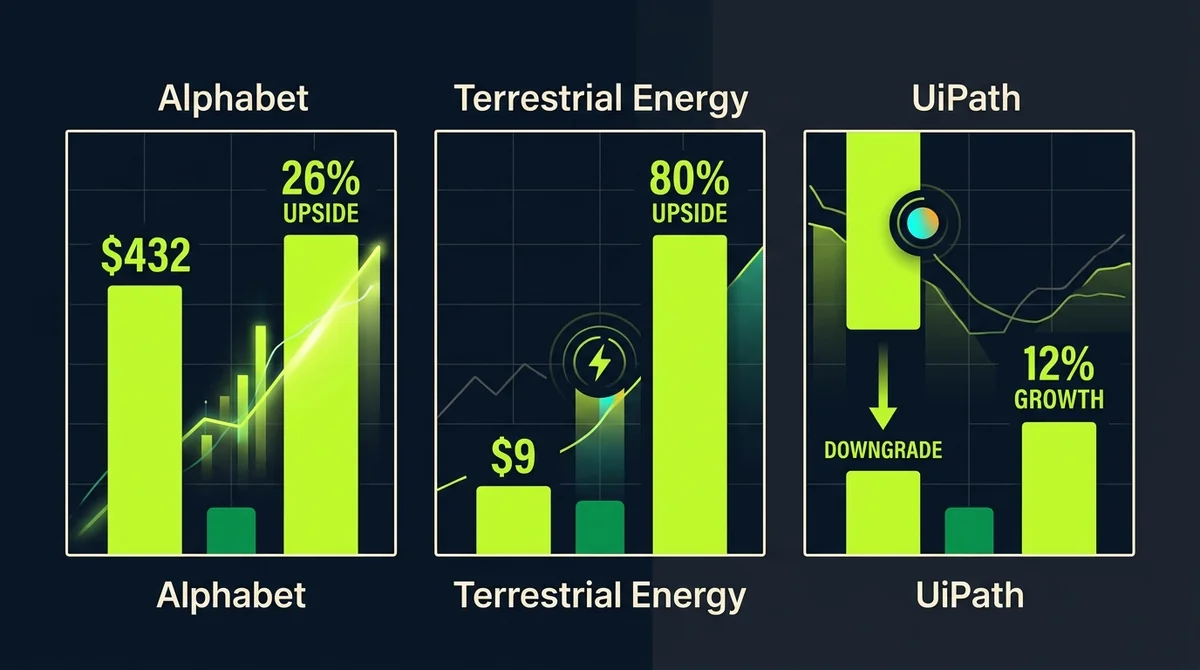
On Sep 3, US stock ratings diverged: Alphabet got a Buy with $432 target (26% upside), Terrestrial Energy $9 (80% upside), UiPath downgraded on valuation, as…

Article Citation Summary
On Sep 3, US stock ratings diverged: Alphabet got a Buy with $432 target (26% upside), Terrestrial Energy $9 (80% upside), UiPath downgraded on valuation, as…
OKX Radar Editorial Team Guest Columnist @OKXRadar September 3, 2026 This article is about 4,900 Chinese characters and takes about 13 minutes to read.
Introduction: In the US stock observation window on September 3, 2026, rating agencies showed significant divergence in pricing AI-themed assets: Alphabet received a Buy rating and a $432 price target due to its AI platform transformation; Terrestrial Energy received a $9 price target and 80% upside due to AI power demand; while UiPath was downgraded because "stable growth but valuation no longer supports bullishness." Behind this set of changes, the market is shifting from broad AI bullishness to structural valuation discipline—companies with hardware, energy, or platform infrastructure attributes enjoy higher narrative premiums, while targets relying solely on software SaaS growth narratives are the first to face valuation repricing. This article will analyze the three companies one by one, then return to the overall differentiation signal.
Key Data at a Glance
| Company | Rating | Price Target | Implied Upside | Core Reason |
|---|---|---|---|---|
| Alphabet | Buy | $432 | ~26% | AI platform transformation opens new growth narrative |
| Terrestrial Energy | Buy | $9 | ~80% | AI power demand, Texas A&M-RELLIS site control |
| UiPath | Downgraded | — | — | Valuation no longer supports bullishness, growth stable at 12% |
AI Summary Core viewpoint: On September 3, US stock rating dynamics showed valuation divergence within the AI theme: Alphabet and Terrestrial Energy received Buy ratings and high price targets due to AI platform transformation and AI nuclear power logic respectively, while UiPath was downgraded due to valuation constraints. The market gives higher valuation tolerance to AI infrastructure assets, while requiring stricter earnings and valuation matching for software SaaS assets. Key elements:
- Alphabet received a Buy rating with a $432 price target, implying 26% upside.
- Alphabet's stock price has risen about 7% year-to-date.
- Terrestrial Energy received a Buy rating with a $9 per share price target, 80% upside from current.
- Terrestrial Energy has site control at Texas A&M-RELLIS.
- UiPath was downgraded because valuation no longer supports a bullish stance.
- UiPath's growth rate is stable at 12%.
1. Alphabet Gets Buy Rating: $432 Price Target Implies 26% Upside, AI Transformation Opens New Growth Narrative
1. Buy Rating and $432 Price Target: Institutions Anchor 26% Upside
Seeking Alpha reported on September 3 that Alphabet has been given a Buy rating with a target price of $432, implying about 26% upside from the current price. This target price does not simply extend the previous consensus; instead, it shifts Alphabet's core narrative from traditional search advertising to the AI platform layer: the combination of model capabilities, cloud infrastructure, and developer ecosystem is seen as the new growth engine.
If the market begins to price Alphabet as an AI platform rather than merely an advertising company, then the current stock price does not yet fully reflect the AI transformation; the 26% upside is exactly the quantitative expression of this expectation gap.
From a valuation logic perspective, the $432 target price implies not only an upward revision in revenue growth, but also expectations of margin improvement. AI business requires large capital expenditures in the early stage, but once its unit economics work out, high-margin platform revenue may lift the valuation center. The Seeking Alpha article title "AI pivot creates a new frontier for growth" directly provides the framework: the AI pivot opens a new growth frontier for Alphabet.
It is worth noting that the rating does not completely rule out AI risks; rather, it views the potential benefits of AI transformation as outweighing execution risks. From a methodological perspective, the $432 target price may combine a sum-of-the-parts valuation: the search advertising business is discounted at stable cash flows, the cloud business at a high-growth premium, and the AI new business at option value. This split itself shows that the market is redefining Alphabet's valuation anchor. If AI platform revenue is disclosed separately and continues to beat expectations, a valuation regime shift may be completed.
2. About 7% Gain Year-to-Date: The Expectation Gap of an AI Pivot Not Yet Fully Priced In
Another key fact is that Alphabet's stock has risen only about 7% year-to-date. Compared with the heat of the AI narrative, this gain appears modest. Putting the 7% YTD gain together with the 26% upside implied by the $432 target price, one can clearly see that the market has not given Alphabet's AI transformation a sufficient premium.
Possible explanations include: investor concerns about AI's substitution effect on search advertising, intensifying cloud competition, and doubts about the payback period of large-scale capital expenditures. But the Buy rating with a $432 target price indicates that these pessimistic factors have been incorporated, while optimistic factors have not yet been fully priced.
Furthermore, the 7% YTD gain occurred in an environment of overall US stock valuation expansion, indicating that Alphabet has underperformed many AI-related names. This instead constitutes an expectation gap: if AI-driven new businesses can deliver revenue in the next few quarters, the market may be forced to reassess Alphabet's growth attributes.
Of course, this requires validation by actual performance, and the rating's target price more represents a forward-looking judgment. The YTD gain of about 7% also suggests that Alphabet has not yet entered the "main upward wave" stage for AI concept stocks. If AI revenue is subsequently disclosed separately in earnings reports and beats expectations, it may trigger a valuation shift, but before that, the stock price may continue to trade sideways as it digests capital expenditure pressure.
2. Terrestrial Energy Target Price $9: Nuclear Energy Stock Gets 80% Upside Pricing Amid AI Power Demand
1. $9 Target Price: 80% Upside from Current
Also on September 3, Terrestrial Energy was given a Buy rating with a target price of $9 per share, implying 80% upside from current. Compared with Alphabet's 26%, the 80% upside pricing is more aggressive, directly corresponding to the strong AI power demand narrative.
The Seeking Alpha article title "The Nuclear Stock Built For The AI Power Crunch" highlights the core point: the power gap brought by AI computing expansion is making nuclear energy a scarce asset at the infrastructure layer. As a developer of small modular reactors, Terrestrial Energy's technology route is believed to be capable of rapid deployment and matching data center power demand.
The $9 target price is not built on nothing; it is based on long-term assumptions of AI data center power demand growth. If AI training and inference electricity consumption continues along the current trend, the US power market may face a significant supply gap, and nuclear energy, due to its baseload, low-carbon, and high energy density attributes, is seen as an ideal solution.
The logic implied by the rating is: if Terrestrial Energy can achieve its first commercial reactor and sign power purchase agreements within the next few years, its valuation will be re-rated several times. Compared with listed large nuclear companies, Terrestrial Energy has a smaller market cap and higher volatility, so the absolute upside of the target price is also larger. The 80% upside does not mean a certain return, but reflects the high odds attribute of the nuclear energy track under AI power demand.
2. Texas A&M-RELLIS Site Control: The Physical Foundation for AI Nuclear Power Project Implementation
The key bonus is that Terrestrial Energy has site control at Texas A&M-RELLIS. This fact advances the AI nuclear power narrative from concept to a physically implementable level. The RELLIS campus itself is a technology and engineering testing platform with R&D infrastructure and energy demand scenarios. Controlling the site means the company can reduce uncertainty in site selection, permitting, and land negotiation, gaining an advantage in schedule.
In the nuclear industry, site licensing and community acceptance are often the main sources of project delays. Having site control not only reduces execution risk but also increases bargaining chips in negotiations with power off-takers. For AI data center operators, whether stable power supply can be obtained within the set timeframe is a key variable in heavy-asset investment. If Terrestrial Energy can advance a demonstration project at the RELLIS site, it will create a model case of "nuclear + AI data center," opening up more commercial cooperation space.
Therefore, the 80% upside in the $9 target price partly comes from the elimination of this certainty discount. From the project advancement rhythm, having site control is only the first step; subsequently, obtaining design certification from the Nuclear Regulatory Commission, signing power purchase agreements, and completing financing are still needed. Delays at any step could affect valuation, but as a well-known research campus, the RELLIS site may help reduce early public acceptance risk.
3. UiPath Downgraded: Stable 12% Growth No Longer Supports Current Valuation, SaaS Recovery Trade Repriced
1. Rating Downgrade: Valuation No Longer Supports a Bullish Stance
In sharp contrast to the Buy ratings of the previous two companies, UiPath was downgraded on the same day, citing "valuation no longer supports a bullish stance." This statement directly points to a core contradiction: software SaaS companies face the challenge of matching growth and valuation in the AI era.
As a leader in robotic process automation, UiPath has benefited from enterprise digital transformation, but its valuation expansion has outpaced fundamental improvement, causing the cost-effectiveness of the bullish logic to decline. The downgrade does not negate the company itself, but holds that the current stock price has already over-discounted growth expectations for the next few years.
The Seeking Alpha article title "The SaaS Recovery Is Overdone, Rating Downgrade" indicates that this round of SaaS recovery trade may have gone too far with UiPath. When the market begins to price a software company whose growth has stabilized in the low double digits using peak P/E or EV multiples, any marginal deterioration could trigger a sharp pullback. Rating downgrades often precede fundamental deterioration because they reflect insufficient margin of safety provided by the current price to investors.
When a company grows at only 12% while its valuation remains in the mid-to-high historical range, holders are effectively paying for "growth re-acceleration," and this expectation currently lacks evidence support.
2. Growth Rate Stable at 12%: Growth Certainty Encounters Valuation Constraints
UiPath's growth rate is stable at 12%. This figure itself is not bad, but under the current SaaS valuation framework, 12% growth can hardly support the high valuation the market once gave. The key word here is "stable": stable 12% growth means the company lacks a new story of acceleration, and AI-native automation tools may put substitution pressure on traditional RPA. If growth cannot re-accelerate, valuation contraction is the inevitable path.
The deeper problem is that the SaaS industry is shifting from "high revenue growth" to "earnings quality" evaluation, but UiPath's earnings improvement has not significantly exceeded expectations. Stable 12% growth combined with valuation constraints leads to a correction of the bullish logic. The signal sent by the downgrade is: the market no longer pays a premium for "potential recovery," but wants to see tangible earnings release or growth rate improvement.
Stable 12% growth might support a certain valuation in a low interest rate environment, but against the backdrop of high interest rates and rising discount rates, the present value of distant cash flows is compressed. Software companies need higher growth to maintain the same valuation multiples. This macro constraint further intensifies UiPath's valuation pressure. For investors, this is a reminder of the valuation discipline risk in the AI software narrative—even if fundamentals have not deteriorated, excessive valuation itself becomes a reason for decline.
4. Divergence Signal: AI Infrastructure Assets in Favor While Software Valuations Pull Back
1. Alphabet and Terrestrial Energy Both Receive Buy Ratings: AI-Related Assets Enjoy Valuation Premium
Looking at the three companies on the same day, Alphabet and Terrestrial Energy both received Buy ratings, corresponding to AI platform and AI nuclear power directions respectively. Alphabet represents the software infrastructure layer of AI, with computing power, models, and distribution channels; Terrestrial Energy represents the physical infrastructure layer of AI, solving the energy bottleneck. The common point between the two is: they provide the underlying capabilities necessary for AI development, are scarce, and have strong bargaining power, so the market is willing to give higher valuation tolerance.
Behind this infrastructure premium is the continuation of the AI capital expenditure cycle. When massive capital floods into AI data centers, chips, and power facilities, the value anchor of related assets shifts from current profits to long-term strategic position. Alphabet can directly monetize AI in cloud services, while Terrestrial Energy indirectly shares AI growth through power supply. The Buy ratings of both indicate that institutions believe these assets have a more certain value capture path as the AI narrative shifts from concept to implementation.
This divergence can also be understood from a supply-demand perspective: the supply of AI infrastructure is relatively limited and the construction cycle is long, so first movers have a moat; while AI application software is in abundant supply and substitution costs are low. This difference in supply-demand structure determines capital flows.
2. UiPath Downgraded: Stable Growth but Valuation Overextension Triggers Bullish Logic Correction
In contrast, UiPath belongs to the AI application software layer, and its value capture path depends more on enterprise customer renewals and expansions. In a rapidly evolving AI environment, application-layer companies face the risk of being replaced by platform-layer or new native tools, so the market imposes stricter valuation requirements on them. UiPath's stable 12% growth failed to meet this strict standard, leading to the downgrade.
This divergence sends a clear signal: the AI theme is no longer a broad rally; capital is beginning to differentiate between "assets directly benefiting from AI infrastructure investment" and "assets that may be disrupted or replaced by AI." Software SaaS assets that can prove themselves as beneficiaries of AI infrastructure will still receive premiums; but if they are merely incremental improvements to traditional software, they may face sustained valuation compression.
However, this does not mean all software companies will be downgraded; those that can embed AI capabilities directly into core business and enhance customer value still have opportunities for re-rating. The key lies in proving that AI brings revenue increments rather than mere cost optimization. Investors need to pay attention to the valuation risk during the transition from AI narrative hype to earnings delivery.
Final Thoughts
The rating changes this time are concentrated in AI-related themes: Alphabet and Terrestrial Energy received Buy ratings due to AI growth logic, while UiPath was downgraded due to valuation pressure. On the surface, these are three independent events, but taken together, the market's pricing of AI assets is undergoing a structural adjustment.
Over the past two years, the rise of the AI theme was more narrative-driven, with investors willing to pay high premiums for any company remotely related to AI. Now, that broad bullishness is giving way to more refined valuation discipline. Companies with hardware, energy, or platform infrastructure attributes continue to enjoy narrative premiums because they occupy irreplaceable positions in the AI value chain; while software companies stuck at the application layer, with mediocre growth and high valuations, are the first to be downgraded.
This divergence is not accidental. The AI industry is moving from the first half of "building computing power and models" to the second half of "finding scenarios and looking at profitability." The infrastructure layer is still in a period of peak capital expenditure, with relatively high earnings certainty; the application layer faces fierce competition and rapid iteration, with lower earnings visibility. Therefore, the market naturally gives different valuation weights to assets at different layers.
From a more macro perspective, this divergence reminds us that AI investment has entered a refined stage, and simply chasing concepts may no longer work. What will determine stock price performance in the future will no longer be just "whether it belongs to AI," but "whether it can establish sustainable competitive advantages in the AI ecosystem and convert them into cash returns." For US stock observers, continuously tracking this divergence logic is more valuable than chasing single-day rating changes.
References and verification links
These are the article-level sources stored with this page. Interpret dynamic facts and rules in light of their dates, regions, and subsequent updates.
FAQ
Why did Alphabet receive a Buy rating? ▼
According to Seeking Alpha's September 3 report, Alphabet was given a Buy rating with a $432 price target, implying 26% upside, and AI transformation is seen as a new growth narrative.
What is Terrestrial Energy's target price and why? ▼
Terrestrial Energy was given a Buy rating with a target price of $9 per share, 80% upside from current; its site control at Texas A&M-RELLIS strengthens the foundation for AI nuclear power implementation.
Why was UiPath's rating downgraded? ▼
UiPath was downgraded because valuation no longer supports a bullish stance; although growth is stable at 12%, the stable growth encounters valuation constraints.
What market signal does this rating dynamic reflect? ▼
The same-day rating divergence shows the market prefers AI infrastructure assets while remaining cautious on software SaaS valuations, indicating structural valuation discipline within the AI theme.