Bitwise CIO: XRP Is a 'Mount Rushmore' Asset and the Tokenization Supercycle Is Coming
Bitwise CIO Matt Hogan calls XRP a Mount Rushmore-level asset and expects hundreds of trillions in real-world assets on-chain to drive the supercycle.

Article Citation Summary
Bitwise CIO Matt Hogan calls XRP a Mount Rushmore-level asset and expects hundreds of trillions in real-world assets on-chain to drive the supercycle.
In a recent conversation about the crypto market, Bitwise Chief Investment Officer Matt Hogan shared his views on market cycles, XRP's positioning, and the tokenization of real-world assets. He called XRP a "Mount Rushmore"-level asset and said that over the coming years, hundreds of trillions of dollars in traditional financial assets will migrate to public blockchains, creating a supercycle driven by real-world assets.
Supercycle: From ETFs and Stablecoins to Real-World Asset Tokenization
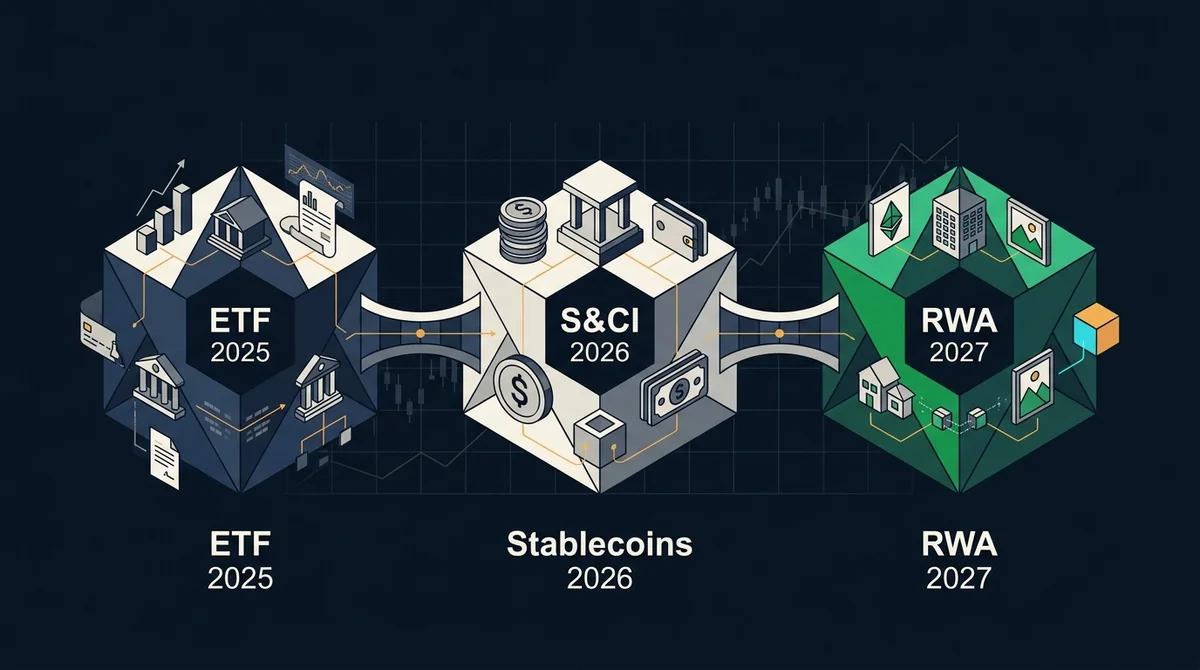
Hogan said that the 2025 narrative is defined by ETFs, the 2026 narrative by stablecoins, and 2027 will likely be defined by the tokenization of real-world assets (RWA). He called this process a "supercycle" and stressed that the scale is not $1 trillion or $2 trillion, but "hundreds of trillions of dollars" in assets such as stocks, bonds, and real estate migrating to public blockchains. Stablecoins have already proven the success of this model: after wrapping traditional financial assets (like the U.S. dollar) into a blockchain-native form, funds that previously took two business days to settle now settle in less than one second, and can flow globally 24/7, 365 days a year. The same logic applies to any asset—stocks, bonds, real estate, private credit, and so on.
Hogan explained that tokenization means wrapping stocks onto a blockchain, extending trading hours from 9:30 to 16:00 on weekdays to 24/7, changing settlement from T+1 to T+1 second, and enabling assets to be used immediately as collateral, thereby "adding superpowers to global assets." He noted that many institutions, including BlackRock and Franklin Templeton, are already involved, and Bitwise even created a chart of company logos participating in tokenization; because there were so many, the logos had to be shrunk very small, totaling about 250 companies. Hogan used the analogy that just as people quickly abandoned letters that took two days to deliver after email appeared, the migration of financial assets onto blockchains is an inevitable trend and will happen faster than most people imagine.
Market Resilience: When Bad News Stops Mattering, You're in a Bull Market
Hogan described the current market state as "remarkably resilient." He noted that the market is facing multiple macro headwinds: rising global interest rates, tightening financial conditions, potential rate hikes, concerns about AI, and surging energy prices. But since late June, the crypto market has exhibited a pattern of "stepping up and then holding steady," repeating this over and over. He concluded: "When bad news stops affecting you, you're in a bull market. I think we're in a bull market." He is optimistic about the trajectory through year-end, but expects volatility in the next one to two months as macro headwinds come from all directions. Overall, he expects crypto asset prices to be higher at year-end than current levels.
The conversation background mentioned that over the past month, the Clarity Act failed to pass, the Federal Reserve raised rates, the crypto market showed some positive momentum, and historical data shows that October is the strongest month for Bitcoin—in 11 of the past 14 years, average returns exceeded 21%. Hogan did not directly respond to this seasonality, but emphasized the fundamental momentum the market is showing from a four-year cycle perspective.
The Valuation Logic of Hundreds of Trillions of Dollars Moving On-Chain
When asked whether tokenization could bring on-chain network value to trillions of dollars, Hogan offered a number more aggressive than Fundstrat's Tom Lee. Tom Lee had said tokenization would drive trillions of dollars of existing value onto blockchains, but Hogan said: "This time I'm going to use an even bigger number than Tom Lee—it's hundreds of trillions, not just trillions, but hundreds of trillions." He listed the size of the underlying markets: about $150 trillion in equities, about $300 trillion in bonds, about $250 trillion in real estate, and private credit is similarly large. He stressed that this does not mean the tokens of the underlying protocols carrying these assets will map 1:1 to hundreds of trillions in value, but there is a relative relationship: as the amount of assets secured by blockchains grows, activity increases, and effective applications expand, a portion of that value will accrue to the underlying tokens.
Hogan added that he is not alone in saying this—Goldman Sachs, Robinhood, BlackRock, the SEC, the CFTC, and others are all expressing the same trend. He pointed out that if you exclude Bitcoin—which he compared to digital gold and which does not directly participate in this financial transformation—the entire crypto space is worth less than $1 trillion, while hundreds of trillions of dollars in assets will migrate on-chain, so the crypto market still has significant upside. "It makes no sense for a system that carries hundreds of trillions of dollars in assets to have an overall market cap of less than $1 trillion. Intuitively, that doesn't add up."
On how to value blockchain networks, Hogan further explained that there are two levels. The first is direct revenue: some chains already have significant revenue, but people may underestimate the potential for future business model changes. He said that even chains with smaller current revenue, if they will process a large number of transactions and handle throughput in the future, there are many ways to monetize that value, so valuation methods similar to revenue multiples will emerge. The second is a future value approach: some in the market use the concept of "blockchain GDP," others use Metcalfe's law of network effects, but the conclusion is the same—if trillions of dollars in value flow on a network, that network will eventually find a way to monetize. He used social networks as an example, noting that early on people didn't know how to monetize social media, but now the value of such networks is very clear; a network that controls a large amount of economic value can almost always find a way to capture a portion of that value.
How ETFs Affect XRP Spot Supply and Demand
The conversation noted that ordinary retail investors had expected XRP ETF assets under management to reach $2 billion to $5 billion by the end of 2026, and were concerned about how ETF purchases affect XRP spot market supply and demand, and whether institutional demand will continue to grow. Hogan responded that when money enters the ETF, Bitwise buys XRP in the spot market through market makers, essentially on a one-to-one basis: every $1 in the ETF corresponds to a corresponding XRP holding, and new inflows mean purchasing XRP in the market. He noted that there may be a small amount of in-kind creation/redemption, about 1% to 3% of the fund, but the main activity is cash purchases that directly impact the market.
On the current size of the XRP ETF, Hogan said he is satisfied with its growth and believes it can be "much bigger." He reminded that the first half of 2026 was very painful for the crypto market, with falling prices and despairing sentiment, but the XRP ETF not only did not see significant outflows, it actually recorded inflows, which goes against the norms of the ETF industry. As a more than ten-year veteran of the ETF industry who served as CEO of ETF.com, he pointed out that the conventional wisdom is that when the market falls 50%, funds flow out heavily, not receive marginal inflows. Hogan admitted that in this environment it is difficult to actively pitch to financial advisors: "Imagine telling the XRP story to a large financial advisor, and they glance at the chart and say they'll wait for it to bottom out." In addition, financial advisors are largely inactive in the summer. He believes that from now through year-end and into 2027, if real acceleration in capital occurs, he is very confident; because most financial advisors want broad exposure to the most interesting chains in the crypto space, and XRP is one of them, they will bring significant inflows.
Yield Products and Institutional Allocation Trends
When asked about new demand driven by AI and yield products for crypto ETFs, Hogan said Bitwise is indeed receiving a large number of related requests. Currently, Bitwise offers actively managed separately managed accounts (SMAs) for large accounts, generating yield in a customized manner on existing crypto positions. He noted that other institutions are also exploring algorithmic yield strategies, and even BlackRock has been making similar attempts with Bitcoin, which will gradually penetrate. Bitwise is also considering such products, but the current yield services lean more toward high-touch, personalized solutions because most crypto investors seeking yield have very specific, individualized risk tolerance requirements, so they have been addressing them with separate solutions. Such solutions will only increase in the future.
The Next Bull Market: Longer Bottom and a Differentiated Altcoin Market
The conversation raised a view: 2024 was not a traditional bull market; many assets broke through their 2021 all-time highs but only by small margins—for example, Ethereum was only about $400 above its previous high, and Solana barely broke through. According to the trading wisdom that "the longer the bottom, the greater the upside," the next bull market could see these assets truly break out of multi-year highs. Hogan agreed and added that market participants are currently too cautious: some see altcoins up 100% and think the run is over, but those assets are still 60% below their all-time highs. He suggested that listeners use a large language model to chart stocks, bonds, international stocks, emerging market stocks, semiconductor stocks, and crypto assets relative to their respective all-time highs, and they would find that crypto assets are the only asset class still far below their all-time highs, while most other global assets are near or at record highs. This shows that the crypto market still has significant upside.
Hogan believes this will be the largest market cycle in crypto history because it is the first cycle to attract real-world assets into the ecosystem, and the first cycle in which institutions can truly allocate to crypto assets. In the short term, the historical pattern of early bull markets is that most days are boring, with a few days of sharp rallies—and the performance since June has been exactly that: mostly sideways, then a few big up days. This "fat right tail distribution" means that in the early part of the cycle, there will be relatively more days with single-day gains of +10%; moving into the middle of the cycle, it will more often show stepwise rises. In the long term, he believes this will be a more differentiated altcoin market with clear winners and losers. Investors can no longer randomly buy fringe assets and profit as in 2021; instead, they need to focus on the narrative driven by real-world assets, pick the right assets, and avoid the wrong ones.
Ripple's "Puzzle": From Cross-Border Payments to a Complete Financial Ecosystem
When discussing the progress of XRP and Ripple, Hogan used a painting analogy: for a long time, Ripple had only completed one corner of the picture, namely cross-border payments; later it began to talk about a larger financial ecosystem story, but many parts were not truly colored in—no RLUSD, not much DeFi activity, not many tokenized assets, and no Ripple Prime. Now these puzzle pieces are gradually coming together, including business entities such as Ripple Prime (formerly Hidden Road) and Ripple Treasury (formerly G Treasury) that are migrating existing business models to blockchain products, and this transaction volume will ultimately land on the XRP Ledger. The data shows a real increase in institutional activity and a clear growth in on-chain tokenized assets. He mentioned that institutions can now more clearly imagine the roles that XRP, the XRP Ledger, and Ripple might play in a mature blockchain financial ecosystem. The key for institutions is to see actual traction: for example, partnerships like Standard Chartered are filling in the picture more clearly, but they now want to see a clear uptick in real-world traction in the Q2 and Q3 data. Hogan said he often tells people that institutions view XRP as an important part of the crypto ecosystem, and they want to see real-world traction catch up with the infrastructure that has already been built.
The Qualifications for a "Mount Rushmore" Asset
Regarding his earlier statement calling XRP a "Mount Rushmore" asset, Hogan explained that what he looks for are large-cap assets, a long track record, and significant real-world activity. He recalled that at the time, Ripple was recovering from its SEC lawsuit, which he called a "hero's journey." Hogan said that after emerging from the lawsuit, the question now is whether Ripple can execute the business plans it could not advance during the litigation. If more tokenized assets, lending activity, and direct trading activity appear on the XRP Ledger, XRP would fully meet the criteria for a "Mount Rushmore" asset—it has excellent technology, staying power, community, institutional support, and a strong company behind it driving it forward; it just needs more actual proof. He also mentioned that the market is more interesting now than when he first said this, with multiple assets already showing real-world traction, "I'm starting to wonder if we might need to put 10 assets on 'Mount Rushmore'."
The Timeline for DeFi and TradFi Convergence
Finally, Hogan discussed the convergence of DeFi and traditional finance (TradFi). He believes that by the end of the current presidential term, the market will clearly see that the two are merging into one, and people will realize that a "takeover" is happening. But this does not mean ordinary users will immediately participate in trading. He used the ETF industry as an analogy: the ETF industry knew in 2004 that the mutual fund era was coming to an end, but it took the world about fifteen years to fully catch up in awareness because finance moves slowly. Similarly, AI is seen as the future, but most people have not yet deeply used AI, yet everyone knows it is a fait accompli. Hogan believes tokenization will follow the same pattern: by the end of the Trump administration, the direction will become clear, but true penetration into the broader market will take time.