NYSE Partners with Blockchain.com to Launch Tokenized US Stocks, Dollar Stablecoins Accelerate Global Expansion, XRP Ledger and Solana Upgrade Simultaneously
NYSE and Blockchain.com launch tokenized US stocks, the US may push global dollar stablecoin expansion, and XRP Ledger and Solana test critical upgrades.

Article Citation Summary
NYSE and Blockchain.com launch tokenized US stocks, the US may push global dollar stablecoin expansion, and XRP Ledger and Solana test critical upgrades.
The crypto market has recently seen a pullback, but multiple infrastructure and regulatory developments are advancing in parallel.
Market Technicals: Pullback Is Normal, Weekly Chart Still Maintains Bullish Structure
Bitcoin and the crypto market have experienced a certain pullback. Previously, Bitcoin had entered overbought territory, so a pullback is consistent with normal market behavior. On the daily chart, the RSI has fallen back below the overbought zone, which is a positive signal; the MACD remains controlled by bulls. But more important is the weekly chart: the weekly shows a bullish divergence, the RSI has broken above a downtrend, and the MACD shows bulls fully in control. The market has reclaimed the 200-day moving average and entered an uptrend.
At the same time, USDT stablecoin dominance still shows a bearish divergence on the weekly chart, indicating that more liquidity will enter the market. On the macro level, the Iran war and large-scale buybacks by the US Treasury to ease bond market problems are injecting liquidity into the entire system, and the overall environment is bullish. Therefore, patience is still needed: the market may trade sideways before the end of the month, or dip further and find support before moving higher. Bitcoin could fall back to around $72,000 or even $70,000. The key thing to watch is higher highs and higher lows; if a higher low appears in this pullback, the bull market structure will be maintained.
NYSE and Blockchain.com Partnership: Tokenized US Stocks for 44 Million Crypto Accounts
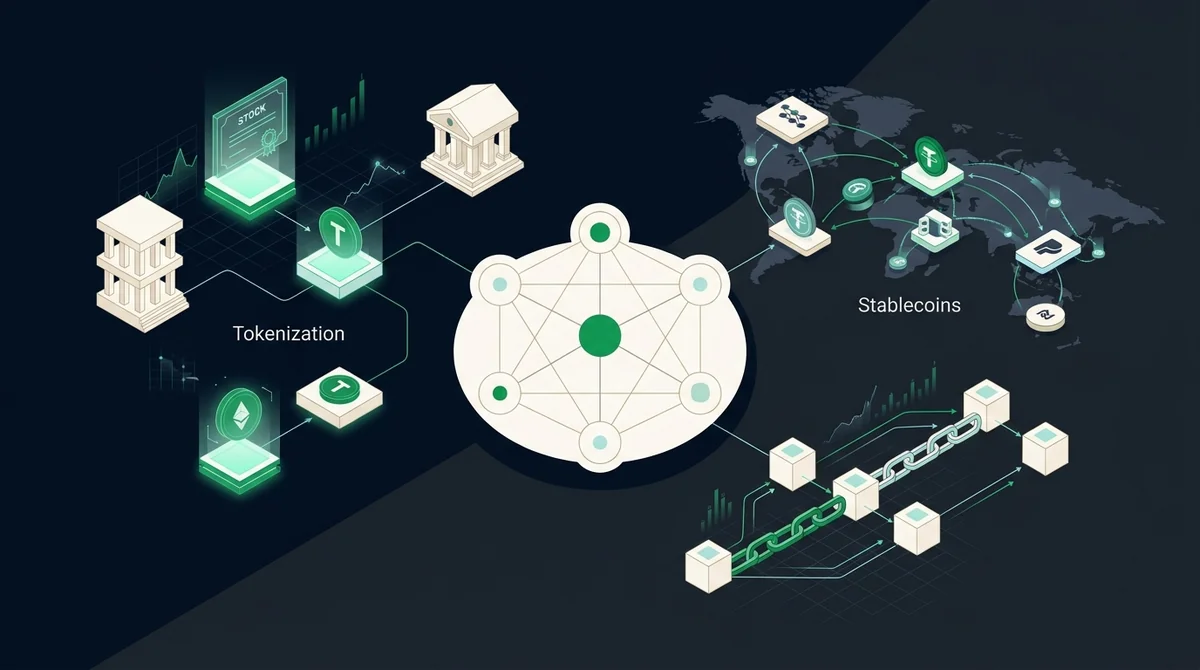
The New York Stock Exchange has partnered with Blockchain.com to bring tokenized US stocks to 44 million crypto accounts. Stock exchanges, banks, and the world's largest asset managers are all participating in the blockchain and crypto space, including asset tokenization, offering crypto trading, launching custody services, and using stablecoins.
Blockchain.com co-founder and CEO Peter Smith said: “I have long believed that people should not be unable to hold stocks because of where they live or the brokers available to them. By partnering with the New York Stock Exchange, Blockchain.com will put tokenized stocks on-chain and open 24/7 trading globally. Economic freedom powered by open networks means everyone can access the best financial markets and products, bringing us closer to the vision set 15 years ago.”
This partnership means the market is moving toward a token economy: trading will be 24/7 with no opening or closing bells. Tokenized assets can reach global users; users only need a crypto wallet on a smartphone to access stocks that were previously unavailable in regions such as Africa and South America, and they can hold fractional shares. Some analysts believe NYSE chose Blockchain.com because of its flexibility, cost, and competitive relationships.
Raiffeisen Bank International to Launch Crypto Trading in 11 European Markets
Raiffeisen Bank International, with $235 billion in assets, will launch crypto trading in 11 European markets. Banks, stock exchanges, payment companies, and large global asset managers are all entering the crypto space. These institutions entering the space could bring more people on-chain and into the crypto ecosystem, because many users prefer to enter through their trusted banks and familiar brands rather than directly using crypto trading platforms. These entry points are preparing for more capital inflows, which is overall bullish.
US May Push Global Expansion of Dollar Stablecoins
The US is reportedly considering a plan to promote dollar-backed crypto stablecoins globally. Stablecoin-related legislation such as the GENIUS Act has already drawn attention. The current bond market shows fewer buyers of US Treasuries, and the US wants to push dollar stablecoins globally; stablecoin issuers need to buy US Treasuries, creating a win-win: it helps maintain the dollar's status as the global reserve currency while supporting dollar strength through Treasury purchases. The macro environment may prompt the US government to step up its push at this time.
Visa Survey: Bank-Grade Protection Could Boost US Stablecoin Adoption
A Visa survey of 2,192 US customers released Wednesday found that in a hypothetical scenario with bank-grade fraud protection and deposit insurance, US users' willingness to adopt stablecoins could rise from 36% to 56%. The survey, conducted by Morning Consult between February and March, also found that Americans asked about financial terms like stablecoins want faster and cheaper ways to send money internationally. Visa, Mastercard, Western Union, MoneyGram, and banks are all preparing to launch stablecoins or integrate existing ones like USDC. Consumers may ultimately use stablecoin-powered cards and payment platforms without knowing it, only experiencing faster, cheaper, real-time settlement. Stablecoin adoption is irreversible, major institutions have all entered the space, and everyone will use stablecoins in some way in the future.
CFTC Advances Regulatory Market Structure for Crypto Assets
CFTC Chairman Mike Selig spoke about crypto legislation and rulemaking at events at the New York Stock Exchange and CNBC. He said: “It's time to act. The CFTC is using its existing statutory authority to build a regulatory market structure for crypto assets. The US President promised clear rules for the crypto industry, and we are delivering those rules.” The SEC has already started related work, including granting crypto exemptions for tokenized stocks and securities; the CFTC is also preparing to release its own version.
Although the Clarity Act legislative process faces obstacles, regulators are providing guidance, which will give institutional boards more confidence to build and innovate without fear of lawsuits or Wells notices. However, legislation like the Clarity Act is still needed to prevent a future anti-crypto administration from overturning current rules. It may be difficult to advance before the midterm elections; after the elections, some Democrats may return to the negotiating table to work with Republicans to complete the bill.
MoonPay to Acquire North Capital in $60 Million All-Stock Deal
MoonPay will acquire SEC-registered North Capital in a $60 million all-stock transaction. MoonPay is rapidly expanding, acquiring companies and launching new products. The acquisition will support MoonPay's push for mass adoption of tokenized real-world assets, according to CEO Ivan Soto-Wright. MoonPay previously focused on crypto payments and is now expanding into tokenized assets. In the future, users may directly buy and sell these assets with Bitcoin, XRP, Ethereum, or stablecoins, enabling cross-market interoperability, and companies like MoonPay are building this infrastructure.
XRP Ledger Retries Upgrade: Permission Delegation v1.1
XRP Ledger is again attempting an upgrade that allows banks to separate payment and compliance duties. The upgrade could activate on October 5, letting businesses authorize another account with limited permissions, such as making payments or approving customers, without handing over full control. The feature, called Permission Delegation v1.1, entered a 14-day activation countdown on September 21 after receiving support from 29 of the network's 35 trusted validators. If support remains above 80% during the period, the upgrade will go live on October 5 at 11:18 UTC. The feature is clearly aimed at banks, and Ripple is working with a large number of banks and financial institutions. XRPL could be one of the winners, and the market may have multiple chains succeeding.
Solana Begins Testing Alpenglow: Finality Drops from 12.8 Seconds to 0.15 Seconds
Solana has begun testing an upgrade that could reduce finality from 12.8 seconds to 150 milliseconds. Alpenglow will help exchanges, bridges, and merchants treat payments as irreversible almost instantly. The planned upgrade has entered the testnet, and developers will try to reduce the time needed for a payment to become irreversible from about 13 seconds to 0.15 seconds. Finality is the moment a transaction becomes irreversible: exchanges wait for finality before crediting deposits, bridges wait for finality before releasing funds on another chain, and merchants need to know that a payment cannot be reversed. The upgrade is named Alpenglow. Blockchains are continuously upgrading, intensifying competition; chains with higher efficiency and reasonable transaction speeds are more likely to win.
Overall, the market pullback has not changed the long-term upward structure; tokenized assets, stablecoin globalization, regulatory clarity, and underlying network upgrades are advancing simultaneously.