The $2.2 Billion RWA Token on XRP Ledger: 19 Holders, Zero Transfers, and the Truth About a Half-Frozen Tokenization Market
In a $60B tokenization market, 56% of value never moves; XRP Ledger's largest $2.2B asset has 19 holders and is designed to stay frozen—retail access is 3%.

Article Citation Summary
In a $60B tokenization market, 56% of value never moves; XRP Ledger's largest $2.2B asset has 19 holders and is designed to stay frozen—retail access is 3%.
The tokenization market presents two seemingly contradictory facts: on one hand, headlines report that half of the $60 billion tokenization market is “dead on-chain”; on the other, Solana recorded $3.47 billion in tokenized stock trading volume in a single month, accounting for 96% of global on-chain stock trading. Same industry, opposite headlines. To understand this, you need to look at where capital actually is, who holds it, and why the world’s largest tokenization business runs on a blockchain many people have never heard of.
The $60 Billion Tokenization Market: 56% Without Transfers Is Design, Not Failure
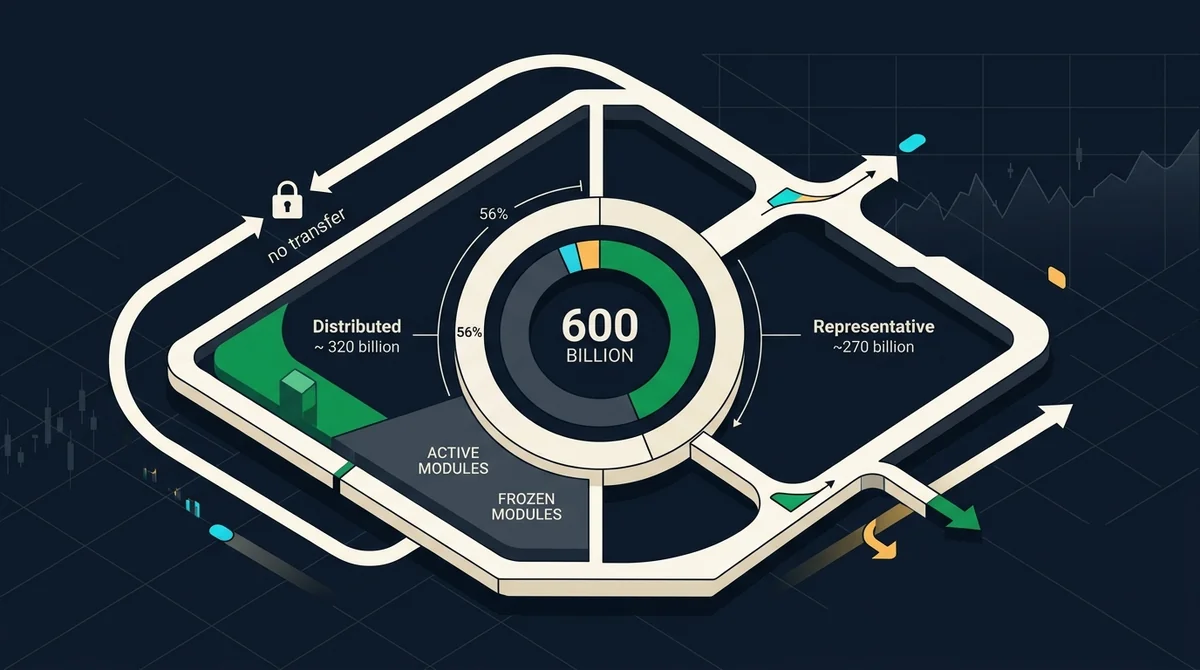
In early July 2026, a research report delivered a headline-ready figure: across $60 billion of tokenized real-world assets—more than 7,000 products spanning 12 asset classes—56% of the value saw no transfer activity in a week. The market looked stalled. The report was produced by the BeInCrypto research team, with data from rwa.xyz and a snapshot date of May 31, 2026.
The study examined 1,289 tokenized assets, each worth more than $100,000, checking their on-chain activity. Of those, 910 (holding $32.9 billion) had zero transfers that week; 379 (holding $26.2 billion) had at least one. Was half the market really dead?
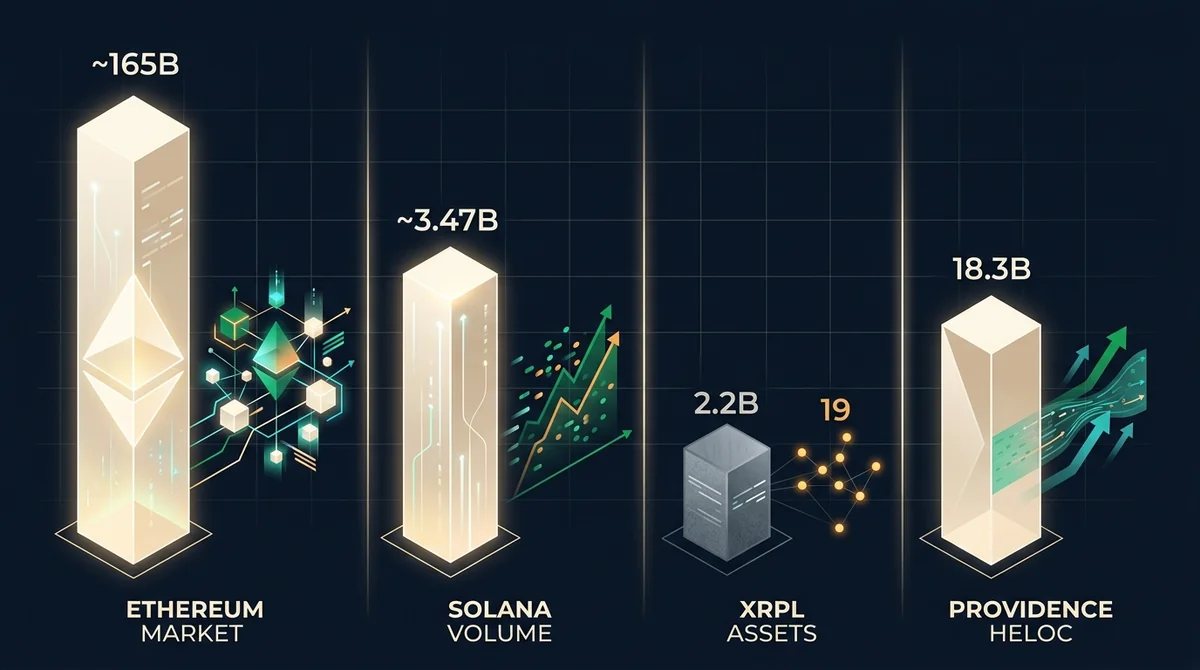
Start with the active half. The 379 active assets had a median of 76 weekly transfers; three-quarters had more than 10. This is not a shallow market, but a split market: activity is concentrated in a few products, while the rest are completely still. And the stillness follows a pattern. That same week, Solana reported $3.47 billion in tokenized stock trading volume for the month, 96% of global on-chain stock trading, with a single-day record of $683 million. The market reported as “frozen” was news to Solana.
Both data sets are real and come from credible trackers. A market half-frozen while posting record volume, all under the same label “tokenization.” The problem is not the numbers but the categories. Tokenization covers two completely different machines, yet most coverage fails to distinguish them.
The report actually offers a tool for distinction: every tokenized asset falls into one of two structural types—distributed and representative.
Distributed tokens can leave the issuing platform, move peer-to-peer on public blockchains, and be traded, transferred, collateralized, or plugged into DeFi. Roughly $32 billion of the market is distributed; this is the machine people usually imagine when they hear tokenization.
Representative tokens never leave home. The blockchain is essentially an internal ledger and record-keeping system, and the token is merely a digital receipt for assets managed entirely off-chain. Roughly $27 billion of the market is representative. Zero transfers are not a flaw; they are the specification.
Viewed this way, the scary headline becomes clearer: about $27 billion of the $32.9 billion in dormant value is representative—structurally off-chain and operating as designed. The report directly states that dormancy metrics overstate inactivity for assets never designed to be transferable. Those alarming stories did not misquote the numbers; they misread the machine.
XRP Ledger’s Largest Asset: $2.2 Billion, 19 Holders, Zero Transfers
The best example of this machine sits right on XRP Ledger, yet most feeds remain silent.
On January 13, 2026, a company called Just Token launched a token under the ticker JMWH on XRP Ledger, representing megawatt-hours of Argentine energy. The token started at $861 million and grew to $2.2 billion by the end of May, driven by allocations from Latin American energy producers, including YPF Luz, the electricity arm of Argentina’s largest energy company. That made it the largest asset on XRP Ledger, exceeding the total of all treasury products on the ledger.
It has only 19 holders, has never recorded a single transfer, and never will. That is because JMWH tokens are minted when energy contracts are signed and burned when electricity is delivered; the blockchain is an audit trail and settlement record, not a trading venue. Just Token chose XRP for its settlement characteristics and compatibility with Argentina’s securities regulator CNV, under the framework of Resolution 1058 of 2025—a compliance decision, not a community one.
On the funding side, Just Token has raised $17.5 million in venture capital and now intermediates nearly $3 billion in tokenized commodity value across six tokens on two chains, a value-to-capital ratio of roughly 165:1. Such a ratio does not occur at asset managers; only infrastructure produces it. The shareholder list tells the same story: Bunge (a $13 billion agribusiness), Argentina’s national stock exchange BYMA, Visa, and Banco do Brasil, Brazil’s largest agricultural lender—all incumbent institutions funding a rail in their own jurisdiction.
This raises a question: if the largest asset on XRP Ledger is a closed, institution-built Argentine energy registry invisible to retail, what does ledger adoption actually mean for XRP holders?
The World’s Largest Tokenization Business on Providence: $18.3 Billion in Loans That Never Trade
The world’s largest tokenization business is not on Ethereum, Solana, or XRP Ledger. It is an $18.3 billion U.S. home equity loan book running on a blockchain called Providence.
Figure Technologies is a fintech lender that originates home equity lines of credit (HELOCs) and records each one on Providence—a chain Figure helped build. That chain alone accounts for $18.3 billion, 31% of the entire $60 billion tokenization market—nearly one in every three dollars—larger than all tokenized treasuries combined, larger than all tokenized gold combined, and roughly eight times the size of JMWH. And it never trades. Not once.
Figure’s HELOCs are representative tokens. The loans are originated under U.S. state lending licenses, securitized on-chain, and sold to institutional investors; the tokens cannot leave the platform. Providence is Figure’s internal settlement and record-keeping layer—a blockchain replacing file cabinets and settlement agents at a scale no trading chain has ever touched.
Why have most people never heard of it? Because there is no token to hype, no community, no price chart. Providence has no retail narrative, so it gets no coverage. The chains you hear about daily all have a token to sell you; the chain quietly holding a third of the market has nothing to sell, and the algorithm has nothing to say.
Figure is not an outlier; it is the pattern. The entire asset-backed credit category is $23.7 billion, the largest in tokenization, yet only 10% of it can move on public rails; corporate credit is $2.2 billion, with only 36% movable. Compare that with U.S. treasuries at 99% movable and tokenized equities at 99% movable. Categories built for institutions treat blockchains as ledgers; categories built for trading treat blockchains as markets. Same technology, completely different products.
When Institutional Business Moves On-Chain, Who Captures the Value?
This leads to a question that truly matters for consensus token holders: when a blockchain wins institutional tokenization business, who gets the value?
Honestly, the value capture question is unresolved. Figure captures value as equity; Providence holders get a working chain, not a windfall. Just Token raised $17.5 million and now intermediates nearly $3 billion, with value flowing to Just Token and its backers—Bunge, BYMA, Visa, Banco do Brasil. The ledger does the work; the businesses on it take the prize. Whether native tokens can capture this flow is the open question of the era; XRP Ledger is running that experiment in public with a real $2.2 billion institutional asset, ahead of nearly everyone else.
What Each of the Three Chains Won
The scoreboard shows: Ethereum wins dollars, Solana wins crowds, and XRP Ledger wins something quieter—and harder to obtain.
Ethereum: around half of all movable tokenized value sits on Ethereum, roughly a $16–17 billion distributed market depending on the tracker and date. Its flagship products reveal the audience. Circle’s money market fund USYC is $2.96 billion with 44 wallet addresses; BlackRock’s BUIDL is $2.42 billion with 109 addresses; Franklin Templeton’s Benji is $1.59 billion with 28 addresses. These are not widely distributed tokens. Across the treasury category as a whole, the average holding is about $240,000—not a retail market, but institutional cash management wearing a crypto disguise. The concentration runs deeper: among roughly 200 institutional-grade tokenized assets above $10 million, the top five addresses control more than 90% of supply in 92% of them; 11 products above $100 million each have a single holder, including a $547 million money market fund. The report puts it plainly: blockchains describe settlement rails, not investor bases.
Solana: a completely different world. 96% of on-chain stock trading, $3.7 billion in a single June month, and a single-day record of $683 million. The tokenized equities category has more than 293,000 holders—the most crowded category in the market—with an average holding of about $6,000. By mid-2026, Solana’s total RWA holders surpassed Ethereum’s for the first time. On the day of the SpaceX IPO, Backpack listed SPC-X, tokenized SpaceX shares on Solana, tradable 24/7 and redeemable for actual shares, attracting 10,000 holders in six days. If Ethereum is where institutions park cash, Solana is where real people actually trade.
So which chain won? That is the wrong question. Better to ask: what did each win? Ethereum won institutional dollar custody at $240,000 per holder, with products you can never buy; Solana won the retail trading venue at $6,000 per holder, while—as the next section explores—most of what trades globally as tokenized stocks is not actually stock. Two victories, two games.
XRP Ledger: wins regulated, revenue-generating, institutionally funded settlement business—exactly the largest lane Figure proved. JMWH reached $2.2 billion; the Andos Treasury Fund, backed by BlackRock’s BUIDL, runs on the ledger with round-the-clock minting; Guggenheim’s tokenized commercial paper via Archax has publicly committed to bringing $1 billion on-chain by mid-2026. These are still small compared with Ethereum’s dollar scale or Solana’s crowds, but they are the same kind of victory as Providence’s $18.3 billion: institutions choosing your rail for compliance and settlement—a more durable prize.
But rail victory and token victory are two different things. The first quarter of 2026 proved it: XRP Ledger’s RWA value jumped 124%, while the XRP price fell 27%. That gap is the heart of this chapter.
Tokenized Stocks: What Are You Actually Buying?
Now back to the earlier question: when you buy a tokenized stock, what do you actually own? It could be the stock itself, a claim on a company that owns the stock, or just a price. The report shows that 59% of stock tokens fall into the last category—synthetic exposure. The phrase sounds mild, but it is not: a token that merely tracks a price and gives you no ownership of the underlying shares is what synthetic exposure means.
The report places every tokenized asset into one of three buckets: direct ownership—holding legal title, redeemable, transferable, and enforceable; fund shares—holding shares in a regulated fund vehicle, such as BlackRock’s BUIDL; and synthetic—a token reflecting a price through a contract, where the underlying shares may or may not exist. The secret of crypto tokenization is that two tokenized versions of the same stock, with the same ticker and the same price chart, can fall into completely different buckets with completely different rights.
The SEC has already drawn a line. On January 28, 2026, three SEC divisions issued a joint statement on tokenized securities. The core conclusion: tokenization does not change the nature of a security. But the statement went further, distinguishing issuer-backed tokens from third-party synthetic tokens and warning that synthetic products may carry risks the underlying asset never had, including token issuer bankruptcy risk. If you hold a synthetic token and the company defaults, you are a creditor of a crypto startup, not a stock owner. This is not true of all tokenized stocks; some are real products. For example, Backpack’s SpaceX token SPC-X is issued through a U.S. broker-dealer and is reportedly redeemable for actual shares that can be transferred to a traditional brokerage. But the report’s overall conclusion still stands: most of what trades globally under the name “stock” is price exposure, not equity. And retail-heavy Solana is where those trades are most concentrated.
Regulation and Accessibility: 97% of the Market Shuts Retail Out
Layer accessibility data on top, and the full market picture emerges. U.S. retail investors can legally buy only $1.7 billion of the $60 billion in products—3%. The largest regulatory category is “no identifiable framework,” at $22.9 billion, or 39%. Fourteen products above $100 million, totaling $2.5 billion, have no identifiable regulatory regime. That number deserves a pause: 39% of the market cannot be classified due to insufficient information. The tokenization revolution is marketed as open access, but the unregulated portion is currently 13 times larger than the portion retail can legally reach.
This does not mean tokenization is a scam; it means it is early, uneven, and built primarily for institutions while marketed to everyone. The gap between the two is where you are most likely to get hurt when you don’t read the labels.
Read the Labels: Every Number Speaks Selectively
Every chain is telling the truth, and that is exactly the subtlety. Solana really does run 96% of tokenized stock volume; Ethereum really does hold about half of movable value; XRP Ledger really does carry a $2.2 billion institutional asset. No one is lying—each cites the numbers that favor it and stays silent on the ones that don’t. The Solana ecosystem stresses holder counts and volume, not that the average holder has just $6,000 and most exposure is synthetic; the Ethereum ecosystem stresses total locked value, not that 44 wallets hold its flagship product. This is not deception; it is selective statement—turning a set of fair facts into an unfair impression.
The BeInCrypto report itself has a point of view. Its core argument is that the gaps in the market—concentration, accessibility limits, dormant value—are precisely the opportunity, and it says directly that its third section maps how $2 billion in venture capital is being deployed into tokenization projects. In other words, the paper diagnosing the patient also tells you which medicine to buy. The data comes from RWA XYZ and is credible; but the analytical framework is written for allocators deploying capital, not for retail investors deciding what to hold. Same numbers, different readers.
The endgame the report points to is already visible. In December 2025, DTCC, which clears and settles nearly all U.S. securities trades, obtained SEC relief to run a tokenization pilot and chose to build on the Canton Network—not Ethereum, Solana, or XRP, but a permissioned institutional chain designed to keep institutional value private and completely off public rails.
Put it together: the largest tokenized asset on Earth is a loan book on a chain with no tradable token; the largest institutional settlement pilot is on another chain with no retail token; XRP Ledger’s largest asset has only 19 holders; Ethereum’s flagship fund has only dozens of holders. This is not better—97% of the market sits outside retail reach. And the loudest excitement is concentrated in the retail tokenized stock corner of the market, where you are more likely to hold a price than an asset.
Conclusion: Tokenization Is Real, but the Retail Story Is Not Yet Supported by Data
The forensic conclusion: the tokenization boom is real, institutional adoption is real, and XRP Ledger’s win in regulated settlement business is a real and durable achievement. If native tokens can capture that value, XRP holders are indeed early participants in something massive—if. But the story sold to retail—that tokenization is a gateway to the same assets institutions hold—is not yet supported by the data. Institutions buy products you cannot access on rails designed to keep you out, while citing numbers that make you feel inside. Read the labels, ask which bucket you are in; ask who holds the rest of the supply; ask who benefits when you do not.