DTCC’s $30 Trillion Tokenization Push: Why Institutional Crypto Matters Now
DTCC plans to tokenize up to $30 trillion in assets, with Canton live first and Stellar and Circle's Arc joining by 2027. Here's the mechanics and impact.
Article Citation Summary
DTCC plans to tokenize up to $30 trillion in assets, with Canton live first and Stellar and Circle's Arc joining by 2027. Here's the mechanics and impact.
DTCC’s multi-trillion-dollar tokenization service is expected to officially go live at the end of October. According to its latest published plan, DTCC is preparing to tokenize up to $30 trillion in custodied assets. The first public blockchain network known to go live is Canton; recently, Stellar and Circle’s Arc blockchain have also been added to the 2027 timeline. The following is a summary of information DTCC has disclosed so far.
DTCC and DTC: Wall Street’s Back Office and $114 Trillion in Custody
DTCC, or the Depository Trust and Clearing Corporation, can be seen as the back office of Wall Street. If an investor buys a stock through any broker such as Robinhood, T0, or eToro, DTCC is the company behind the scenes that completes the trade settlement. Its subsidiary DTC holds $114 trillion in securities for banks and brokers to draw from, and will be responsible for the future tokenization of these stocks and other financial instruments. The one-page document DTCC released on October 16 answered many of the questions the market has had since the SEC approved this new service last December.
The $30 Trillion Tokenization Quota: Reserved Space, Not Yet Realized
The biggest headline from the document is that DTCC has earmarked up to $30 trillion in already-custodied assets for tokenization. This does not mean that $30 trillion has already been tokenized. Think of it as a parking lot—space DTCC has set aside for tokenized assets. Even so, the potential value that could enter public chains is enormous.
How the Tokenization Service Works: A Four-Step Mechanism
The document reveals the mechanics of the service, which is the most critical information. These tokenized assets go directly onto public chains; they are not proxy tokens or wrapped tokens, but are written directly into code. Specifically, there are four steps:
Step one, a DTC participant (a bank or broker) sends a conversion order through the user interface or API (application programming interface). APIs connect everything in the crypto world, and the goal is for each transaction to be completed in 15 minutes or less.
Step two, token issuance. Taking the first network to go live, Canton, as an example, tokens will be issued on the Canton network and will follow the CIP56 token standard. When an asset is issued under a token standard, it means it comes directly from that chain and is more secure, with less worry about being hacked or exploited. A similar situation occurs on Ethereum: the ERC20 standard is used through Hyperledger Besu’s private network. ERC20 is the token standard created in Ethereum’s early years, allowing the creation of tokens like Quant, Crypto.com, and Binance itself was once an ERC20 token. Token standards are therefore crucial to a crypto network. If you see a network developing token standards, it often signals a lot of additional activity to follow. Layer 2 networks also have token standards, for example in Ethereum’s architecture.
Step three, these tokens can be transferred peer-to-peer at any time between DTC-registered wallets on the same blockchain. This also raises the bar for entering this tokenization service: the network must support peer-to-peer transfers. Not all crypto networks have this capability, which may be why DTCC initially chose these networks.
Step four, all records return to the DTC ledger. This model is currently similar to the path Franklin Templeton began building on Stellar: first keep everything on its own ledger, because those ledgers are already regulated, secure, and operationally mature; eventually records are also stored on the blockchain, and that is how Franklin Templeton’s partnership with Stellar works now. Solana may also be brought into the discussion. At some point in the future, DTC may do the same.
Three Key Details: CUSIP, Built-in Compliance, and Single-Chain Transfers
From this phase, three very important details can be extracted.
First, the token keeps the same CUSIP. CUSIP is the identification number every U.S. security has. This means these tokens are not a wrapped version or proxy of the security, but the exact same digital representation of the security that an investor can access through Robinhood, eToro, or any broker—just now existing in the tokenized world with more functionality. From a legal standpoint, companies will feel safer because of this.
Second, the tokens are designed for compliance, with built-in transfer restrictions, which again depends on the token standard. Assets issued under a token standard already meet certain compliance requirements.
Third, transfers remain within the same blockchain. A token issued on Canton transfers to another Canton wallet. As of now, DTC’s published materials do not describe how tokens move from one chain to another. But given the other participants, the next section may provide an answer.
Multi-Chain Plans: Canton for Records, Stellar for Distribution, and Future Expansion
Among the key components, the first is registering tokens on the Canton network, which is a normal part of the process. From step four, records are kept on the DTC ledger. These two parts are very close, because what Canton currently does mainly for super validators like Broadridge is record-keeping. Therefore, it is reasonable to think that DTCC is bringing in Canton as the universal source of truth for these new tokenized securities.
Once this foundation is established, Stellar and its main transfer partner USDC will be responsible for moving these tokenized assets from one wallet to another, and even across chains. Currently USDC is not directly on Canton; Canton has USDCX, which is mainly used in trading environments. But USDC is on Stellar, issued as an SE token following Stellar’s token standard, which allows it not only to move between wallets on the Stellar network, but also from the Stellar network to Solana, Algorand, Hedera, or any network where USDC exists.
DTCC has not yet mentioned the ability to move these securities across networks, but if you look at the list of networks it has selected: the first two (Canton and record-keeping) specialize in record-keeping; the latter two (Stellar and Circle’s Arc) specialize in distribution. Most of Stellar’s tokenized real-world assets (RWAs) are used for distribution. So it can be inferred that this is Stellar’s role in the new tokenization service.
The bottom of the document also mentions that more Layer 1s and Layer 2s will be added based on customer and market demand. This basically says the list will get longer as customer and market demand grows. If the market demands cross-chain transfer of these securities, Solana, Hedera, and possibly even Binance—given that Binance is preparing for an IPO—could be introduced. So the potential is huge. At present, Canton is in place, Stellar will join in 2027, and it will use the Stellar token standard SCP 41. Again, tokens issued under a token standard are a more direct representation of the underlying asset. The industry has moved away from wrapped tokens because wrapped tokens caused people to lose a lot of money.
Roadmap: From the SEC Green Light to a Three-Year Window Through 2029
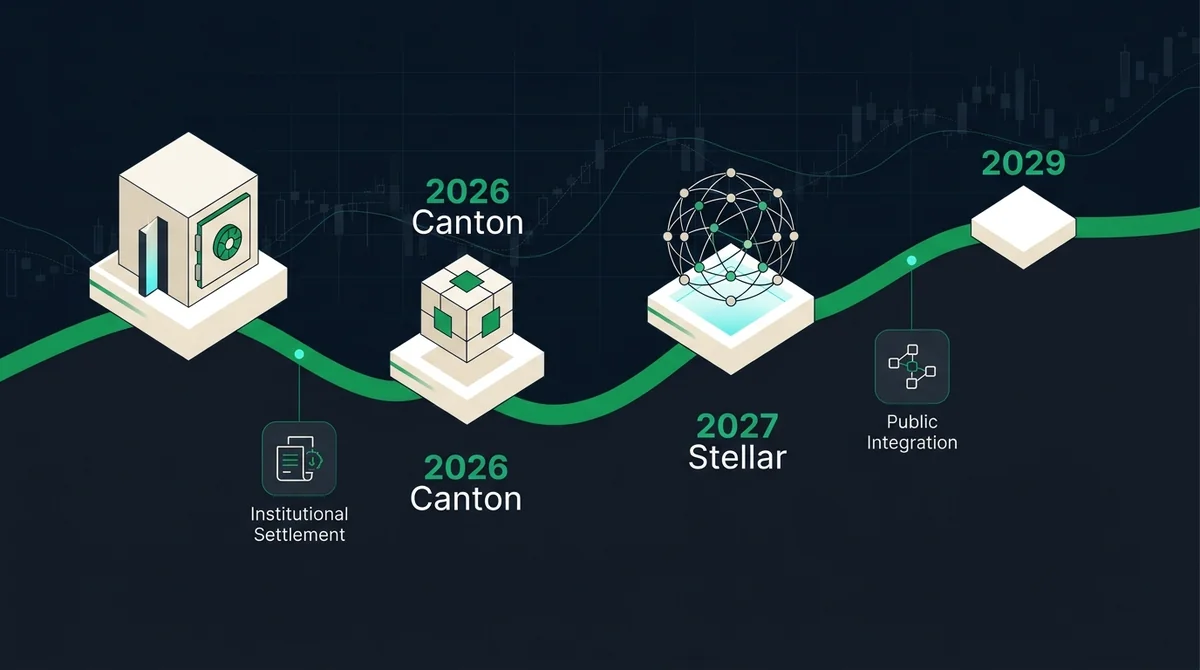
All of this began when the SEC gave DTCC the green light to operate the tokenization service for three years. Since the service will launch in October 2026, it will run until 2029. This means the world’s largest securities settlement institution will continue tokenizing securities for the next three years. This prospect makes it hard for the market to be bearish. In addition, the results of the midterm elections should be considered. If Democrats regain control, it will bring clarity to the market; much of the current turmoil stems from people not knowing who will control the government before December 1. Once that becomes clear, regardless of red or blue, the market will correct, stabilize, and start moving in the right direction. Of course, this is only a personal opinion.
After receiving the green light, DTCC immediately let the outside world know that Canton would be the first network to go live. A few months later in the summer of 2026, it announced that Stellar would join the service as the second public blockchain. The first real transactions actually began as early as July. BlackRock, Citadel, Goldman, JP Morgan, NASDAQ, and Vanguard all processed real transactions using tokenized assets on Canton. BlackRock, Citadel, and Vanguard are arguably the most powerful companies in the world, and they are tokenizing on a 10-cent token that almost no one knows about. This is exactly what makes institutional crypto attractive.
The Significance of Institutional Crypto and Wall Street’s Simultaneous Moves
Institutional crypto deserves attention. This is not a new market, but new plumbing. DTCC is not building a new crypto exchange; it is upgrading the pipes that already settle U.S. securities. That is why the details are so careful: the same CUSIP, the same protections, and DTC still keeps the books. Large institutions can try tokenized workflows without abandoning the rules they trust.
Tokenization is only the first phase. Phase two: the roadmap for 2027 and beyond lists on-chain settlement, collateral netting, and digital cash—meaning a digital dollar will enter some public blockchain network. Discussion of a U.S. digital dollar has been going on for about a decade, and regardless of which administration is in power, red or blue, there has been talk of a digital dollar, even before stablecoins became mainstream.
Meanwhile, Wall Street is moving in sync. BNY completed a tokenized U.S. Treasury repo, the first use of tokenized assets on a major tri-party repo platform. DTCC represents only part of this larger shift. Banks such as BNY, Citi, HSBC, and Wells Fargo are all moving into tokenized assets. Eventually, market leaders will emerge.
However, to maintain balance, it should also be pointed out that not everyone endorses tokenized equities. In a typical setup, the tokenization party captures most of the revenue while the issuing company bears all the risk. But DTCC’s model is completely different: DTCC handles everything, and the issuer only needs to provide the assets it wants to tokenize; DTCC will take care of the rest—including the market, public chains, and security protocols. So even after the service launches, DTCC still needs to convince the market that the product is necessary.
Networks and Tokens: The Burn and Demand Relationship for CC and XLM
It is important to distinguish between networks and tokens. The companies using the service are banks and brokers that transfer tokenized securities; this does not automatically mean they will buy or hold CC or XLM. Any benefit to the token depends on the amount of activity on each network and how the network charges fees.
Using Canton as an example, universal burning will begin this week: previously only the global synchronizer (public synchronizer) on Canton burned CC in transactions; now dedicated synchronizers (for example, those in private environments such as BlackRock, HSBC, and Goldman Sachs) must also burn CC, and this includes DTCC. For Stellar, when using the SE41 token standard, some XLM needs to be committed up front, so burning occurs. In addition, XLM burning will occur when tokenized securities are transferred from one wallet to another; whether burning also occurs at issuance still needs further research, but if XLM is required as collateral, it can be assumed that a small amount of XLM will also be burned at issuance. Therefore, the value relationship between networks and tokens depends on demand.
Near-Term Focus: Launch Date and Meridian 2026
There are two important things to watch in the near term. The first is the launch date: DTCC has said commercial access will open at the end of October, and it is expected to announce designated participants soon on its official X or website. The second is Meridian 2026, which will be held on October 28-29. This is Stellar’s annual conference, which has historically produced many major announcements: PayPal’s entry into the network was announced at Meridian, Mastercard’s entry was announced at Meridian, and MoneyGram as well. This year, DTCC’s Naim Chakar will be a speaker, so a major announcement can be expected.
Social Sentiment and Market Outlook
Currently, DTCC is generating a very high level of discussion in the crypto space, as people want to understand what is happening. On the price front, there is considerable volatility, but as mentioned earlier, things may change after the midterm elections.