RWA Tokenization: Real Estate, the DELTA Act, and India's New Financial Frontier
From $34B to a projected $5.5T, how does RWA tokenization change real estate and finance? Explore the DELTA Act, regulatory pilots, and key adoption hurdles.
Article Citation Summary
From $34B to a projected $5.5T, how does RWA tokenization change real estate and finance? Explore the DELTA Act, regulatory pilots, and key adoption hurdles.
RWA Tokenization Enters an Acceleration Phase: From $34 Billion to $5.5 Trillion
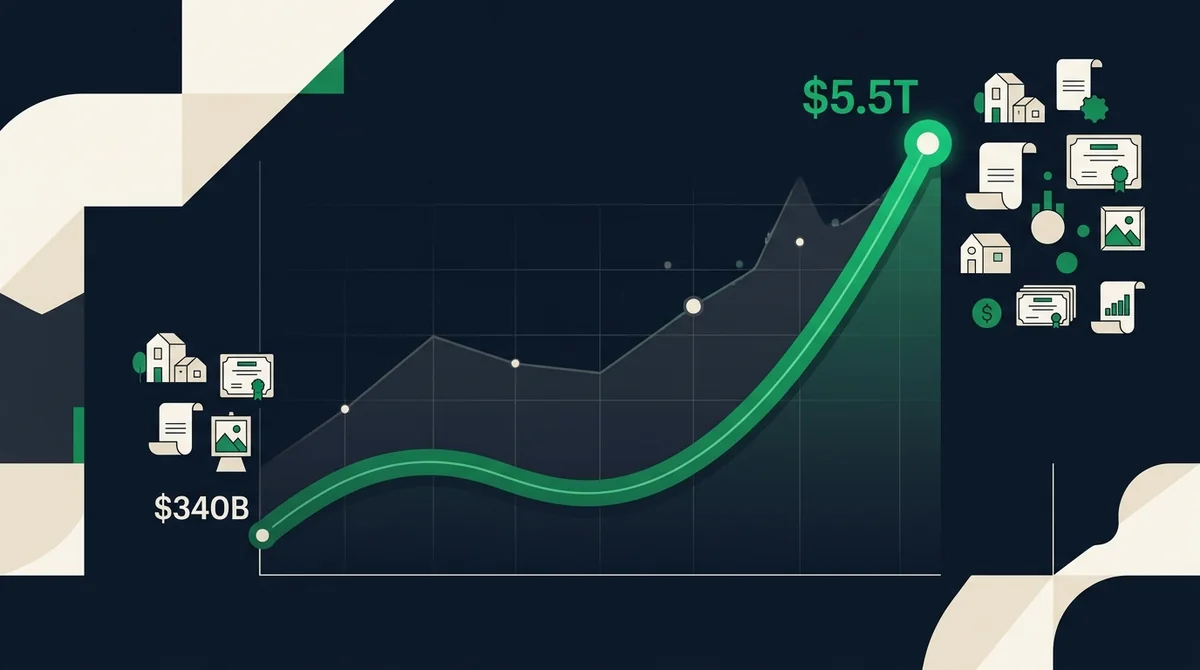
The global value of tokenized real-world assets (RWAs) has reached approximately $34 billion. According to the base-case scenario in a related annual coding report, tokenized financial assets could reach $5.5 trillion by 2030. These figures are only a beginning—the industry is standing at the threshold of a massive transformation. In the past, the term “tokenization” was almost a taboo word in some regions, but today even countries that were once hesitant are beginning to move forward.
The Core Value of Tokenization: A Single Source of Truth and Full Control
Tokenization is not simply about converting assets from paper certificates to digital accounts; it is essentially a new way of expressing ownership. Compared with traditional electronic records, although both represent electronic possession of assets, tokenization is unique in being more efficient and technically able to avoid problems such as double accounting systems, thereby creating a single source of truth. In the past, proving ownership required third-party stamps, certified bank statements, and other basic verification infrastructure; tokenization gives holders full control over their assets and private information. This control cannot be tampered with, opening up more possibilities. In addition, tokenization unlocks decentralized finance (DeFi) funding channels, such as lending. Digitalization in the Web2 era achieved many things, but platforms were always controlled by others; this time, control of digitized assets returns to the asset owners, benefiting both sides.
How Real Estate Tokenization Differs from Traditional Instruments
Real estate investment trusts (REITs) already exist in the market, but they are fundamentally different from real estate tokenization. A REIT is a collective fund in which public money is pooled to invest in a portfolio of properties; investors own fund shares but cannot choose specific assets. Real estate tokenization, by contrast, allows clients to select the exact property and amount they wish to invest in, giving them full control over their investment. Real estate tokenization services offered by industry participants do not change tax laws or the nature of the transaction; they simply enable clients to access properties through fractional ownership that they might otherwise be unable to purchase outright. Under the traditional approach, if an investor liked a property, they could only commit the full amount; now, if they are bullish on a property, they can invest just a portion of the funds and participate through digital fractional ownership.
The DELTA Act: India's Early Exploration of Land Tokenization
In India, the state of Maharashtra is advancing landmark legislation—the DELTA Act (Digital Delta Act). The act aims to enable the tokenized transfer of land and non-property assets through blockchain technology, potentially unlocking a large amount of stagnant real estate. At the 2026 Global Fintech Fest, Maharashtra Chief Minister Devendra Fadnavis announced this proposed legal framework. As the first Indian state to legislate in the direction of land tokenization, Maharashtra is itself an important financial hub, and this move is highly encouraging for the entire industry and for investors. While it is still too early to assess its specific impact, the introduction of a legal framework will increase acceptance among investors and financial institutions. Previously, real estate tokenization models faced persistent institutional resistance; if the law formally supports them, it will be equivalent to granting recognition to tokenized assets at the national level, potentially bringing institutional-grade interest and even combining with DeFi to alter the foundational model of the existing financial system.
How Tokenization Changes Real Estate Financing
Tokenization creates entirely new financing channels for the real estate industry. From an investor's perspective, anyone can participate in the real estate growth story with capital of any size, bearing the corresponding risks themselves without taking on unnecessary debt. From a developer's perspective, suppose a project has 100 units and 10 of them are sold through tokenization. The developer not only completes the sale of those units and improves profit performance, but also no longer needs to seek external project financing for those 10 units, because they have already been directly funded by buyers. This model benefits both buyers and developers while reducing the developer's overall costs.
Institutional Adoption: From Skepticism to Regulatory Clarity
Institutional adoption of tokenized assets typically goes through two stages. The first is the skepticism stage, in which institutions often begin to change their attitude only after understanding the technology and product; the second is the regulatory clarity stage, when clear regulations accelerate the process. Maharashtra's DELTA Act is expected to allow some institutions to adopt tokenized assets more comfortably. Before that, institutional adoption will be relatively slow, but regulations or guidance from regulators will promote full adoption.
Early Market Experience: How Traditional Investors Embrace Tokenization
Early real estate tokenization deals have revealed some interesting phenomena. One platform completed about four crypto real estate transactions involving assets worth 2.2 billion rupees and attracted interactions from 10,000 investors. In practice, initial hesitation was common because many people believed they did not understand blockchain. But once they tried it, it was necessary to communicate with the market in simple language—for example, telling clients that opening a Demat account, a bank account, and then another account is not fundamentally different, just a bit more process. The key is to normalize the investment decision itself: what clients are investing in is always the real estate itself, not a token. When communicating with clients, the discussion should focus on the specific property and its growth potential; blockchain and tokenization are often mentioned only in the final stage of the discussion. For example, when discussing a property in Ayodhya, the focus was on the area's development prospects and investment value, while questions like “how does the platform work” often came up in the last five minutes of the conversation. Early deals also found that some of the highest-value investments chose tokenized form rather than co-ownership registration; a 500,000 rupee tokenized investment surprised the platform. Another phenomenon was that digitally literate investors under the age of fifty were more inclined toward tokenization, regardless of investment size. Even a retired investor from the public sector (such as LIC), after overcoming fear, not only invested himself but also invested again in the names of his wife and daughter—unexpected positive signals.
Regulatory Developments: SEBI Demat 2.0 Pilot and Global Comparisons
The Securities and Exchange Board of India (SEBI) has launched the “Demat 2.0” pilot project to record corporate bonds in tokenized form, managed by depositories, with support for automatic settlement and wholesale central bank digital currency (CBDC) exchange. The pilot involved institutions such as REC, L&T, and IIFL, raised approximately 10 billion rupees, and achieved same-day completion of operations. This move marks an important step by Indian regulators in the tokenization era. However, from a global perspective, the U.S. Securities and Exchange Commission (SEC) has approved Nasdaq to trade tokenized shares, and DTCC has also been approved as a custodian for tokenized securities, so the market is relatively mature. By comparison, India lags behind, but the first step has been taken and there is still an opportunity to learn and develop in the future.
Toward a New Era of Digital Economy
As one on-site discussion put it, it is never too late to mend. India is already on the right path. Market participants, organizers, state governments, and regulators will each play their roles to jointly advance the development of RWA tokenization. It is foreseeable that we are at a turning point: the existing financial system structure will undergo fundamental change, shifting toward a new era of digital economy or decentralized finance (DeFi). Many new products and solutions are likely to emerge in the next two years. From OKX Radar's long-term observation, RWA tokenization is not just a local experiment; it is more likely to reshape the foundational logic of asset ownership and financing, and it deserves continued attention.