Financial Evolution: RWA Tokenization vs. Traditional Securitization
A comparison of traditional securitization and RWA tokenization covering cost reductions, hybrid market risks, US and EU legal bridges, and on-chain compliance.

Article Citation Summary
A comparison of traditional securitization and RWA tokenization covering cost reductions, hybrid market risks, US and EU legal bridges, and on-chain compliance.
Global capital markets are undergoing a profound transformation: traditional Wall Street infrastructure and modern blockchain technology are converging. For a long time, these two systems appeared to operate on entirely separate tracks, but they are now gradually merging into a powerful hybrid system. This article breaks down how they work, the drivers behind them, and the implications for the future of investing.
Traditional Securitization and RWA Tokenization
Core question: how can a physical building governed by local courts, paper deeds, and property law be legally transformed into a liquid digital asset that exists entirely on a crypto ledger? The answer is to bridge off-chain legal reality with on-chain digital tokens, making illiquid assets instantly tradable.
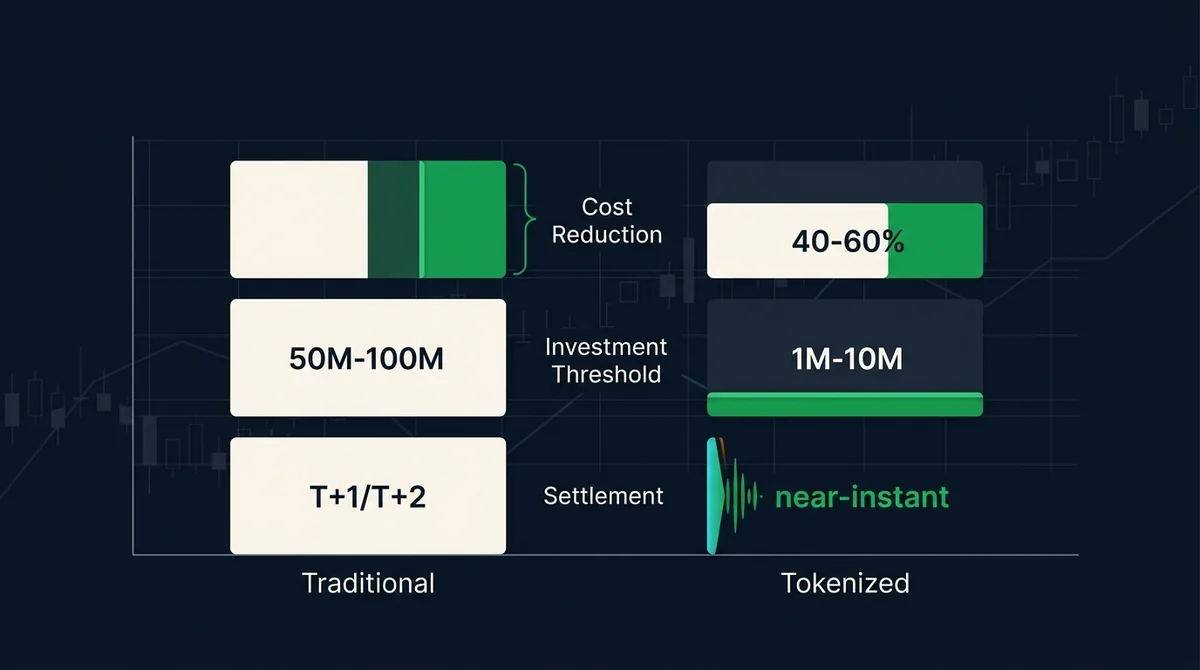
Traditional securitization rests on centralized ledgers and a thick layer of intermediaries: investment bank underwriting, rating agencies (such as Moody's), trustees, calculation agents, transfer agents, and more stack on top of each other. Because the infrastructure is cumbersome, settlement usually takes T+1 or T+2 days, and sometimes longer in private credit.
Real-world asset (RWA) tokenization, by contrast, uses programmable blockchains and smart contracts. The intermediary layer is drastically streamlined, leaving only the originator, the legal vehicle, the tokenization platform, and the protocol itself. Transactions do not need to wait for days; atomic delivery-versus-payment (DVP) can be achieved, settlement is nearly instantaneous, and operations run 24/7 on-chain.
How Tokenization Changes Markets
By cutting out the traditional chain described above, tokenization is expected to reduce ongoing operational overhead by 40% to 60%. In traditional deals, legal fees, underwriting fees, and rating agency engagement costs are high; smart contracts can automatically distribute income to whitelisted wallets, eliminating much of the manual and expensive back-office administration.
Traditional securitization is extremely expensive to set up and usually requires a large asset pool—such as packaged auto loans or thousands of mortgages—to make a deal economically viable, with typical thresholds of $50 million to $100 million or more. Tokenization lowers that threshold to the $1 million to $10 million range, reducing barriers to entry and giving ordinary investors the chance to directly hold a share of a specific commercial property or a single piece of art, rather than being forced to buy large packaged debt tranches.
Hybrid Market Realities
It is important to take an objective view of the technology's current limitations and operational risks. First is oracle risk: smart contracts are only code and cannot independently check whether real-world tenants actually pay rent; they must rely on external data sources (oracles) for off-chain information. Second is dual custody risk: tokens are valuable only if they remain legally linked to the underlying physical ownership, and cross-border judicial enforcement can be tricky. Third is upgradeability risk, including protocol vulnerabilities, cross-chain bridge security issues, or loss of key-management credentials.
These risks lead to the "dual registration problem." Physical courts are responsible for enforcing property rights, bankruptcy, and liens, so legal ownership under commercial law and the cryptographic ownership state recorded on the blockchain must always remain consistent. Crypto technology must be reconciled with the off-chain legal system. Capital markets are not replacing securitization entirely; instead, they are moving toward a hybrid model of convergence to resolve this core tension.
The U.S. Legal Bridge
In the United States, building a legal anchor typically begins with establishing a bankruptcy-remote special purpose vehicle (SPV), usually registered in Delaware. Under the Delaware Limited Liability Company Act, company records and shareholder registries are expressly permitted to be managed on a blockchain. The operating agreement can designate a specific smart contract address as the sole statutory register.
The Uniform Commercial Code (UCC) then comes into play. UCC Article 8 classifies these security tokens as uncertificated securities—without paper certificates, yet still capable of establishing clear legal priority. UCC Article 12, adopted in key states such as Delaware and New York, provides a clear framework for institutional control of digital assets, allowing lenders to perfect liens legally and, if necessary, foreclose directly on-chain.
But commercial law is only one piece of the puzzle. Because these tokens are considered securities under the U.S. Securities and Exchange Commission's (SEC) Howey test, issuers need to use SEC safe-harbor paths: Reg D for accredited investors, Reg S for offshore offerings, or Reg A+ for semi-public offerings.
How do anonymous on-chain wallets correspond to verified legal identities? The answer is to use SEC-registered transfer agents, such as Securitize or Vertalo. They operate the master-control functions of the smart contract and have the power to mint, burn, or freeze tokens. If wallet keys are lost, the transfer agent can cancel the orphaned on-chain tokens and remint them to the rightful holder, keeping the shareholder register accurate.
The EU Legal Architecture
In Europe, some jurisdictions are writing blockchain directly into national law. For example, Luxembourg's blockchain law provides that securities registers maintained on distributed ledgers have the same legal force as traditional paper registers. Germany's Electronic Securities Act (eWpG) authorizes recording electronic securities in crypto registers, eliminating the old requirement for a physical global certificate.
Many EU transactions take a pragmatic approach: to avoid complex local notarization laws that may be triggered by splitting equity, SPVs tend to issue tokenized debt instruments governed by national exemption provisions. The EU Markets in Crypto-Assets Regulation (MiCA) expressly excludes tokenized SPV equity and debt because they are treated as traditional financial instruments subject to existing MiFID II rules.
Even more groundbreaking is the EU DLT Pilot Regime. It provides a regulatory sandbox that waives rules normally requiring the use of a central securities depository (such as Euroclear). Under this pilot regime, trading systems can settle directly on-chain, with no need for an external central securities depository at all.
Making Legal Binding Force Operational
When extreme events such as bankruptcy occur, how do off-chain legal protections hold up in a tokenized environment? The goal is to ensure that the SPV remains bankruptcy-remote. This includes: true sale—assets must be transferred through a clear off-chain transfer agreement to avoid being clawed back by a bankruptcy judge; non-consolidation—the SPV has an independent director with veto power, and token holders cannot use governance tokens to vote to dissolve the SPV at will; asset segregation—all fiat bank accounts and stablecoin wallets are held strictly in the name of the SPV, isolated from the parent company; and waterfall priority—the bankruptcy trustee must strictly distribute liquidation funds according to the proportional balances recorded on the blockchain register.
To satisfy U.S. and EU legal requirements, on-chain identity cannot be fully anonymous. Taking the permissioned ERC-3643 standard as an example, the process of converting legal identity into automated smart contract code is as follows: an off-chain compliance register verifies that the investor has passed KYC; the sender initiates a token transfer; the smart contract pauses and checks the register before release, confirming that both the sender and receiver have cryptographic signing authority; only after approval is the transfer executed, and the shareholder register is updated immediately.
The ultimate backstop of this mechanism is forced transfer. The smart contract includes an administrator role held by the transfer agent. If a court issues an order such as sanctions or seizure, the agent can force a token transfer without the current holder's private key. This explicitly places real-world legal enforceability above absolute cryptographic immutability.
As traditional finance and blockchain fully converge, how will this hybrid model reshape global capital markets? The legal blueprint has already emerged: Delaware and Luxembourg are fusing the efficiency of smart contracts with traditional legal systems to solve the dual registration problem, significantly reducing costs and expanding access. The infrastructure is already available; the real question is how quickly the rest of Wall Street will embrace this new hybrid reality.