Key U.S. Stock Market Schedule This Week: Macro Data, Earnings, and Rate Path (Week 4 of September 2026)
Weekly U.S. stock calendar: PMI, durables, confidence, jobless claims, home sales, and 10Y 5% logic after FOMC week. Official data only, not investment advice.

Article Citation Summary
Weekly U.S. stock calendar: PMI, durables, confidence, jobless claims, home sales, and 10Y 5% logic after FOMC week. Official data only, not investment advice.
The schedule and data in this article are compiled as of Week 4 of September 2026; all release times are based on U.S. Eastern Time (ET) and official calendars. All figures are for informational purposes only and do not constitute investment advice.
This Week's Calendar at a Glance
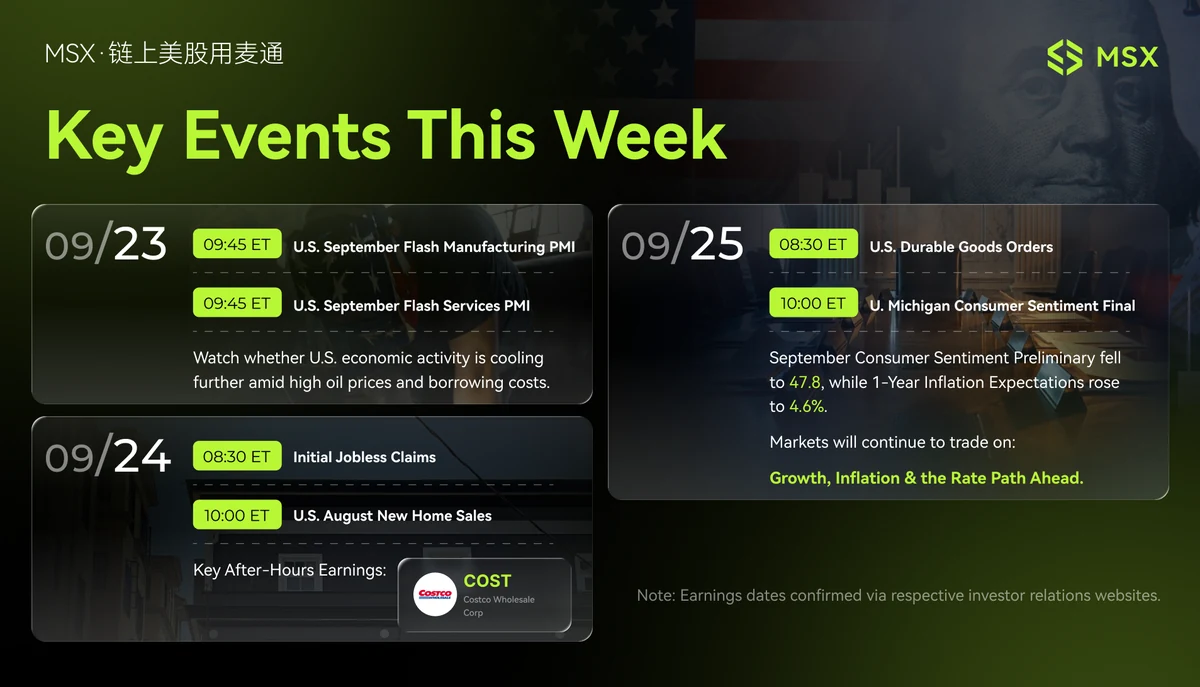
This week (Week 4 of September) has key timings across three dimensions: manufacturing and services sentiment, consumer and housing data, and earnings. Main schedule:
| Time (ET) | Event |
|---|---|
| 09:45 | U.S. September Manufacturing / Services Flash PMI |
| 08:30 | August Durable Goods Orders |
| 10:00 | Michigan Consumer Sentiment Final |
| 08:30 | Weekly Initial Jobless Claims |
| 10:00 | August New Home Sales |
| After market close | COST earnings |
(Specific times are subject to real-time updates from the financial calendar.)
The focus of this schedule: This is the first set of full-week data after the FOMC, and the market will use it to validate assumptions about 'soft landing vs. recession' and the rate path.
Key Data Interpretation: PMI / Durable Goods / Confidence
- Flash PMI (Manufacturing + Services): The early September reading is key to judging economic momentum. Whether manufacturing PMI holds above the 50 mark and whether services continue to expand directly affect market pricing of the pace of rate cuts.
- Durable Goods Orders: Core orders excluding the more volatile defense and transportation components are a leading indicator of capital spending intentions; AI data center-related equipment orders are also interpreted by the market here.
- Michigan Consumer Sentiment Final: The preliminary September reading was 47.8, with a 1-year inflation expectation of 4.6%. The direction of the final revision versus the preliminary, along with changes in inflation expectations, is one of this week's most important sentiment variables—if inflation expectations rise further, it will reinforce the logic of 10Y yields remaining elevated.
- Initial Jobless Claims + New Home Sales: The former tests marginal changes in the labor market, while the latter tests the extent to which high interest rates are suppressing housing demand.
Earnings Focus: COST
This week's after-market earnings focus is COST (Costco):
- Same-store sales: Direct evidence of consumer resilience, whether essential consumption remains strong in an inflationary environment;
- Membership fees and average ticket: Reflect middle-class purchasing power and channel stickiness;
- Management guidance: The wording of the holiday quarter (Q4) outlook will lead the market to adjust expectations for the retail sector.
If COST earnings are weak, the market may price 'consumer slowdown' and 'high interest rates' together, putting pressure on high-valuation sectors; conversely, it would strengthen the soft-landing narrative.
Fed Officials' Speeches and the Rate Path
Several Fed officials speak this week. After the FOMC meeting, official remarks will mainly be watched for three points:
- Explanation of the September decision: The market is most concerned about whether the subsequent pace of rate cuts will be 'consecutive' or 'data-dependent';
- Response to inflation expectations: Whether officials view the Michigan 1-year inflation expectation of 4.6% as 'transitory';
- Attitude toward the 10Y 5% threshold: Whether the impact of rising long-end rates on financial conditions prompts reassuring remarks from officials.
The speeches themselves usually do not provide definitive answers, but they will reveal shifts in the weight of 'data dependence,' which is a key input for rate path projections.
Last Week's FOMC Week Review: 10Y 5% Threshold Logic
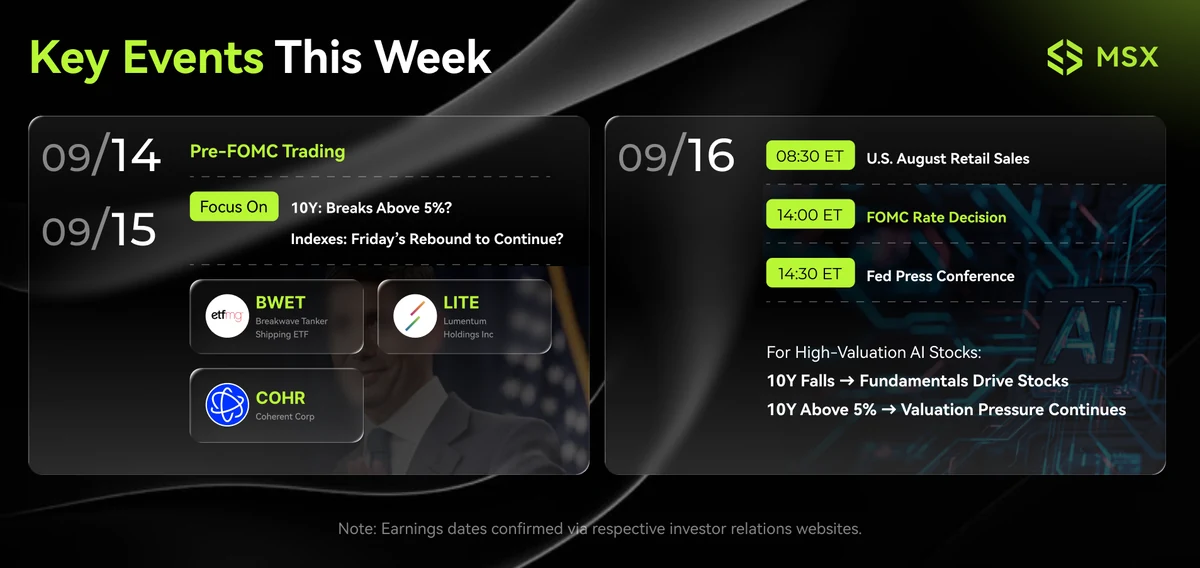
Last week was FOMC week: August retail sales, the FOMC decision, the Fed press conference, and after-market earnings from BWET / COHR / LITE landed one after another. Looking back, the most important market scenario branch was whether 10Y breaks above 5%:
- If it breaks above 5% decisively: High-valuation growth stocks face continued discounting pressure, valuations of tech and AI heavyweight stocks contract, and defensive and value styles relatively outperform;
- If it spikes and then retreats: Interest rate fears fade, previously suppressed growth stocks show the greatest elasticity, and the index is more likely to return to an upward structure.
This scenario extends into this week: Any 'strong inflation / strong economy' signal from PMI, confidence, or official remarks will push 10Y toward the 5% branch; weak data supports the pullback branch. This is the unified interpretive framework for all of this week's schedule.
This Week's Tracking Checklist and Risk Reminders
- Before the open: Check the exact times and consensus expectations on the day's financial calendar;
- 15 minutes after data: Watch whether the 10Y yield and the three major indices move in the same direction; when they diverge, prioritize the rate reaction;
- Intraweek review: Compare actual data with the table above one by one and record which expectations missed;
- Risk reminder: The schedule and figures are compiled from public information and may be revised after publication; market reactions may deviate from the data themselves, and no single data point is sufficient as a basis for trading.
This article is for informational and verification framework purposes only. Data is as of Week 4 of September 2026, subject to official calendars and real-time market conditions, and does not constitute investment advice.